

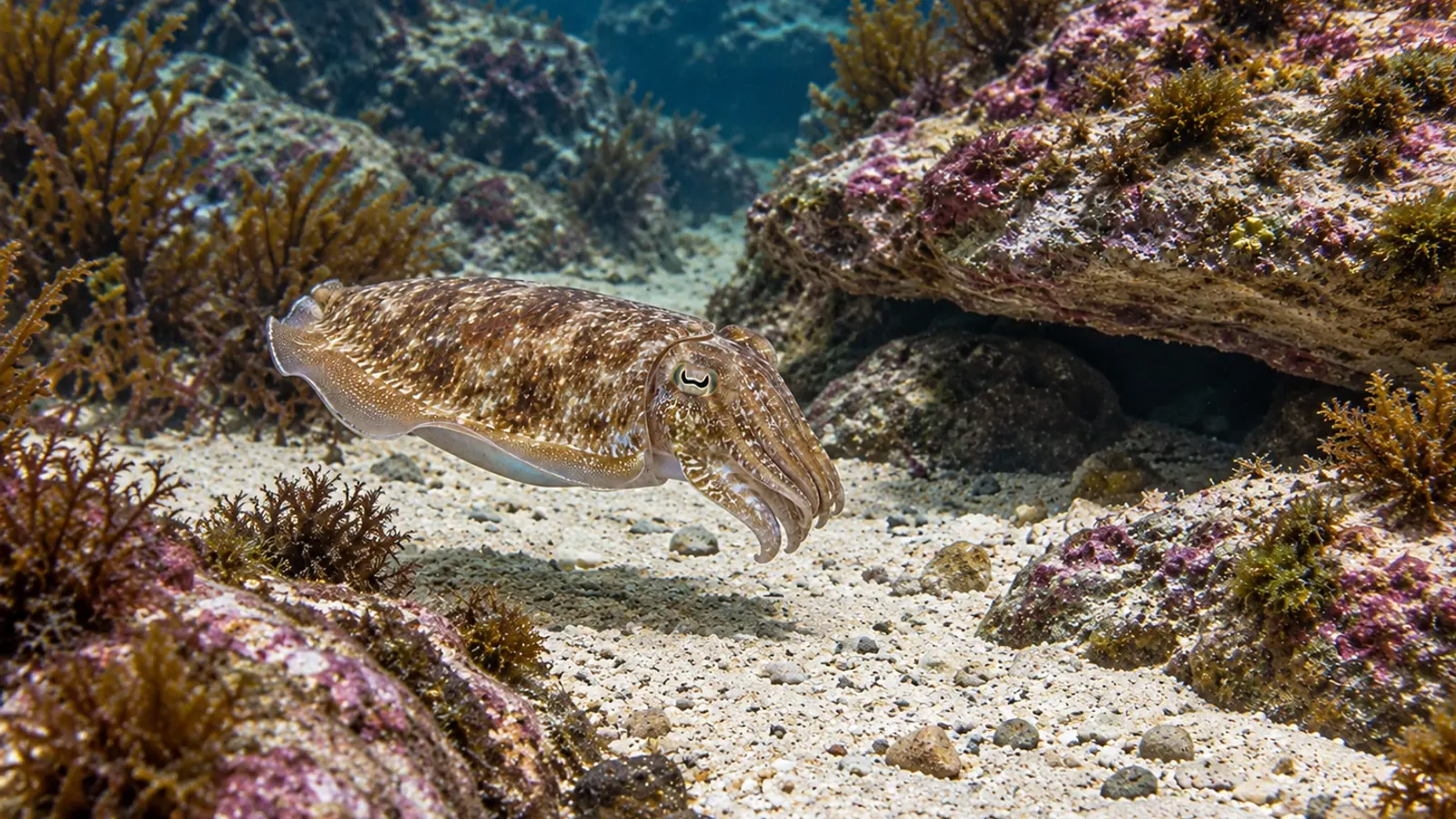
Common cuttlefish: prey timing changes feeding choices
A cuttlefish may leave one prey item when a preferred alternative becomes predictable. A 2020 study involving French and British researchers found flexible feeding choices in Sepia officinalis. For aquarium teams, the findings make the feeding record relevant to a missed meal while leaving health assessment essential.


- Content type
- Practical guide
- Sector
- Public aquariums
- Animal group
- Cephalopods
Finding an uneaten prey item is the beginning of an investigation, rather than its conclusion. In common cuttlefish, feeding choices can reflect earlier meals and the regularity of later food availability. Pauline Billard and colleagues explored this flexibility in a study published in 2020, using animals reared in France and the United States.
For aquarium teams, the useful question is how much of the feeding history accompanies an observation. Leaving a prey item does not necessarily mean that a cuttlefish is waiting for something better. They do make the feeding record relevant alongside the animal’s condition, its environment and any recent changes.
Establishing preference before interpreting a choice
The study involved 29 subadult common cuttlefish, Sepia officinalis, aged three to six months during the work. Nineteen were reared at the CREC facility in Luc-sur-Mer, Normandy, and ten at the Marine Biological Laboratory in Woods Hole. This was the overall study population, rather than 29 independent animals in every comparison.
The researchers first offered crab and shrimp simultaneously at equal distances. Repeated choices established that every animal studied preferred shrimp. Checking each animal avoided treating a food as preferred merely because it was thought attractive to the species. It also provided a defined basis for the later comparisons.
These preferences concerned the prey types offered in the experiment. They did not establish a complete diet or a lifelong preference. In an aquarium, recording prey identity, presentation and the animal’s response provides more information than a single entry stating that it did or did not eat.
Evening availability changed daytime feeding
In the first experiment, a crab was offered each morning. A shrimp then became available either every evening or on a random schedule, depending on the condition. Crab consumption was recorded before the evening feed. After 16 trials, the conditions were reversed to test whether the cuttlefish would adjust.
When shrimp arrived predictably each evening, daytime crab consumption declined over time. When evening shrimp availability was random, crab consumption was relatively maintained. Reversing the conditions was followed by a change in feeding strategy. The observed pattern was therefore flexible, rather than a fixed preference expressed identically throughout the test.
There is a limitation to this comparison: a shrimp every evening also supplies more regular food than a shrimp on only some evenings. Total overnight intake could contribute to the difference, alongside predictability. The authors discuss this alternative explanation. It should remain part of any account intended to inform aquarium practice.
Alternate evenings provided a further comparison
A second experiment supplied shrimp on alternate evenings, with crabs available during the day. Animals at both laboratories reduced crab consumption on days preceding an evening with shrimp. They maintained greater crab consumption on days when shrimp would not be provided that evening.
The pattern is consistent with learning the feeding arrangement and adjusting behaviour over a short timescale. It was not simply the result of having eaten more the previous night: choices followed the availability due that evening. The experiment used monitored conditions and a defined learning criterion, rather than an informal observation of a missed meal.
The authors did not treat this as proof of future planning. A further requirement would be to establish whether behaviour was independent of the animal’s present motivation for food. Flexible choice does not by itself demonstrate conscious anticipation resembling a human experience. Nor does the task measure whether an animal’s overall welfare is good.
Making the feeding record useful to the next observer
An aquarium team can record time, prey type, quantity offered and consumed, and the interval before capture. A shared ethogram can distinguish orientation, approach, attack, capture and abandonment. These categories let different keepers describe comparable events without immediately assigning an intention to the animal.
Photoperiod, the daily pattern of light and darkness, also belongs in the record when comparing daytime and night-time feeding. A changed lighting or maintenance schedule may alter the context in which a response is seen. The study did not determine an ideal lighting programme for every cuttlefish collection.
These are proposals for observation, not a validated clinical appetite test. Their purpose is to make possible explanations easier to examine: prey type, learning about a schedule, disturbance or a change in condition. Several factors can occur together. A consistent record helps preserve that uncertainty rather than replacing it with an appealing story.
Flexibility is not a reason to impose a feeding challenge
The experiment does not justify arbitrarily delaying or restricting meals to test collection animals. It did not establish the long-term consequences of a schedule for health, growth or nutritional adequacy. The laboratory housing described in the paper provides context, rather than general accommodation standards.
A behavioural indicator needs to be considered alongside other observations. Repeated refusal, loss of body condition, altered posture or reduced activity calls for a broader assessment of water, husbandry and health. Stress may be one explanation to investigate; an uneaten crab is not a direct measurement of stress.
The same distinction improves public interpretation. Saying that cuttlefish adjusted choices to predictable food availability describes the evidence. Saying that an animal was planning its dinner or behaving stubbornly adds an intention that the experiment did not demonstrate. An accessible account can explain the finding without making that extra claim.
Interpret the meal within its history
The practical contribution is to widen the observation from one meal to the feeding calendar. A preferred prey and a predictable schedule can influence choices. They do not remove the need to investigate other explanations when a change persists or accompanies other signs.
Vetofish can help develop observation records and assess changes in husbandry through its animal welfare service. Work with public aquariums focuses on decisions informed by individual histories, while keeping a research task distinct from a clinical test.


