

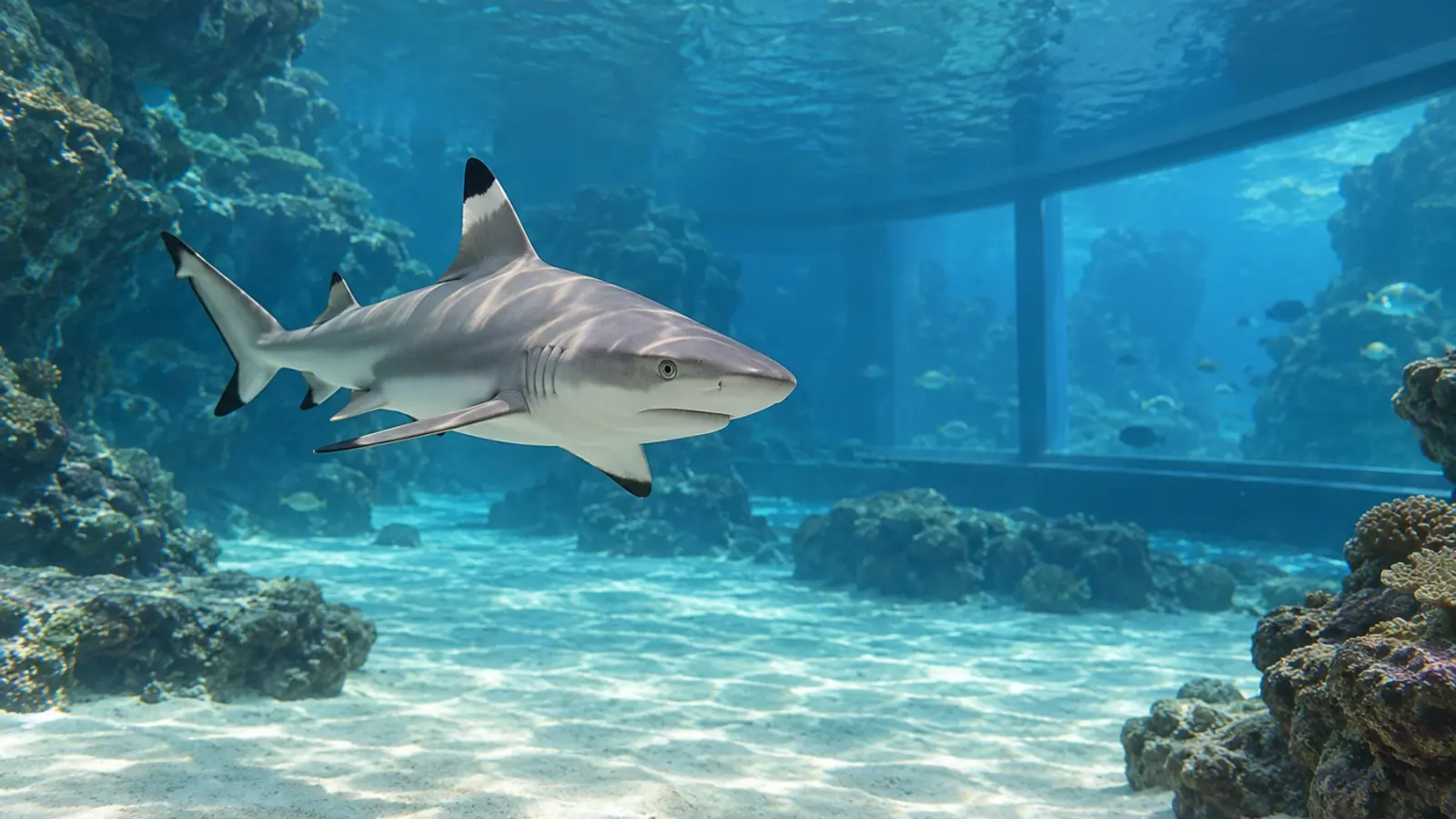
Sharks: observe space use between feeding sessions
A feeding aggregation does not describe how sharks use an exhibit throughout the day. Field research from Moorea supports observations outside feeding periods, while keeping reef findings separate from evidence about aquarium collections.


- Content type
- Practical guide
- Sector
- Public aquariums
- Animal group
- Elasmobranchs
- Keywords
- EthogramTemperatureStress
Several sharks may gather in one part of an exhibit during feeding. That observation describes a feeding event much better than it describes how the animals use the habitat for the rest of the day. If an aquarium team observes only meal times, a temporary attraction can be mistaken for a lasting habitat preference or a routine that applies at all hours.
The observation record should include feeding history: customary locations, timing, delivery method and recent changes. Field research can suggest useful questions for aquarium teams. It does not directly measure what a particular feeding arrangement does to animals housed in an exhibit.
A field comparison from French Polynesia
Mourier, Claudet and Planes investigated blacktip reef sharks, Carcharhinus melanopterus, around Moorea in French Polynesia. Their 2021 paper reports monitoring from June 2008 to November 2010, involving 35 tagged sharks and six acoustic receivers. Areas affected by tourist provisioning were compared with control areas.
There was no significant overall effect on mean residency when habitats, sexes and times were combined. Differences emerged when the analysis separated lagoon from fore reef, day from night, and males from females. Some differences in habitat use were still apparent at night, after daytime provisioning had stopped.
These findings provide a reason to examine behaviour beyond the meal itself. Acoustic detections do not establish illness, reduced reproductive success or a welfare state. The study was an observational control–impact comparison, without random allocation of sharks to sites.
A reef finding is not an aquarium effect size
The Moorea sharks could move through an open environment. In an aquarium, available space, social groupings, access and opportunities to avoid other animals are constrained by the installation. Keeper-provided food meets the animals’ nutritional needs; it is a different situation from attracting free-ranging sharks for tourist encounters.
The useful comparison concerns observation design. An aquarium team can ask whether a zone is used only as feeding approaches, whether particular individuals remain afterwards, and whether other animals avoid it. Those questions need testing in the exhibit concerned. An effect size measured on a reef should not be used as an expected change in a tank.
Smith’s review of fish welfare in public aquariums recommends combining behavioural indicators with information about animal condition and the environment. A change in space use can then be investigated alongside food intake, social interactions and water conditions, rather than treated as a diagnosis on its own.
Compare periods that have a clear meaning
Useful monitoring separates periods before, during and after feeding, together with periods well away from food delivery. Observations should cover several representative days. An unusual maintenance day, a one-off event or a meal intended for one individual should be annotated rather than pooled with ordinary sessions without explanation.
An ethogram defines behaviours that observers can recognise consistently: entering a zone, remaining there, pursuing another animal, avoiding it or gaining access to food. A label such as restless swimming is difficult to compare unless its meaning is specified. Individual identity, observation zone, start time and session duration should remain attached to the record.
Lighting, temperature, flow, visitor numbers and diver activity can change at the same time. Recording them reduces the temptation to attribute every difference to feeding. Cameras can extend observations beyond staffed periods, provided their coverage, visibility and blind spots are understood.
Keep individual differences visible
A group average may conceal an animal that obtains little food or remains isolated after a meal. Space use should therefore be considered with actual consumption and interactions. Frequent passage near a viewing window does not establish a preference when the main feeding location is also beside that window.
A behavioural change may reflect social conditions, a health problem, a change in flow or learning associated with food delivery. Conditioning describes an acquired change in responses to cues. It does not, by itself, establish whether the resulting experience is positive or negative. These explanations need to remain open until observations help distinguish them.
When the feeding arrangement changes, the previous routine should remain in the record. A defined comparison is harder to interpret if all delivery locations move at the same time as ration changes and new animals arrive. Any adjustment must maintain individual access to suitable food and safe working arrangements for staff.
Recognise what the observations cannot resolve
An acoustic detection depends on receiver coverage; a missing detection is not necessarily an absence. In an exhibit, camera blind spots and uncertain individual identification create different limitations. Missing information should remain visible when the team reviews a pattern.
Stress and overall welfare cannot be read directly from an occupancy map. A concerning change calls for wider clinical and environmental assessment. There is no universal duration near a feeding station that classifies the welfare of every elasmobranch species.
Follow the habitat between meals
Observing non-feeding periods adds information to nutritional monitoring. The aim is to understand which animals use each space, under what conditions and with what changes over time. Field findings help frame the questions while the aquarium’s own observations support its management decisions.
Vetofish’s animal welfare service can support the development of a suitable observation framework. For public aquariums, this can connect individual records, meal organisation and intervention criteria to observations that can be checked in the exhibit concerned.


