

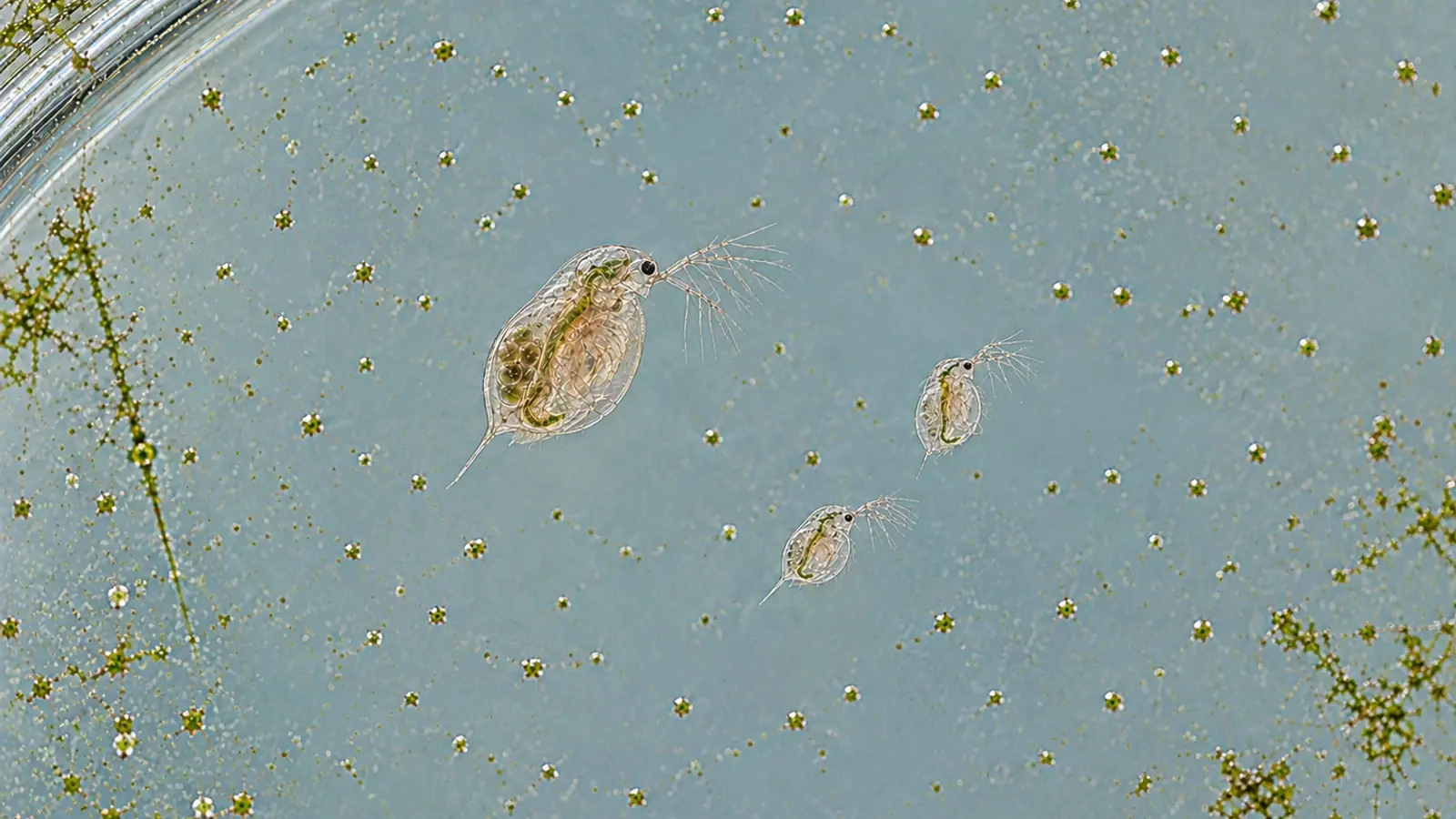
Daphnia offspring carry a maternal-age history
Newborn Daphnia of the same clone and age can still begin an experiment with different maternal histories. A controlled study varied mothers’ age and food, then followed their offspring. Differences in size at birth did not establish that larger offspring were better adapted to food limitation.


- Content type
- Scientific news
- Sector
- Research facilities
- Animal group
- Crustaceans
- Keywords
- ReproductionTemperatureLighting
Clone identity and time since birth do not capture a Daphnia’s entire biological history. Neonates collected together can come from mothers of different ages or feeding backgrounds. Losing that information when groups are assembled can obscure variation associated with the mothers and complicate interpretation of the treatment.
Coakley and colleagues investigated this problem in Daphnia magna. Their paper appeared online in 2017 and in a 2018 issue of the Journal of Evolutionary Biology. The study separates a maternal effect on offspring characteristics from evidence that those characteristics provide an advantage in a particular environment.
One clone does not mean one physiological starting point
The experiment used a single clone from the Kaimes population in Scotland. At least three acclimation generations preceded the main comparisons. Reducing genetic differences in this way helped the researchers examine variation associated with maternal conditions.
Clonal reproduction by parthenogenesis does not make all individuals physiologically interchangeable. Phenotype also depends on development and environment. This is why a clone identifier is more informative when it is accompanied by generation and maternal-origin records.
The findings remain specific to the clone studied. They do not describe an average response across every D. magna population. Equally, failing to demonstrate the predicted advantage in this experiment does not show that maternal effects are unimportant in natural populations. The relevant conclusion must follow the particular hypothesis tested.
Mothers and offspring experienced separate food treatments
Mothers received one of two food levels. Offspring were taken from the first, second or fifth clutch, and subsequently experienced one of the two food levels themselves. Clutch rank served as a measure of biological maternal age. It was not a universal conversion into days since a mother’s birth.
The design called for 72 contributing mothers and 144 offspring, with two offspring from a mother allocated across the food conditions. Different mothers supplied the different clutch-rank groups. The comparison was therefore not a complete longitudinal follow-up of every successive clutch from the same mothers.
Measurements included size at birth, timing of first reproduction and the number of offspring produced in the first five clutches. The last measure is not lifetime reproductive output. Numbers available for particular analyses depended on the observations obtained; the planned sample should not be substituted for the analytical sample.
Larger neonates were not shown to be better prepared for food limitation
Offspring of older mothers were larger at birth. Maternal food also affected birth size, with the relationship depending on maternal age. Descendants of older mothers began reproduction earlier under the conditions investigated. These are distinct outcomes that should be reported separately.
The researchers’ adaptive predictions required more. They expected offspring to perform better when their food environment matched their mother’s, or offspring of older mothers to perform particularly well under restricted food. Those predictions were not clearly supported by the experiment.
Food received by offspring accounted for much of their reproductive production. Initial size was therefore not a simple summary of subsequent performance. Selecting only the largest neonates to create an allegedly better group would be an extrapolation and could change the population the experiment actually represents.
Preserve maternal information before allocating animals
For a research team, the useful response is to retain traceability. Maternal identifier, clutch rank, generation and birth window can be recorded before allocation. Food records should specify what has been measured, rather than retaining only the volume of a suspension of microalgae.
When siblings enter an experiment, their shared origin should remain retrievable in the dataset. The statistical treatment then depends on the design. Removing maternal identifiers does not create biological independence; it removes the ability to examine how individuals were grouped and what sources of variation they share.
Maternal age and offspring age also need separate fields. A batch of neonates collected within one period can still combine different maternal histories. Where those histories were not recorded, describing the limitation is preferable to assigning a common maternal age retrospectively without evidence.
An effect is not proof of a particular inheritance mechanism
The observed differences do not establish a specific epigenetic mechanism. The experiment cannot distinguish every route by which a mother may influence her offspring. It also did not test all ecological outcomes, such as competitive performance in a natural population or survival throughout an entire life.
Clutch rank was a useful age marker for this design, but feeding conditions can alter reproductive timing. Converting it automatically into chronological age would lose that qualification. Likewise, the experimental temperature and light regime describe the system studied; they are not universal standards for every research culture.
Deaths, missing responses and analysis rules should remain in the record. A number planned at the start does not establish the number contributing to each outcome. Differences need an explanation without automatically treating every missing observation as a biological effect of the treatment.
Keep birth size separate from later performance
The study demonstrates why maternal effects on size or reproductive timing should not automatically be labelled an anticipated adaptive advantage. Clone and neonate age remain important, while maternal history adds another component needed to understand the animals entering the comparison.
This distinction also helps teams choose the outcome relevant to their question. A size measurement may be suitable for a morphological endpoint, while reproductive timing and offspring production answer different questions. Agreement on one measure does not establish equivalence on all the others, and a shift in one should not be used to invent an unmeasured benefit.
Vetofish’s training services can support review of culture records, group-assembly rules and reporting. For research facilities, the aim is to make biological conditions and limitations auditable, without treating one clone as a universal reference or claiming that records alone remove every source of variation.


