

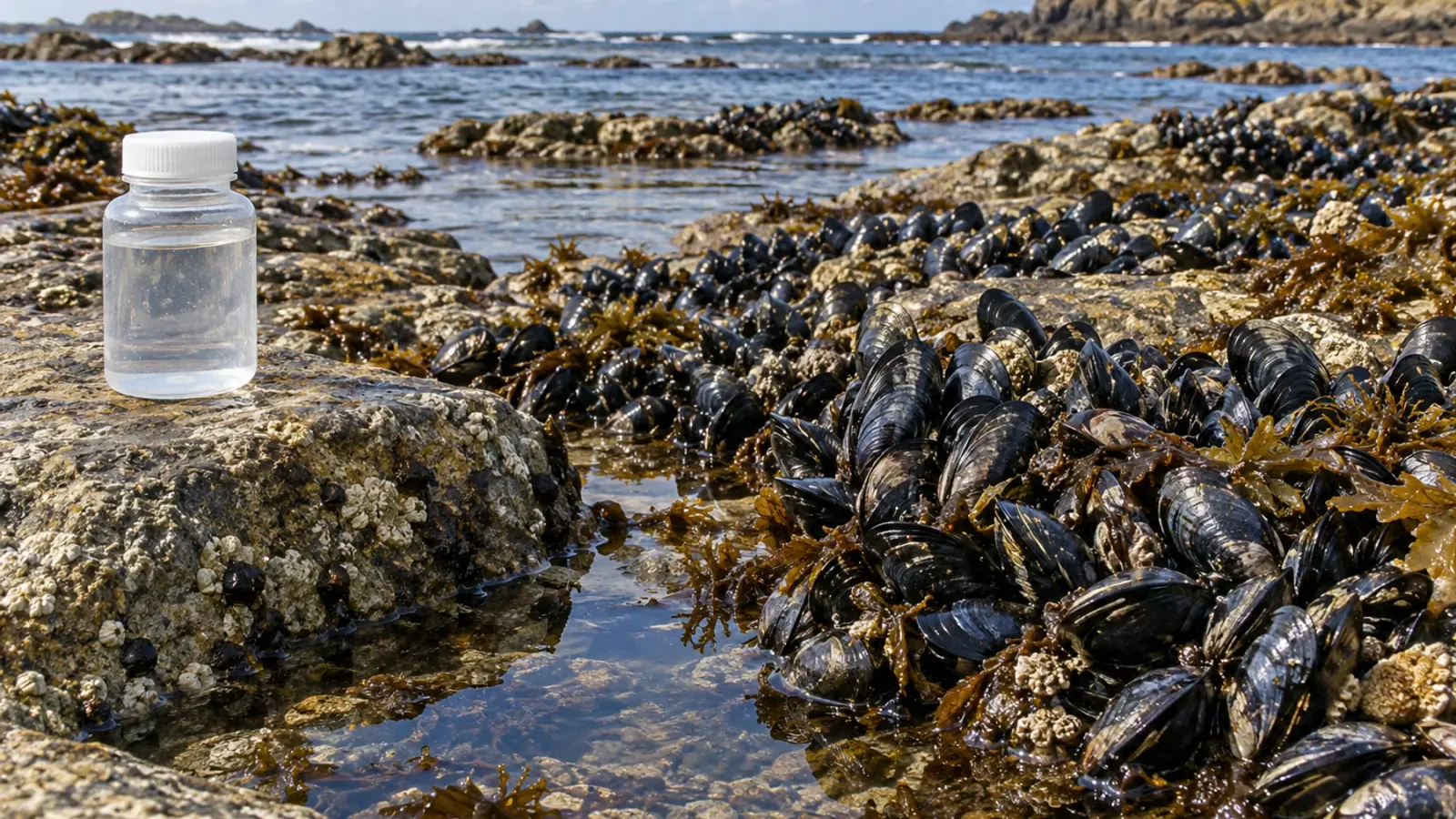
Aquatic sentinels: interpreting parasite detections
A 2026 review documents Cryptosporidium and Giardia detections in fish and shellfish. These findings can inform environmental surveillance, but do not by themselves establish parasite viability or transmission to people.
- Content type
- Scientific news
- Sector
- Environment
- Animal group
- FishCorals and invertebrates
- Keywords
- PCRBioaccumulationBiosecurity
A sentinel provides evidence of exposure first
Finding a parasite in an aquatic organism may help identify environmental contamination. It does not immediately establish whether the animal is infected, whether the parasite remains viable or whether human exposure could lead to infection. These are separate questions requiring different evidence. A useful surveillance programme preserves the distinction from collection through laboratory reporting and communication with decision-makers.
The 2026 review by Li and colleagues brings together work on Cryptosporidium and Giardia in fish and shellfish. It relates these observations to connections between human, animal and environmental health. For managers, its value is in designing and interpreting surveillance. An individual detection should not automatically become a local health alert or proof that consuming an animal caused human transmission.
Global study totals are not a current national estimate
The authors searched publications available up to 20 March 2025, covering different regions, species and conditions. For Cryptosporidium in fish, their combined total was 858 positive results among 9,878 examined animals. That describes the included studies. It is not a representative sample of all fish, nor an estimate of present-day prevalence in France or another country where a reader may be planning surveillance.
Detection methods and examined tissues differed between studies. A difference in the proportion positive can therefore reflect environment, species, method or site selection. Directly comparing countries or zoological groups using pooled totals could conflate those influences. A local programme needs its own documented strategy and questions specified in advance, including how results from different collection periods or sample types will be compared.
Distinguish mechanical concentration from a host relationship
Filter-feeding shellfish can accumulate parasite stages from surrounding water. Accumulation does not necessarily mean the parasite multiplies within the animal. The review also discusses observations compatible with a biological role in some fishes. Both extremes should therefore be avoided: treating every positive organism as a passive carrier, or assigning all of them an amplifying role simply because parasite material was detected.
Here, sentinel describes the use of an organism to provide information about its environment. Host describes a biological relationship that needs clarification. Tissue location, parasite identity and additional observations affect the interpretation. Keeping this information in a report is more useful than reducing the finding to a species list with a generic “parasite present” entry, which can conceal important differences between the underlying observations.
Ask what the analytical method actually establishes
PCR detects a genetic sequence. Amplification consistent with the target does not by itself demonstrate viable stages or an ability to infect people. Molecular identification can refine the taxon or genetic group, but does not replace every stage of risk assessment. Appropriate analytical controls remain necessary when interpreting a weak signal or a negative finding, including the possibility that the sample matrix affects detection.
FAO’s account of the May 2025 expert meeting highlights inconsistent detection across food types and the shortage of reliable viability assays. It supports a One Health approach bringing relevant expertise together. This institutional communication describes surveillance and prevention needs. It does not introduce a new French regulatory threshold for fish or shellfish, and should not be presented as a new legal obligation in another jurisdiction either.
Make collections suitable for the intended comparison
A sampling plan should state whether it aims to identify a contamination input, compare periods or investigate an incident. Species, organism size, tissue or fraction tested, location and date need to accompany the result. Examining a whole shellfish does not automatically provide the same information as examining a selected tissue. The record should allow a later reader to see exactly what was compared and where uncertainty remains.
Water and organisms may provide complementary information, reflecting different exposure periods. Collection, transport and preservation should be agreed with the laboratory. Field records can also relate sampling to known catchment events. That context helps formulate hypotheses; it does not establish a particular contamination source without further investigation. A plausible upstream source and a positive animal sample are not, by themselves, a demonstrated chain of transmission.
Connect an environmental signal with a proportionate response
A detection may justify confirmation, closer monitoring or examination of possible contamination sources. The appropriate action depends on the strength of the result and how the site is used. Managers, laboratories and relevant authorities need comparable information when discussing next steps. Identifying a genotype described as zoonotic does not show that a human case originated from the sampled animal or location.
Communication should separate established findings, hypotheses and missing information. One negative collection cannot guarantee continuing safety, just as one positive PCR cannot demonstrate infection in people. Comparing successive results requires records of the methods, organisms and environmental conditions involved. This also makes it easier to explain why a follow-up investigation is needed without overstating what the initial result has already proved.
Build a shared interpretation of the evidence
Aquatic sentinels can improve understanding of contamination when the interpretation stays within the evidence provided by the analysis. The priority is to connect a field question with an appropriate method and retain its limits when findings reach decision-makers. Clear terminology helps different disciplines work from the same observation rather than from incompatible assumptions about infection or risk.
Vetofish can contribute through its advisory and support service for aquatic environmental work. Support may cover surveillance design, information supplied to the laboratory and health interpretation of results, in coordination with the expertise and responsibilities of the other partners involved.


