

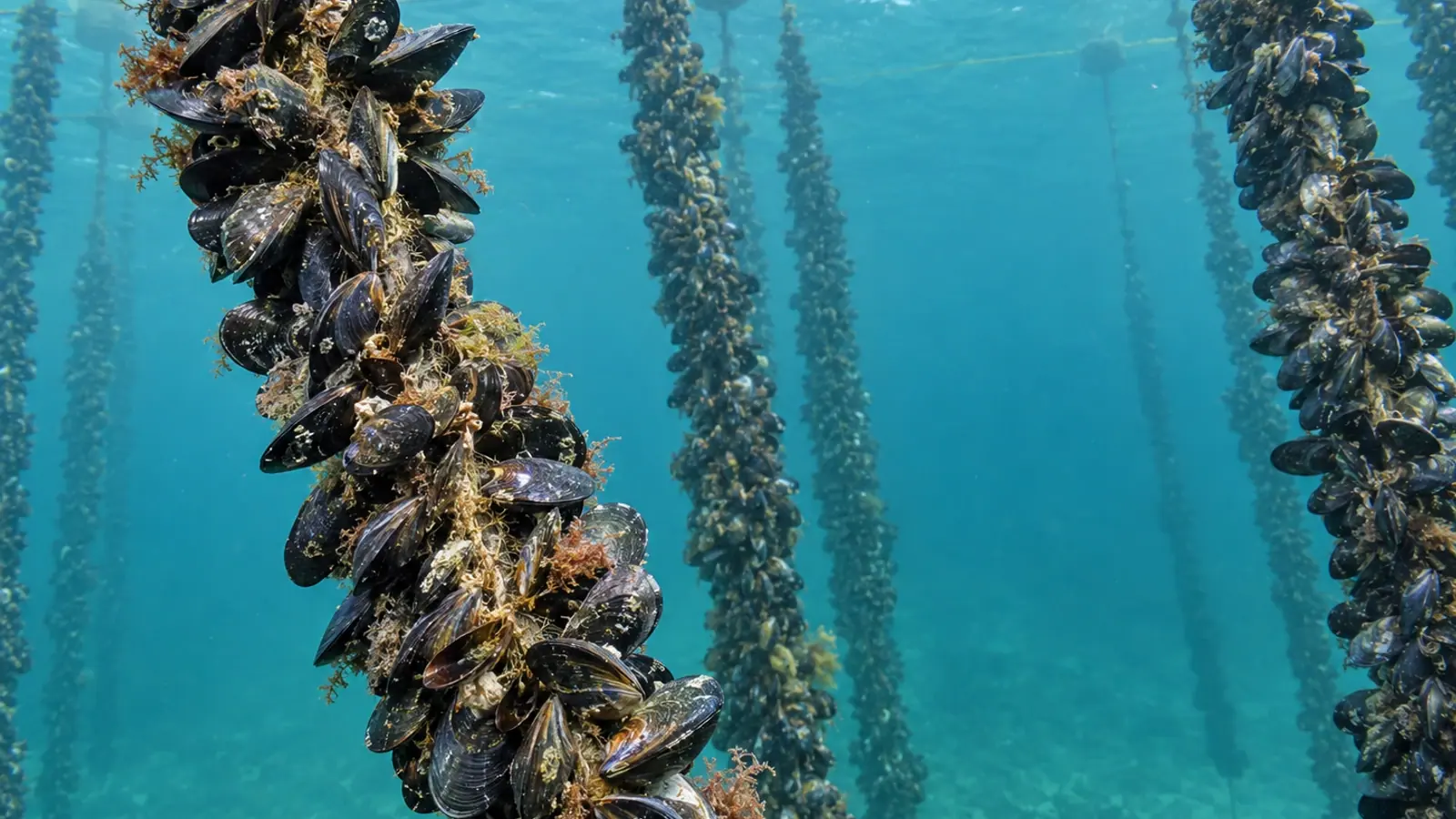
Heat weakens byssal threads in farmed Mediterranean mussels
An intact shell does not show how securely a mussel remains attached to its support. A 2025 study in Mytilus galloprovincialis found that prolonged heat reduced byssal thread production and strength. For mussel farms, attachment records need to be interpreted alongside thermal history.
- Content type
- Scientific news
- Sector
- Aquaculture
- Animal group
- Corals and invertebrates
- Keywords
- TemperatureSalinityStress
Mussels disappearing from a suspended rope present more than a shell-quality question. Their attachment also depends on the byssus, the bundle of threads that anchors the animal. Changes in that attachment system may be difficult to recognise during a quick inspection of a batch, then become relevant when the mechanical loads change.
Antonina De Marco and colleagues examined this function in the Mediterranean mussel, Mytilus galloprovincialis, in a study published in 2025. Their measurements concern thread production and mechanical properties under controlled conditions. They provide a reason to examine thermal records alongside attachment observations, while keeping laboratory findings separate from farm losses.
Two sustained temperatures, with a defined experimental setting
The mussels came from an Adriatic farm off Cesenatico, Italy. They were one year old, with a mean shell length of about 65 mm. The researchers distributed 264 animals among twelve 70-litre aquaria, with six aquaria in each group. That describes the experimental organisation; it does not make all 264 mussels independent replicates of the temperature treatment.
Controls remained at 20 °C, while the exposed group was brought to 28 °C for thirty days. Natural seawater salinity was maintained between 28 and 30, and the animals received microalgae. This was a comparison between sustained laboratory conditions with monitored feeding and water quality. It did not reproduce the full variability of an offshore farm, including changing currents and wave loads.
Thread number, thread strength and plaque adhesion are different endpoints
A mussel’s foot produces the byssal threads. Each thread includes distinct regions and ends in an adhesive plaque on the substrate; collagen contributes to its structure. Attachment therefore depends on several connected properties. Counting threads, testing an individual thread and measuring a plaque’s adhesion address different parts of that system.
To examine newly produced byssus, ten mussels per group were placed individually on polypropylene supports after their original byssus had been removed. At thirty days, exposed mussels produced an average of 22 ± 8 threads, compared with 58 ± 23 in controls, with the variation expressed as standard deviation. Mechanical tests also found a 55% reduction in the maximum force sustained by exposed threads.
The percentage describes a mechanical test of a thread. It does not mean that a farm would lose 55% of its mussels or harvest. The corresponding plaque-adhesion tests did not detect statistically significant differences between groups. That finding also needs its qualification: failing to detect a difference does not establish strict equivalence of the plaques.
Use the finding to improve farm records
The immediate management application is a better description of detachment events. Retain temperature measurements at the depth occupied by the mussels, the duration of elevated conditions and differences between levels within the installation. A single surface reading may not describe exposure along a suspended rope. Batch identity, animal size and recent handling help place the event in context.
Record which ropes and sections are affected, the condition of the supports and whether losses change over successive observations. Repeat photographs taken under comparable conditions can help document their distribution. They cannot quantify byssal breaking force. Pulling animals off a rope as an informal strength check would alter the very attachment being investigated and is not a farm test validated by this paper.
The laboratory treatment is not a farm threshold
The experiment assessed new byssus after removal of the original threads. Established animals on a culture rope have a different attachment history, including accumulated threads, growth and mechanical exposure. Physiological sampling and mechanical testing also involved their own subsets of animals. The total of 264 mussels is not the denominator for every reported endpoint.
Neither 20 nor 28 °C should be presented as a universal safe limit or detachment threshold. The study concerns one species, source population and exposure period. Current, waves, support condition and other factors may contribute to losses on a farm. A thermal association needs to be examined alongside those factors and the animals’ health, rather than being treated as a complete diagnosis based on matching dates.
The same distinction applies when planning an intervention. The study does not demonstrate that moving ropes to another depth, changing the support or altering handling will prevent losses. Such proposals need an assessment of the actual installation and the consequences for the animals. The experimental comparison identifies a vulnerability, rather than an approved operating response for every mussel-growing site.
Treat attachment as a function worth monitoring
Shell condition and attachment performance describe different aspects of an animal. Sustained heat reduced both the production of threads and their resistance in this experiment, while all components did not respond in the same way. Monitoring can reflect that distinction by linking the batch, its exposure history and observations of its hold on the support.
Start an investigation by defining the event: detachment, mortality, support deterioration or a combination. That definition determines what additional observations could separate the explanations. It also prevents a mechanical hypothesis from displacing other relevant investigations and avoids assuming that a relocation or handling operation will help when its benefit has not been evaluated.
Support for a documented investigation
Vetofish can help organise batch records, water measurements and descriptions of losses, then identify useful further examinations with the professionals involved. Our advisory and support service works with aquaculture teams seeking to connect a production event with verifiable observations. The aim is a traceable investigation, with the limitations of each measurement retained, rather than a prediction of detachment from a single temperature reading.


