

Salmon cages: can oxygen measurements be trusted?
Monitoring data from 18 Nordic companies reveal gaps in salmon cage oxygen records. Sensor position, missing readings and access delays determine whether measurements can support timely decisions.


- Content type
- Scientific news
- Sector
- Aquaculture
- Animal group
- Salmonids
- Keywords
- OxygenTemperatureSalinityStress
An oxygen chart can hide gaps in monitoring
Dissolved oxygen matters directly to salmon held in sea cages. A digital record, however, is useful only when its measurements describe the environment that the fish actually experience. Readings can be missing, assigned to an unclear depth or delivered after the opportunity to act has passed. Assessing the monitoring system therefore involves more than checking a sensor specification or looking at a smooth line on a dashboard.
Berntsson, Liland and Stevik examined this problem in a study published in July 2026. They assessed monitoring records shared by 18 Nordic companies, alongside interviews with representatives of eight participating companies. The findings describe commercial equipment in use and distinguish collecting measurements from making them useful.
Define the decision before judging the dataset
The records came from one supplier’s cloud platform. Data extracted in 2024 covered 106 registered sites. Two were identified as storage locations and excluded from site analyses, leaving 104 farming sites for those comparisons. Equipment metadata and available time series did not always contain the same number of loggers. Registration on a platform was therefore insufficient evidence that an instrument had produced usable measurements.
The authors considered three purposes: reporting past conditions, supporting operational decisions and informing planning or forecasting. Each requires a different assessment of data quality. Information can arrive in time for a retrospective report yet be too old to support a feeding decision. A short record might help explain one incident while remaining inadequate for evaluating seasonal patterns or a predictive model.
This distinction gives farms a practical starting point. Before adding instruments, specify which decision each stream of information should support, who needs it and when. A monitoring network designed mainly for record keeping should not be assumed to provide validated real-time decision support.
A vertical profile is only part of the picture
Temperature and salinity measurements commonly accompanied oxygen monitoring, while current measurements were less frequent. These environmental variables help interpret oxygen variation. Their value still depends on knowing where the measurements were taken and which part of the production site they represent.
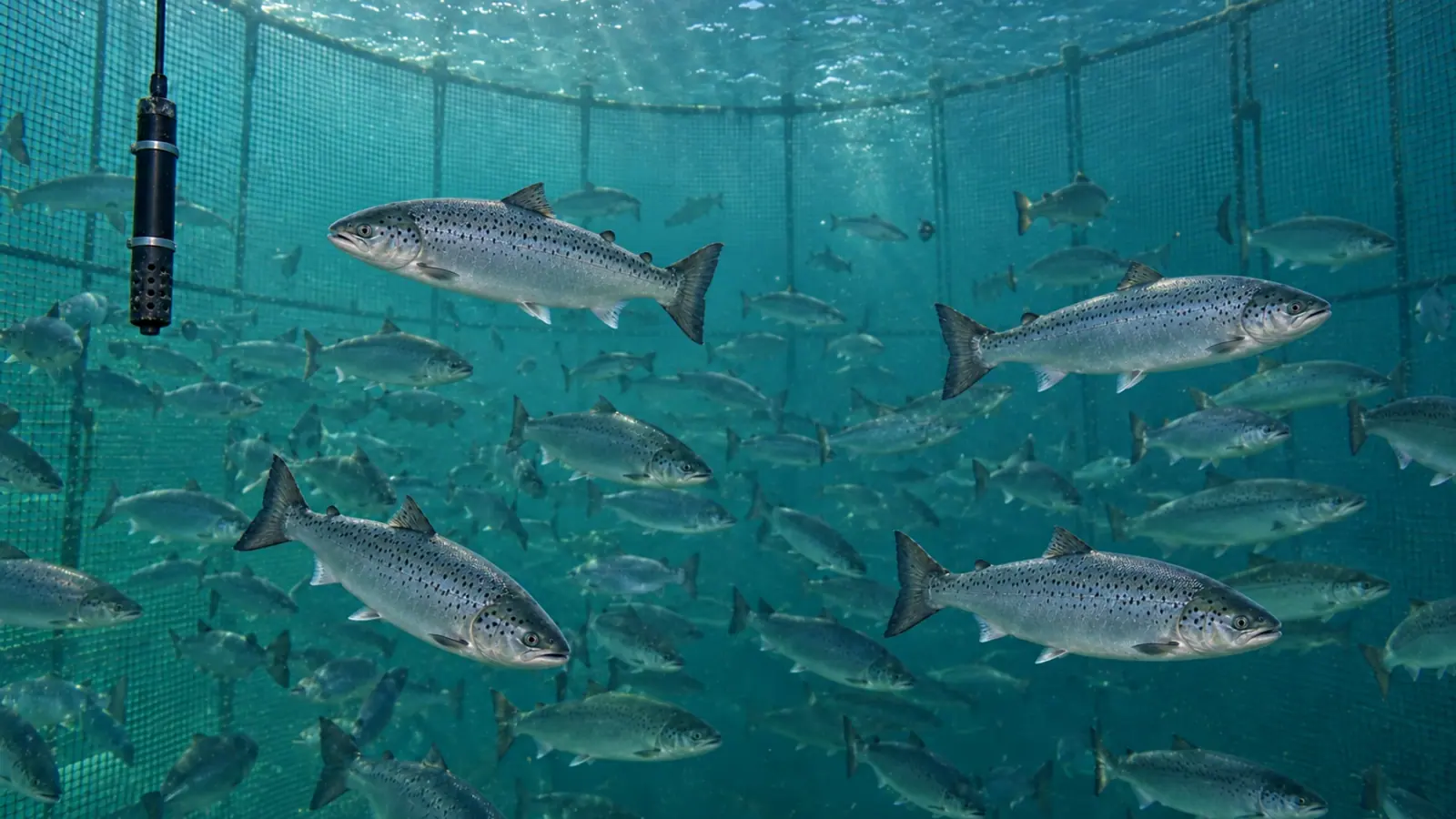
In 76% of the time series, monitoring used one horizontal position across the farm, usually within or near a cage, with measurements forming a vertical profile. Sampling several depths captures some variation through the water column. It does not automatically describe neighbouring cages or conditions elsewhere at the same depth.
Some interviewees positioned equipment where they expected conditions to be least favourable. That can be a useful hypothesis, but it requires verification rather than becoming a permanent assumption. Current direction, cage configuration and biomass distribution all belong in the interpretation of a sensor location.
Farm records should therefore connect logger positions with the cage layout and relevant production information. Moving a device without recording the change can create an apparent environmental shift. An analyst comparing the periods before and after that move could otherwise attribute a difference to the farm environment when it arose from the monitoring arrangement.
Missing readings are a finding, not a safe interval
The study identified empty time series, incomplete records and readings judged invalid. These categories can overlap. Adding their percentages would not produce a meaningful overall failure rate. More fundamentally, an interval without measurements cannot establish that oxygen conditions were acceptable throughout that interval.
Unusual readings also need scrutiny before removal. A genuine environmental event, maintenance, a sensor lifted from the water and an instrument fault can all generate unexpected values. The authors recommend retaining flagged observations with quality indicators and an event log. This preserves the distinction between the original record, a reviewed observation and a later correction.
Interpolation can make a chart appear continuous, but it does not recover an unobserved event. Where a gap covers an important production period, a reconstructed curve can conceal uncertainty. Reporting the gaps and their duration gives the reader a clearer account of which conclusions the record can support.
Make the route from measurement to action explicit
Useful metadata include the instrument identifier, measured variables, units, deployment dates, depth, horizontal position and checks or maintenance performed. Relevant production events should use a compatible timeline. Operators can then compare an oxygen change with activity at the farm and observations of the fish.
The time between acquisition, transmission and access also deserves attention. Frequent measurement alone does not ensure that an operator receives usable information before a decision is needed. Testing the alert pathway, including receipt and responsibility for responding, helps identify this gap. The appropriate response remains specific to the site, its fish and its established operating procedures.
A review should also ask how a suspicious reading can be checked. Another relevant measurement, a documented site observation or a suitable independent check can support that investigation. Automatically dismissing an anomaly because it looks inconvenient risks losing precisely the event that monitoring was intended to detect.
What the findings do and do not establish
This exploratory investigation documents substantial data quality problems in the participating systems. It is not a representative survey of all salmon farms, nor an independent comparison of every manufacturer. The results do not establish a universal oxygen limit or an optimal number of sensors. Applying the framework to another species or production system requires reassessing biological needs and water movement.
The practical conclusion is to audit the monitoring chain before relying on increasingly elaborate interpretations of its output. A record with known locations, visible gaps and timely access gives decisions a firmer basis than a larger collection of poorly documented readings.
Vetofish support
Vetofish can help teams examine monitoring coverage, connect records with husbandry decisions and review how alerts are handled. Our advisory and support service can assess the placement of measurements and the information available to operators within our work with aquaculture facilities. The aim is a monitoring arrangement suited to the site and its fish, with clear limits on what each dataset can show.


