

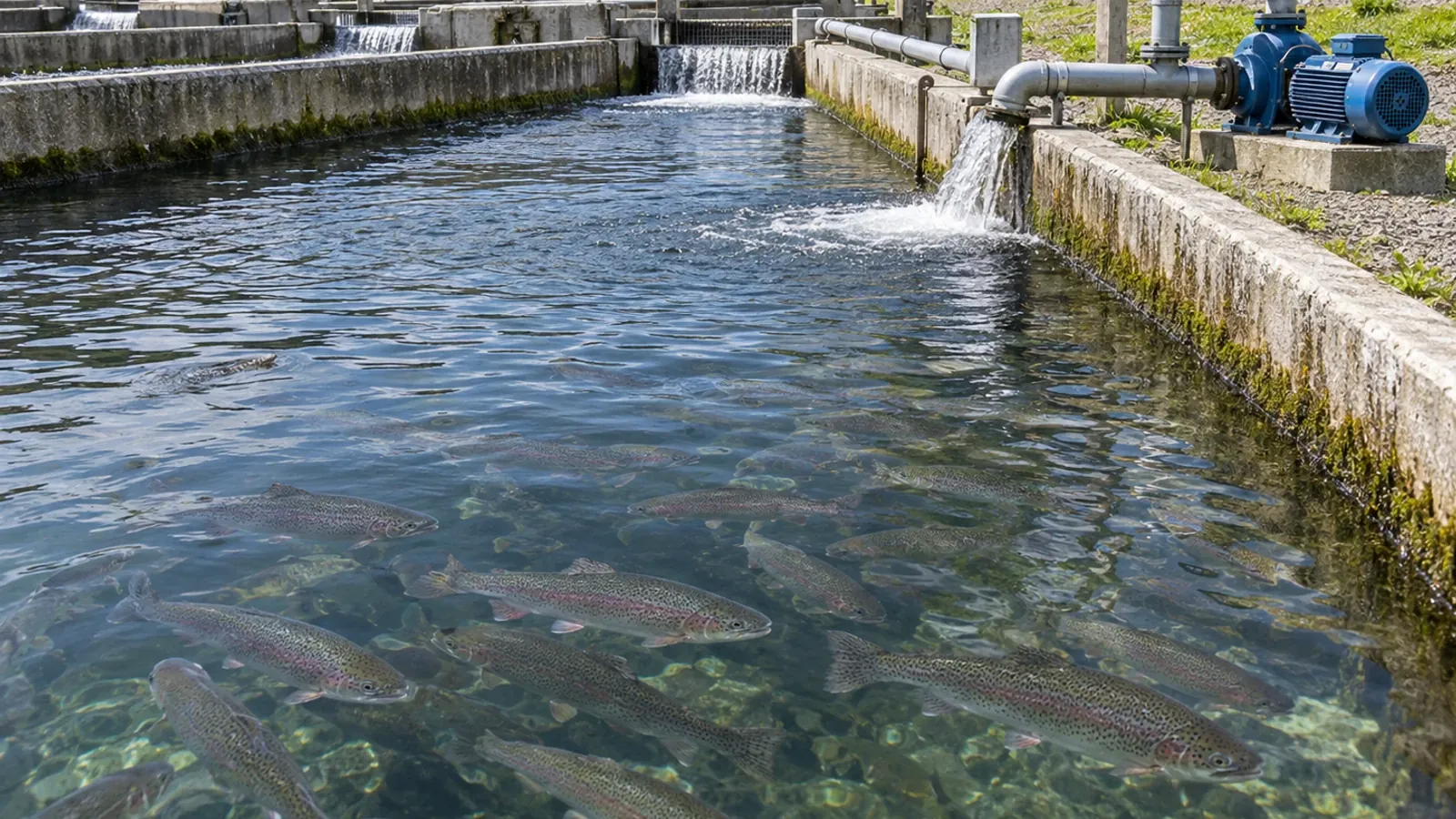
Fish-farm pumps: measure flow at the duty point
Motor power alone cannot tell a fish farmer how much water reaches the stock. Assessing the installation requires both flow measurements and a record of its hydraulic conditions. This guide draws on public Department of Energy guidance to explain what to record before changing a pump.


- Content type
- Practical guide
- Sector
- Aquaculture
- Animal group
- Fish
- Keywords
- OxygenTemperatureSalinity
Water is reaching the raceways and the motor is running. Neither observation establishes that the stock receives the flow the installation was designed to deliver. The US Department of Energy’s 2005 technical note, Pump Selection Considerations, recommends measuring actual flow and head before selecting pumping equipment. Its engineering approach remains useful, although the document does not specify biological water requirements for farmed fish.
Applied to aquaculture, the first task is to separate three questions: what a pump can supply under stated conditions, what it supplies in the existing pipework, and what the animals need. A catalogue value cannot answer all three. A documented operating measurement gives the farm team and supplier the conditions they need to discuss the equipment.
Start with the water delivered to the stock
Flow rate describes a volume moved per unit of time. Its location matters. A reading at the pump outlet, on a main supply line or at an individual raceway inlet describes a different part of the installation. Total flow does not establish how evenly water is divided between branches. Filters, valves and bypasses can affect the route taken by the water.
Set out the conditions the supply must cover before comparing equipment. These might include normal operation, the lowest permitted supply level, a filter-cleaning configuration or the loss of one line. Assess them with the people responsible for the system. A measurement exercise should not require an improvised interruption of water to stocked units.
Biological demand needs its own assessment. Species, life stage, biomass, feeding and water quality all belong in that discussion. The DOE note helps define the hydraulic service required of a pump. It supplies neither a universal tank-turnover target nor evidence that a particular flow guarantees healthy fish.
A pump curve belongs to a particular configuration
A centrifugal pump’s performance curve relates the flow it can deliver to the head it develops under specified conditions. Head expresses the energy transferred to the water in terms of an equivalent water column. It includes more than the visible height difference between the supply and discharge points.
Water also encounters resistance in pipes, fittings, valves and equipment. These hydraulic losses contribute to the system requirement. The operating or duty point reflects both the pump’s performance and the resistance of the installation. The maximum flow printed in a catalogue is therefore incomplete information unless the corresponding conditions are known.
Check that the curve matches the installed model, speed and impeller configuration. Motor power alone cannot replace those details. Two units with similar-looking specifications may perform differently when connected to the same system. Conversely, the same pump can deliver a different flow after the pipework or operating configuration changes.
Attach the operating conditions to every measurement
A useful record includes valve positions, the lines being supplied, reservoir level, filter condition and instrument location. DOE guidance points out that changing water levels can alter the head requirement. Without that context, a difference between two days may be attributed to the pump when the installation itself has changed.
The measurement method must suit the flow and access available. A flowmeter needs to be used within its installation and operating requirements. For a small, safely accessible discharge, collecting a known volume over a measured interval can provide a local cross-check. It is only appropriate where collection does not compromise the animals’ water supply or expose staff to a hazard.
For a hypothetical example, collecting 20 litres in 10 seconds gives 2 litres per second, equivalent to 7.2 cubic metres per hour. This is an arithmetic example, not a measurement from a fish farm. The lesson is to convert units before comparing results. Repeated readings can reveal timing errors or variable flow; they cannot make an incorrectly calibrated container accurate.
Investigate a change before assigning its cause
A lower reading can accompany a change in water level, an obstruction or a different valve configuration. These observations guide inspection but do not identify a failed component on their own. Cavitation is another possible problem when suction conditions are inadequate. Assessing it requires the manufacturer’s requirements and the installation data, rather than an assumed margin applied to every pump.
Water chemistry, temperature and solids also affect equipment selection. Suitability for one water source should not be taken as evidence of compatibility with saline or more heavily loaded water. Mechanical and electrical work belongs with appropriately qualified specialists.
Restoring circulation does not demonstrate that dissolved oxygen is adequate at every fish-holding unit. Water-quality measurements and animal observations remain necessary. Hydraulic measurements describe how water moves through the installation. They do not replace assessment of the conditions that water provides for the stock.
Keep an operating reference the team can reuse
The practical outcome is a concise operating record: configuration, water levels, measured flow, measurement conditions and the matching performance curve. This makes later comparisons meaningful and gives a supplier the information needed to investigate a problem. Energy records can complement it, provided instantaneous power is distinguished from energy consumed over a period.
Before deciding that a pump is undersized or unnecessarily powerful, establish what reaches the stocked units in service. Our advice and support service can help connect hydraulic observations with water-quality and health-monitoring data. Through our aquaculture expertise, we work alongside pumping specialists where engineering assessment is needed, with the aim of making the farm’s evidence and requirements explicit.


