

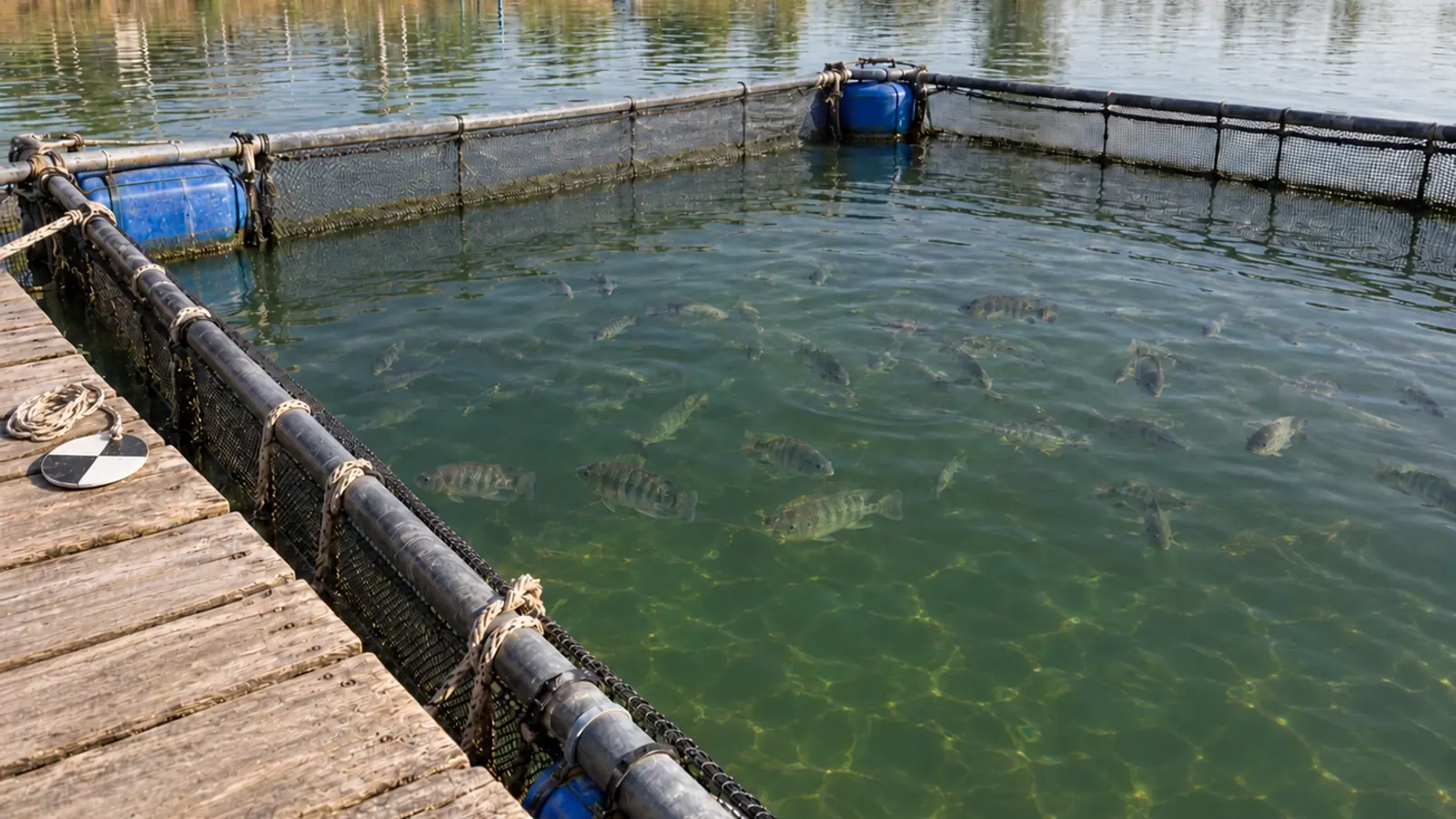
Pond cages: a Secchi disk does not measure oxygen
Being able to see the fish does not establish that they have enough oxygen. Public guidance from SRAC and North Carolina Cooperative Extension helps separate the useful information in a Secchi disk reading from the measurements needed to assess a pond containing cages.


- Content type
- Practical guide
- Sector
- Aquaculture
- Animal group
- Fish
- Keywords
- TemperatureOxygenLighting
Being able to see the fish does not establish that they have enough oxygen. Public guidance from SRAC and North Carolina Cooperative Extension helps separate the useful information in a Secchi disk reading from the measurements needed to assess a pond containing cages.
Water clarity has more than one explanation
A Secchi disk provides an observation of transparency: the observer records the depth at which its pattern disappears from view. The reading does not identify what is reducing visibility. Plankton, mineral particles and organic debris may all contribute. Brown water following rainfall and green water during a productive period therefore need different lines of investigation, even when the disk disappears at a similar depth.
Keep the name of the measurement alongside the result. Secchi depth is not a direct concentration of suspended material, an oxygen reading or a diagnosis. A change can be a useful prompt to examine conditions around the cages. It cannot, on its own, establish the cause or justify a particular treatment.
This distinction matters when observations move between staff, spreadsheets and management reports. A note saying that transparency decreased retains the original observation. A note saying that an algal problem was confirmed adds a conclusion that the disk alone cannot support. The difference may influence the next measurement and the response selected by the farm.
Connect the observation to the pond’s daily cycle
SRAC’s cage-culture guidance, revised in 1997, describes the relationship between pond production and oxygen. Photosynthesis can supply oxygen in the light, while respiration continues in darkness. A pond’s appearance at one point in the afternoon does not describe its oxygen balance throughout the following night.
Caged fish have limited opportunities to move away from unfavourable water. Monitoring should therefore address the water passing through their living space, including relevant depths and times. A convenient reading from the bank may describe that location well without representing conditions within the cages. The sampling plan needs to make that limitation visible.
Neither green water nor clear water is a complete verdict on suitability. The American guidance explains useful mechanisms, but its numerical recommendations should not become universal limits for other species, stocking conditions or climates. This article draws no oxygen threshold or treatment rule from water colour or disk depth.
Make repeat readings interpretable
The North Carolina extension note, updated in July 2026, describes combining the point of disappearance as the disk is lowered with its reappearance as it is raised. It also discusses consistent observation conditions. The original management context is carp ponds. Using its explanation of the visual method does not require adopting its pond-fertilisation or bloom-management advice.
A farm record can include location, time, observer, sky conditions and the appearance of the water. Similar conditions make successive observations easier to interpret. Surface glare or a change in viewing position should be recorded when relevant, rather than silently treated as a biological change. The first task after altering the method is to check whether readings remain comparable.
An event log adds context: rainfall, water exchange, work on cages or a noticeable change in the pond. These entries do not prove a cause. They give the team something specific to examine against measurements and operating records. Retaining the context at the time is usually more reliable than reconstructing it after the apparent change has become a concern.
Decide what needs confirming around the cages
Consider a management example in which the disk becomes harder to see but fish behaviour appears unchanged. The immediate finding is lower transparency under the recorded conditions. Before describing it as a bloom, the team can review colour, recent inputs and other available observations. The explanation remains provisional until the evidence supports it.
If fish behaviour is abnormal, a visual reading cannot postpone assessment of the water. Temperature and dissolved oxygen need suitable equipment and measurements representative of the cage environment. Other relevant parameters and observations then contribute to the investigation. A Secchi disk cannot identify a disease or pollutant, or certify that a health problem is absent.
Written instructions are more useful when they distinguish an observation to record, a measurement to confirm and the person responsible for the next decision. Otherwise, one shift may rely on clarity while another expects an oxygen result. Response procedures must reflect the animals, equipment and actual operation of the farm, rather than a general description of pond colour.
Keep a simple tool in its proper role
The practical conclusion is to retain the Secchi disk as a documented observation tool. Its simplicity is valuable when staff know what the reading describes. A single value remains local and time-specific; a consistent series may help identify changes without replacing physicochemical monitoring.
The record should show where, when and how transparency was observed, with a way to retrieve measurements made near the cages. If those details are missing, improving the record may be more productive than interpreting the number more confidently. Better traceability also makes handovers between staff easier.
Vetofish can help review a cage-farm monitoring plan, including measurement locations, the relationship between visual observations and analyses, and interpretation for the species and pond concerned. The aim is to provide evidence for decisions while keeping a visual indicator within the limits of what it measures.
To move from evidence to action, explore our advice and support service and our expertise in aquaculture.


