

Fish ageing: two matching readings can still be wrong
Two readers can agree on an otolith count and still assign the wrong age. In population monitoring, agreement between readings and independent age validation answer different questions. Fisheries and Oceans Canada guidance sets out how to separate those checks before using age data to interpret growth or recruitment.


- Content type
- Practical guide
- Sector
- Environment
- Animal group
- Fish
Agreement is not an independent birth date
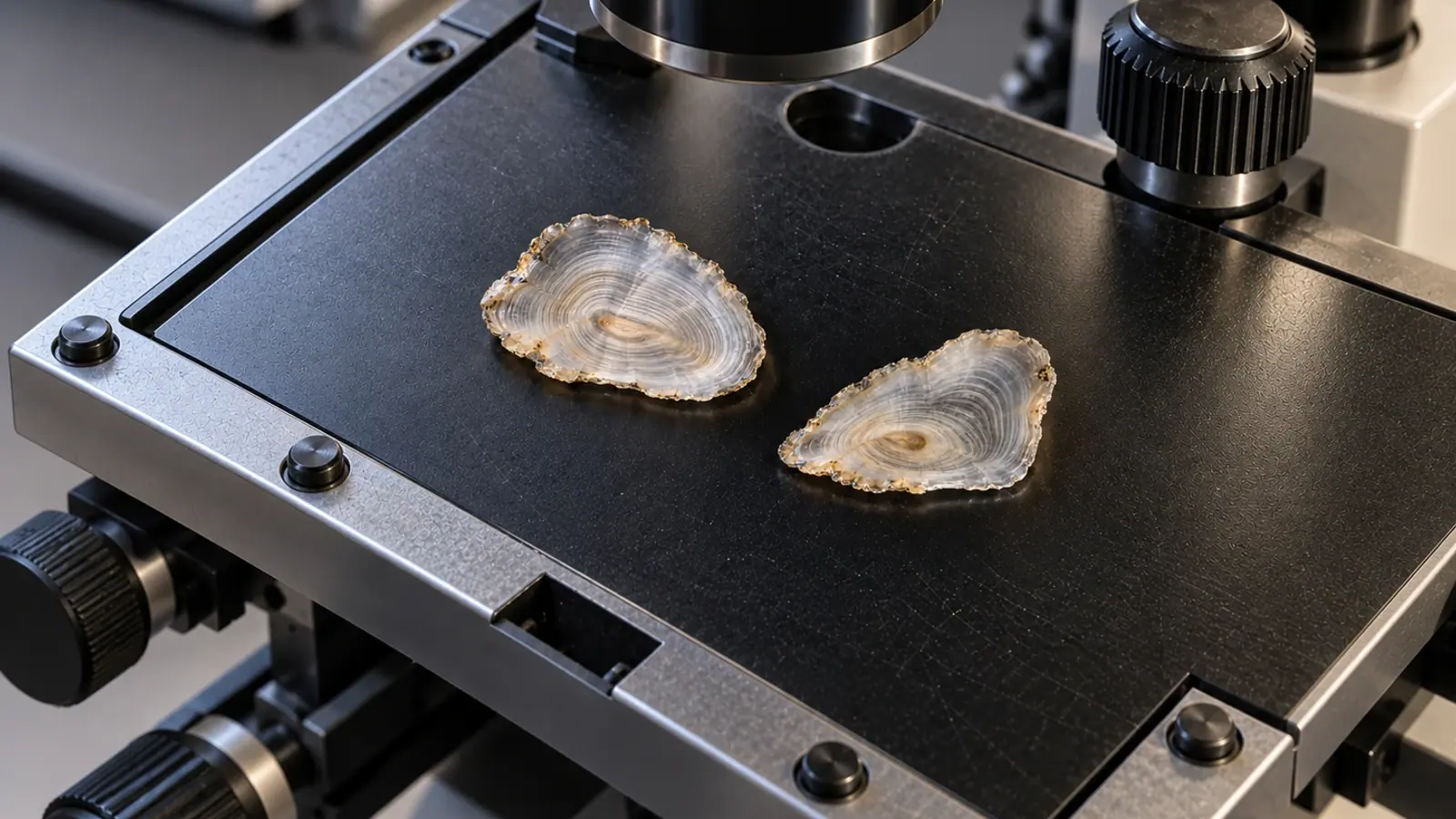
Otoliths are mineralised structures whose growth zones can help estimate a fish’s age. Interpreting those zones depends on the method, species and age range. Recognising a visible zone and establishing that it represents a year are separate steps.
Fisheries and Oceans Canada’s technical guidance distinguishes three parts of quality control: age validation, checks for reader bias and long-term drift, and measures of reading precision. Each check answers a different question about a population-monitoring dataset. They do not turn an age sample into a health diagnosis or prescribe a single method for all fish species.
For a manager receiving an age dataset, the issue is what the table can support. The apparent distribution of younger and older fish may inform interpretations of growth or population renewal. If older individuals are systematically assigned ages that are too low, that demographic picture can be distorted despite frequent agreement between readers.
Separate accuracy, bias and precision
Validation asks whether a reading method represents true age or the periodicity of the increments being counted. Precision describes the closeness of repeated readings. Two readers can be highly consistent because they apply the same rule, even if that rule misses some growth zones.
Bias occurs when a reader systematically assigns higher or lower ages than another over part of the age range. A single reader’s interpretation can also drift over several years. Agreement on current samples does not establish that today’s criteria are the same as those used in an earlier time series.
Consider a hypothetical example in which two readers consistently assign eight years to fish known to be ten years old. Their agreement could be excellent while the assigned ages remained inaccurate. This is an illustration of the measurement distinction, not a reported field result or a proposed acceptable error.
Match validation to the monitored population
The Canadian age-validation guidance describes independent approaches including following known-age fish and certain mark–recapture methods. Which approach is suitable depends on the species, longevity and available information. Validation in young fish does not automatically establish that a reading method is accurate in older fish.
Growth zones can become closely spaced near the edge and harder to interpret. Temperature and reproductive conditions may also be relevant to the history being examined. The preparation and validation domain need to be known; an attractive image or a high reading count cannot settle these questions by itself.
A useful specification can ask what independent evidence supports the interpretation, which age groups it covers and which environment it represents. If the answer is incomplete, that limitation should remain attached to the results. The series may still have value, but its intended use needs to reflect the uncertainty.
This is particularly relevant where a monitoring programme changes contractor, preparation technique or personnel. A familiar age column can hide a methodological break. Recording the change gives later users a chance to examine whether an apparent demographic shift might partly reflect a difference in interpretation.
Retain independent readings and a long-term reference
A quality-control arrangement can include an initial reading made without access to the previous result. Records can retain the reader, date, preparation, proposed age and uncertainty. When two people examine the same structures, their original readings should remain available before they discuss a common interpretation.
Plotting the ages assigned by one reader against those assigned by another helps reveal an age-dependent offset. Fisheries and Oceans Canada warns that a single agreement percentage can conceal this information. A sample dominated by young fish is also easier to make agree than a sample containing many older individuals.
A reference collection retained across years helps examine drift. Rereading only this year’s samples cannot show whether criteria have changed since an older survey. In a monitoring contract, continuity of quality control can therefore be as useful as commissioning a second reader on one occasion.
The scope of that reference collection should be stated. A shared set whose true ages have not been independently established can support comparisons between readers or dates, but it should not acquire the label of a known-age collection merely through repeated use.
Keep uncertainty visible in the population report
A report can show sample sizes by age class, uninterpretable structures, original disagreements and how those disagreements were handled. Final consensus does not erase the differences that preceded it. The proportion of samples receiving repeated readings, and how those samples were selected, should be explicit.
An age-based cohort groups fish attributed to the same birth period. Its interpretation therefore depends on the quality of age assignment. Recruitment to the monitored population cannot be inferred simply from the number of small fish captured. Capture selectivity, sampling design and age uncertainty require joint consideration in relation to the management question.
These institutional documents offer a way to structure that assessment. They do not provide a universal agreement threshold or new measurements from a French river. The practical conclusion is to check validation, bias and repeatability separately, so that satisfactory precision is not mistaken for independent evidence of accuracy.
Vetofish can help review monitoring specifications and the scope of the resulting data through its advisory and support service, for work within its aquatic environmental expertise.


