

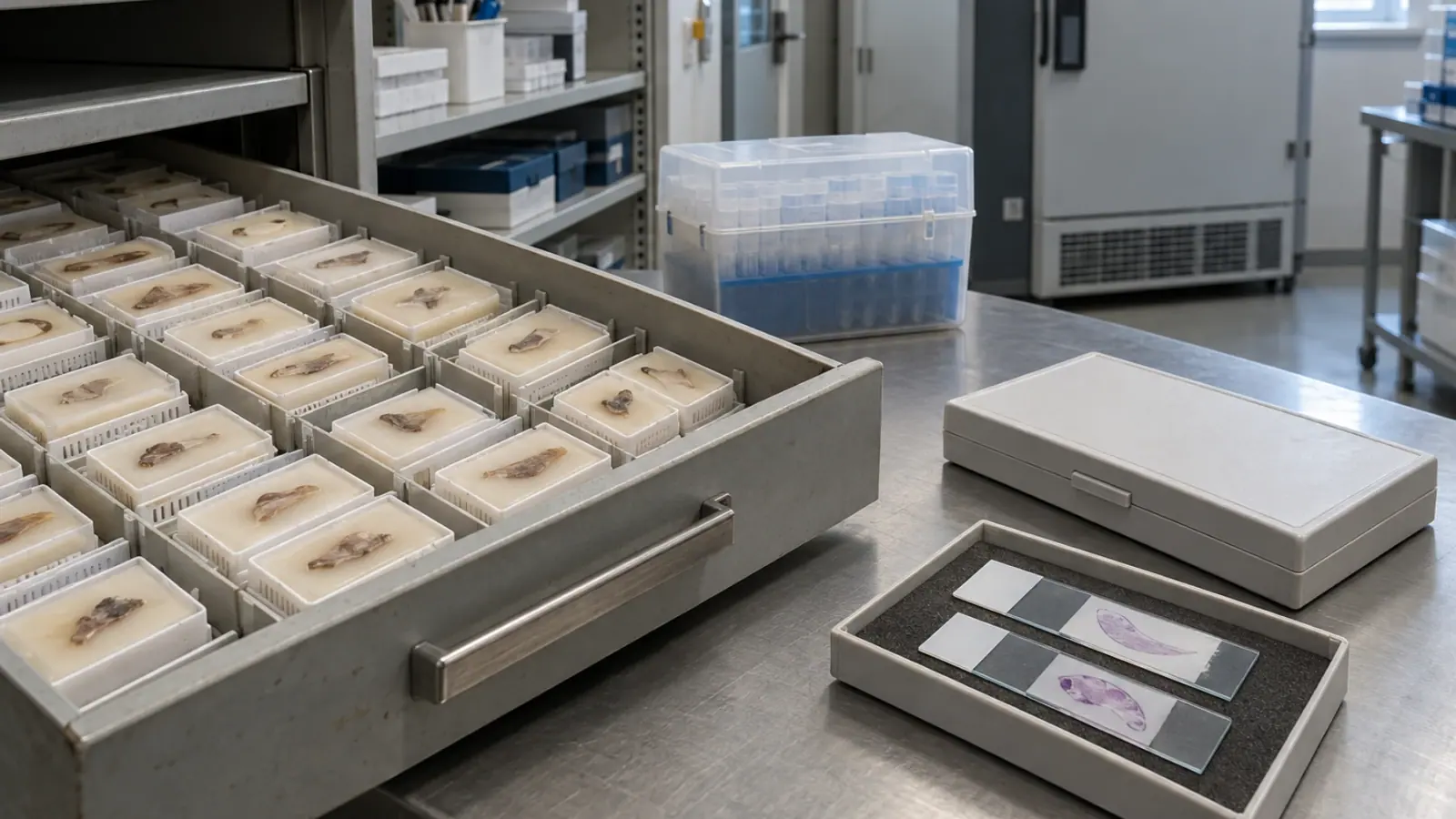
Archived fish tissues: assess fitness for reanalysis
An archived tissue’s age cannot establish whether it remains usable. The NCI’s 2026 best practices inform storage and traceability, but aquatic laboratories must assess preparation history and the intended assay before adapting human-biobanking guidance.


- Content type
- Practical guide
- Sector
- Research facilities
- Animal group
- Fish
- Keywords
- HistopathologyPCRTemperature
Retain material for a purpose, not just a period
A full freezer is not automatically a usable scientific archive. In a fish research laboratory, an older tissue sample may still answer a histological question while being unsuitable for another assay. Decisions about retention and reuse need to connect preparation, storage history and the intended examination. Sample age alone cannot make that assessment.
The National Cancer Institute’s fourth edition of its biospecimen best practices, published in January 2026, develops this approach to biological resources. It primarily concerns human specimens in cancer research. Its organisational and preanalytical principles can inform aquatic laboratories, but its technical parameters have not thereby been validated for every fish tissue. That boundary matters when a team adapts its own procedures.
The history before storage belongs with the specimen
The preanalytical phase covers events preceding the assay, including collection, delay before stabilisation, processing, storage and transport. Two samples can yield different results because of those events even when the final analytical method is identical. A useful archive preserves the history alongside the biological material rather than leaving it in a separate, inaccessible project record.
For fish tissues, the record can identify species, animal or cohort, organ, sampling context and preparation method. Known dates, storage conditions and changes of container or location follow from that information. Missing details should remain identified as missing. Measuring the current freezer temperature cannot reconstruct conditions throughout previous years of storage.
Specimen identity must also remain linked to the study data. A number on a tube is insufficient if its corresponding file disappears or different systems reuse the same numbering scheme. The objective is a verifiable connection between the animal, original sample, derived preparations and results. Adding more labels without protecting those connections does not solve the problem.
Frozen tissue, nucleic acids and paraffin blocks serve different uses
A frozen fragment, extracted DNA, extracted RNA and formalin-fixed, paraffin-embedded tissue are different resources. They preserve different properties and support different examinations. Good morphology does not demonstrate that every molecular target is intact. Conversely, a usable extract cannot reproduce the spatial organisation of the original tissue.
The NCI recommends selecting preservation conditions in relation to intended analytical use and the effects of initial processing. For formalin-fixed, paraffin-embedded specimens, it generally favours storing blocks rather than cutting sections long before analysis. That human-biobanking recommendation is a reason to review aquatic archive organisation, not a validated shelf life for fish histology slides.
Freeze–thaw events should be limited and documented where the material and intended use permit. Planned aliquots may avoid bringing an entire sample into use for every request. Their number and size still need to match likely assays. Dividing material without a purpose can consume a scarce resource or leave fractions too small for useful work.
Monitor storage equipment and plan the response to failure
Storage quality depends on the installation as well as its set point. The NCI highlights temperature assessment across freezer locations. A single sensor does not necessarily describe every storage position. Likewise, an alarm only supports protection if someone can receive it, interpret the problem and take an appropriate action.
The team should know which resources are affected by a failure and the practical order of its response. An accurate inventory allows priority samples to be located without repeatedly opening several units. Transfer arrangements, backup capacity and deviation recording should be planned before an incident. Cold exposure, containers and preservatives require the laboratory’s applicable safety procedures throughout that response.
After a deviation, separate recorded facts from estimates: documented duration, affected locations, measured temperatures and interventions. Missing measurements cannot establish that preservation was maintained. Nor must uncertainty automatically lead to disposal. Fitness for the proposed use needs reassessment, with the information available and its limitations retained in the record.
Approve reuse against explicit analytical criteria
Before requesting archived material, the investigator should define the intended assay, available preparation and relevant quality check. For molecular work, the method’s requirements must be compatible with the material’s condition. For histology, the tissue represented and the quality of preparation matter as much as the physical existence of the block or slide.
Differences in preservation can also confound group comparisons. If all controls share one processing history and all exposed animals another, a preparation effect may be mistaken for the biological difference under investigation. Archive assessment therefore belongs in analytical planning, before the results are interpreted. It is not merely an administrative check at sample dispatch.
A local procedure can classify a specimen as suitable, conditionally suitable or unsuitable for a specified use. The reason, quality checks and amount consumed should be recorded. The classification concerns that particular purpose; it avoids declaring a tube permanently good or bad for every possible future investigation.
Set a retention policy rather than a universal expiry date
The NCI document does not establish an expiry date for all aquatic tissues. Scientific value, documented quality, foreseeable uses, study commitments and storage capacity should guide retention policy. Its United States rules concerning human research participants do not become French legal requirements for an aquatic animal facility. Technical advice and the locally applicable governance framework need to remain distinguishable.
The practical conclusion is to preserve material together with the information required to interpret it. An older, well-documented specimen may be more useful than a recent sample with an unknown history. Only an assessment appropriate to the intended analysis can decide whether it is suitable, and that decision should remain available to the next investigator using the archive.
Organise aquatic archives with Vetofish
Vetofish can help identify the health and biological information to connect with specimens and the questions requiring laboratory input. Our consultancy and support service assists research establishments in distinguishing analytical requirements, traceability and practical storage constraints.


