

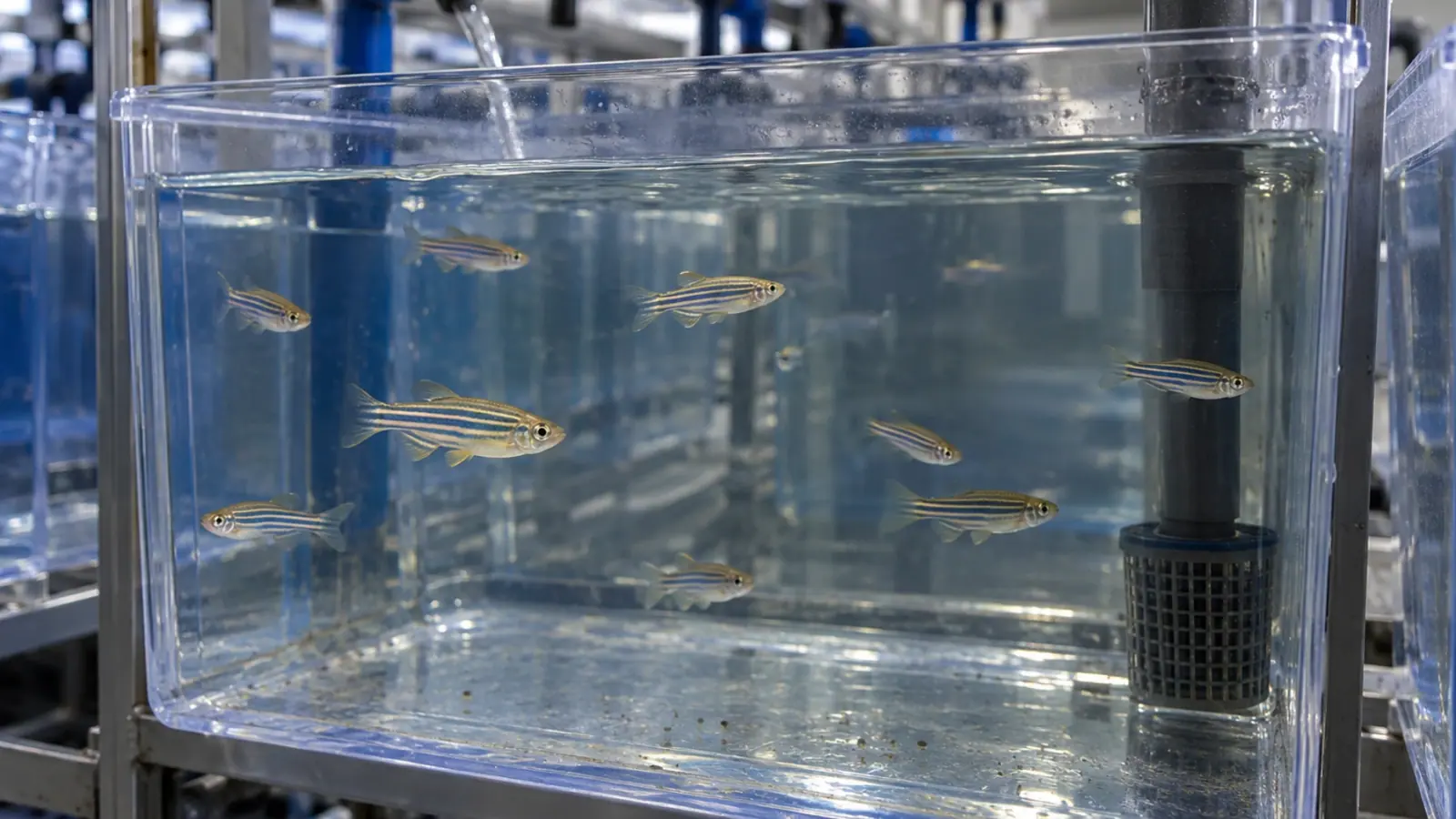
Research fish mortality: define the population at risk
Death counts alone cannot compare aquatic research facilities. Population, time window, life stage and welfare-related euthanasia must be explicit before the record can support a health decision.


- Content type
- Practical guide
- Sector
- Research facilities
Two aquatic facilities reporting the same number of dead fish may be describing very different events. They may house different numbers of animals, monitor different life stages or use different recording periods. Define what the indicator measures and which fish were part of the population at risk before comparing the records.
This practical guide uses the 2022 FELASA-AALAS recommendations by Mocho and colleagues as its professional foundation. It focuses on interpreting mortality records, with zebrafish as a common research example. It does not replace a complete colony health-monitoring programme or introduce a universal acceptable mortality rate.
Attach a population and a time window to the count
Mortality is considered here as the proportion of deaths in a defined population over a stated period. A count without the size of that population cannot support a meaningful comparison. Keep the number of fish, observation window and calculation convention with each summary.
For a closed cohort over a short period, the starting population may provide a useful reference, provided removals are documented. When fish enter, leave or change groups, that simple presentation is no longer enough. Retain movements so that groups observed for different durations are not treated as equivalent.
This is a locally defined analytical choice, rather than a single formula prescribed by the recommendations. Consistency and transparency matter: do not change the denominator silently between reporting periods. Keeping original counts and movements allows the summary to be recalculated when a different question needs answering.
Keep welfare euthanasia visible
The recommendations include both fish found dead and fish euthanised on welfare grounds in mortality monitoring. Keep those categories distinguishable. Earlier recognition and intervention may reduce the number found dead without reducing the total number experiencing serious health problems.
Planned experimental sampling and transfers should not be counted as health-related deaths. They still alter the number of fish available for subsequent observation. Recording the reason for each removal preserves both the health information and the population history.
Reaching a humane endpoint is relevant even when the animal is not found dead. A dashboard limited to recovered carcasses could make delayed intervention appear favourable. The recording system should support prompt care rather than create an incentive to wait for mortality before recognising a problem.
Compare biologically meaningful groups
Adult zebrafish, larvae beginning independent feeding and ageing fish do not share the same risk profile. Mocho and colleagues identify species, phenotype, age, immune status and the type of research as relevant considerations when interpreting morbidity and mortality.
Fertilisation date, genetic identity, sex where known, study assignment and tank location help explain variation. A facility-wide percentage may hide an increase restricted to one cohort, line or system. Keeping these details prevents a local problem from being interpreted automatically as a general failure of husbandry.
The same caution applies between institutions. A higher percentage does not, on its own, establish poorer care. Population composition and recording rules must be comparable before an organisational explanation is proposed. Where they are not comparable, the difference should prompt questions rather than a ranking.
Map the shared exposures
An epidemiologic unit comprises tanks or systems that may share water or unavoidable cross-contamination. In the recommendations, it is not automatically equivalent to a room or rack. Working practices, equipment and reliable biosecurity barriers affect where its boundaries lie.
Records should make it possible to retrieve the tank and its position within the system. A cluster in one area may guide examination of water flow, equipment or a recent operation. It is not yet proof of cause: the fish may also share a genetic line or a husbandry procedure.
Biological cohorts and epidemiologic units answer complementary questions. The former helps identify which animals are affected; the latter helps investigate possible shared exposure. Retaining both avoids losing either the biological detail or the system-level context.
Use trends to direct an investigation
Mocho and colleagues recommend regular recording and assessment of morbidity and mortality, daily where possible, and comparison with the population’s baseline. Morbidity concerns health abnormalities and may rise before deaths occur. Feeding, body condition and observed clinical signs should therefore accompany the mortality summary.
A sustained increase warrants investigation of possible causes, including water quality, feeding, temperature, line-associated abnormalities and pathogen introduction. An acutely distressed fish requires an immediate response. A rule for detecting trends must never become a reason to postpone action for several observation periods.
Clinical examination, histopathology or PCR may be appropriate depending on the diagnostic question. The death count alone does not select the test. Similarly, low mortality cannot exclude subclinical infection that might affect experimental results or be transmitted to other stocks.
Understand the indicator’s limits
The FELASA-AALAS document is professional guidance, not a trial establishing one acceptable rate for all facilities. A baseline should reflect the population and developmental stage concerned. It must not be treated as permission to tolerate avoidable suffering.
Detection and recording practices influence the number too. Missing animals, uncertain counts and changes in classification should be documented. An apparent improvement following a record-system change may reflect data entry rather than healthier fish.
The indicator also cannot distinguish causes without further evidence. A change occurring after a husbandry adjustment is a lead to examine, not proof that the adjustment caused the deaths. Preserve the chronology and diagnostic findings so that the explanation can be tested.
Conclusion and Vetofish support
An effective mortality record retains events, population counts, movements, cohorts and locations. It helps identify a departure from baseline and frame a diagnostic question without reducing the health of a facility to a single percentage.
Vetofish can help define recording categories and escalation procedures through its health expertise service, with support for aquatic research facilities. The aim is to make routine data useful for animal care and for interpreting research outcomes.


