

Fish urine sampling: a research tool to test
A RESAMA conference abstract reports urine collection from seabass and rainbow trout followed by physicochemical analysis. Comparative validation is still needed before the method can be used as an established stress indicator.

- Content type
- Scientific news
- Sector
- Research
- Keywords
- StressEthogramTemperature
A conference report, not a validated diagnostic assay
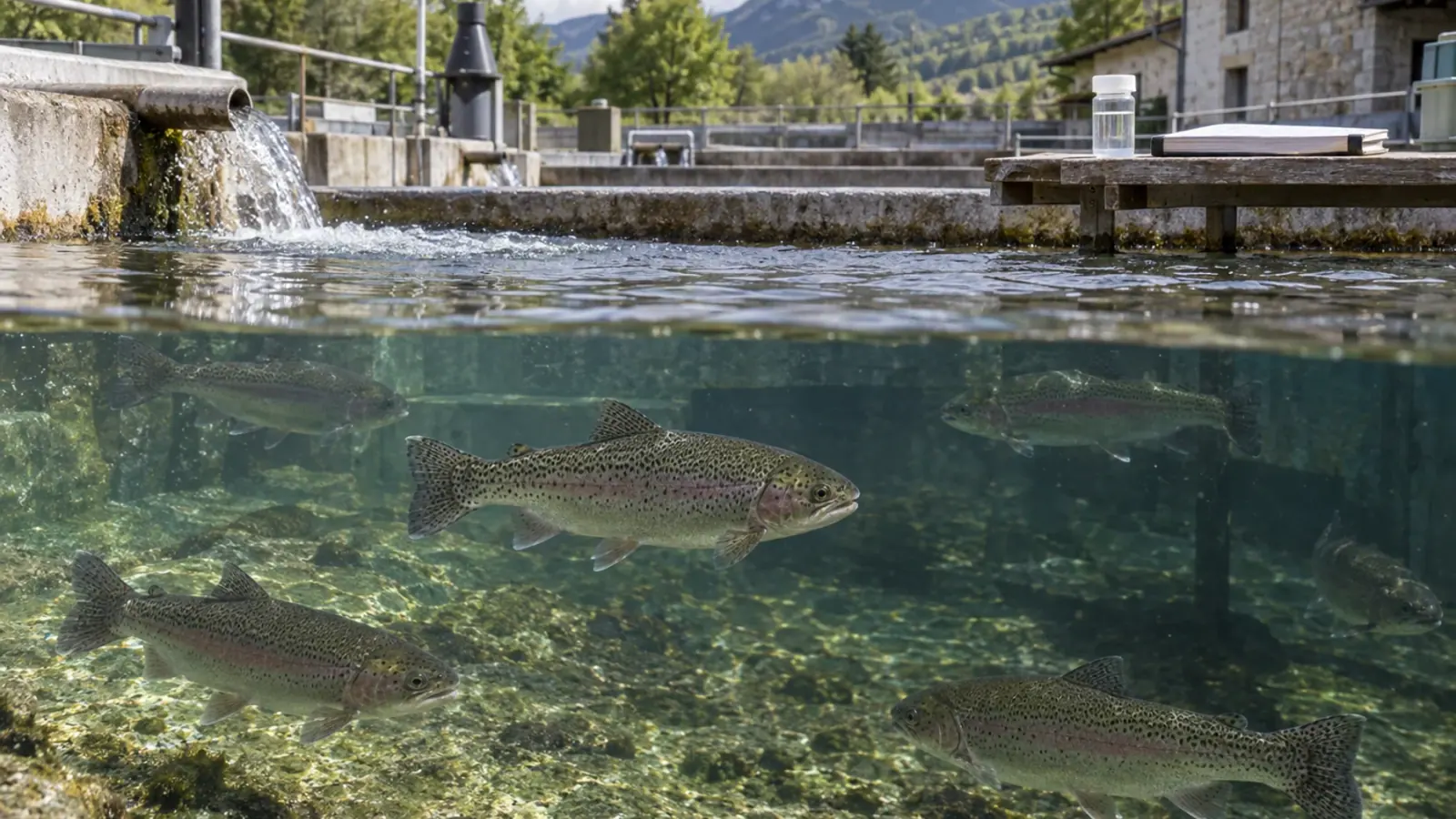
At the 2025 RESAMA meeting in France, Stéphane Betoulle described urine collection from two teleost species, European seabass (Dicentrarchus labrax) and rainbow trout (Oncorhynchus mykiss). According to the published abstract, samples were examined using nano-osmometry and Fourier-transform infrared spectroscopy. The approach was developed in the laboratory and then tried in a field study involving rainbow trout. The abstract reports molecular patterns associated with fish stress.
That abstract is direct evidence that the project was presented and describes its broad approach. It is not a full methods paper. It does not supply sample numbers, analytical performance, independent comparators or uncertainty estimates. Those omissions prevent readers from treating a spectral pattern as a validated individual diagnosis, a universal stress score or a measure of welfare on its own.
Why urine might be useful
Longitudinal research often requires repeated physiological observations while limiting destructive sampling. Urine is one possible matrix, but its value depends on the analyte, the collection method and the question being asked. Available sample volume, contact with tank water and the interval between collection and analysis can all affect interpretation. A method that works for one compound or setting may not transfer to another.
Fish urine has been used in peer-reviewed research before. In a 2015 experiment on territorial cichlids, Aires and colleagues measured urinary androgens to investigate responses to familiar and unfamiliar intruders. The study asked an endocrine and behavioural question in a specific species and protocol. It establishes a precedent for extracting biological information from urine; it does not validate osmolality or infrared spectra as general indicators of stress in seabass or trout.
“Non-lethal” and “without burden” also mean different things. A collection procedure may preserve the fish while still requiring capture, restraint or handling. The full protocol, its duration and the animal’s recovery need to be described before a welfare advantage can be assessed. The word “non-invasive” in a conference abstract cannot substitute for those practical details.
Questions for a pilot study
The first step is to specify the biological question. Is the team comparing experimental groups, following the same population over time or examining a response to a particular event? Each objective calls for a different sampling plan and level of precision. Selecting a promising analytical instrument before defining the inference can leave a study with attractive spectra but no answerable question.
For every sample, record species, life stage, size, time of day, water conditions, handling duration, collection method and storage. Aquatic sampling makes dilution or mixing with water a particular concern. These factors should be controlled where possible and documented where they cannot be controlled. A comparison between groups is difficult to interpret if collection conditions differ systematically between them.
Reproducibility is the next test: how similar are results from comparable samples under the conditions relevant to the decision? Assess storage effects, individual variation and laboratory variation. An analysis may separate groups in its development dataset yet fail with different fish, another season or another instrument. Plans for validation should make such failures visible rather than quietly excluding inconvenient samples.
A proposed stress indicator also needs comparison with independent observations and a clear biological rationale. A behaviour ethogram defined before the trial can structure those observations; water temperature, other conditions and the animal’s history must also be recorded. A single urinary signal cannot establish that all individuals in a tank share the same state or that a particular husbandry factor caused it.
Include animal burden in the comparison
A pilot comparing urine collection with an existing sampling method should measure more than analytical yield. Describe capture, time out of water if any, restraint, post-procedure observation and stopping criteria. Ethical review should consider the entire sequence and the frequency of repeat sampling, not simply the label attached to the matrix.
Where feasible, define the sampling, analysis and interpretation rules in advance and keep an audit trail of excluded or contaminated specimens. Variable or negative results are valuable during method development. Reporting them helps other laboratories judge whether an approach is ready for a different species or setting.
Limits and conclusion
The RESAMA abstract identifies a real exploratory project in two fish species and outlines physicochemical analysis. It does not provide enough detail to recommend a threshold, sampling interval or health decision. The cichlid paper supports a narrower conclusion: urine has been informative for a different endocrine question under controlled conditions.
The next useful step is documented validation of collection, contamination control, repeatability, comparators and species-specific scope. Until then, urine sampling is a research approach worth testing rather than a ready-made welfare or diagnostic assay.
Vetofish support
Vetofish can help research teams define a monitoring question, select complementary observations and make the limitations of a pilot explicit. Our advice and support service can assist research facilities without presenting an exploratory method as established practice.


