

Floodplain fish migration: monitoring time matters
Hydroacoustic monitoring in an Irtysh tributary recorded more movement before morning twilight. The 2026 study highlights the limits of daytime counts and the distinction between passage flows and unique fish.


- Content type
- Scientific news
- Sector
- Environment
- Animal group
- Fish
- Keywords
- TemperatureLightingReproduction
Seeing few fish around midday does not establish that a floodplain connection is rarely used. Movements may concentrate at other times and occur in both directions during the same period. A study published in July 2026 by Chemagin, Popova and Schletterer illustrates why observation timing matters when describing these movements.
The work concerns spring 2022 in the Varpak River, a small tributary of the lower Irtysh in Russia. It offers a documented example of continuous monitoring at a lateral connection. It does not evaluate a restoration project in France, and it provides no universal temperature or water-level target for restoring migration elsewhere.
Follow the connection, not only the main channel
Fish migration can link habitats used during different parts of the life cycle. Movement into a floodplain adds a lateral dimension to those journeys, beyond upstream and downstream travel along the main river. Describing it requires the passage location, observation period and direction of movement to remain part of the record.
Habitat includes the places, conditions and resources used by organisms. An area accessible during flooding may serve functions different from those of the permanent channel. Fish presence establishes use; it does not alone demonstrate favourable growth, successful reproduction or a contribution to recruitment. Those outcomes require evidence matched to the function being claimed.
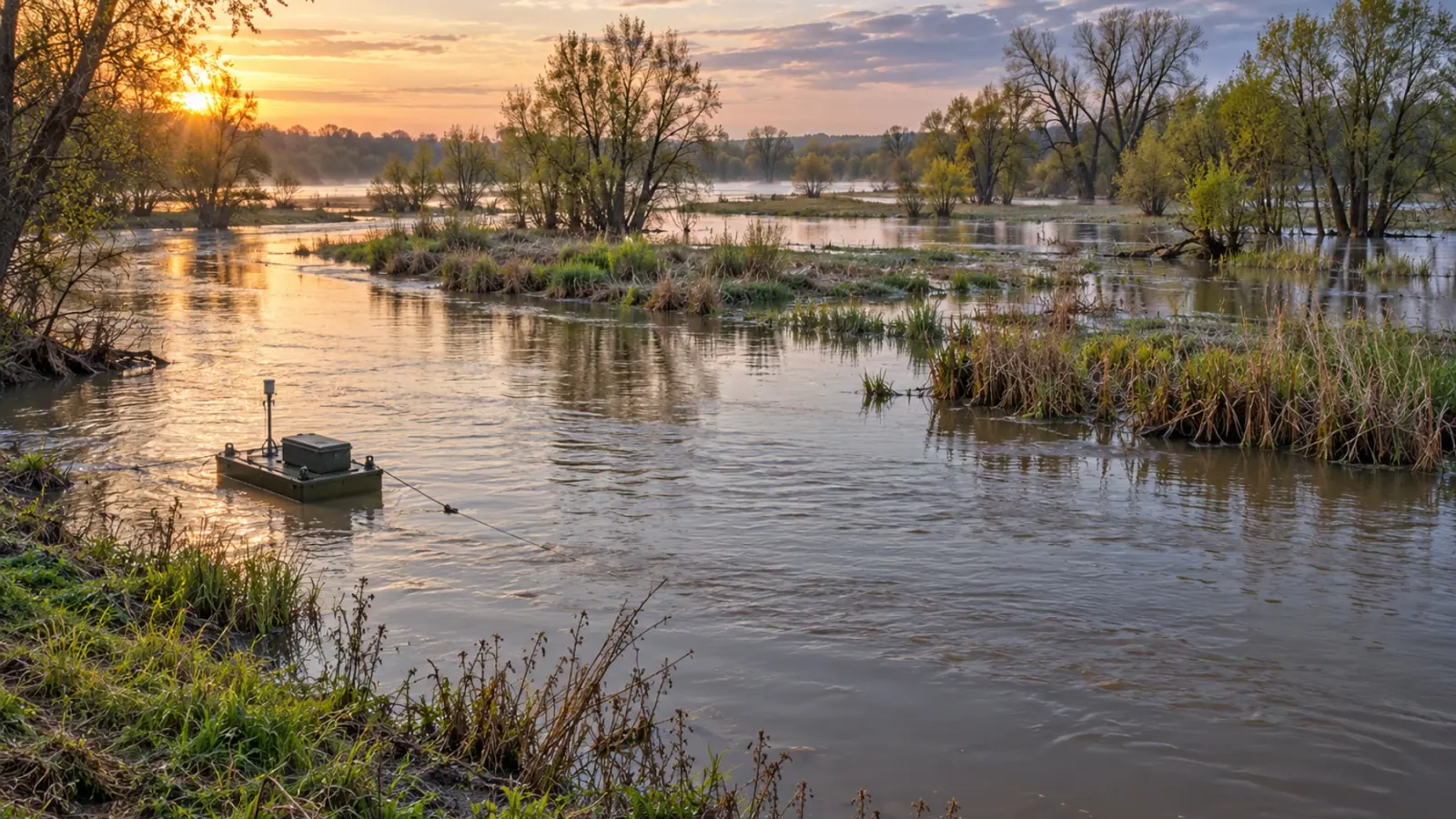
The researchers installed a hydroacoustic system on a floating platform in the Varpak, scanning laterally from the left bank. It recorded movements in both directions and estimated size classes from acoustic echoes. Control catches provided information about the assemblage, which included a predominance of cyprinids and percids. That contextual information differs from identifying every acoustic detection to species.
Seasonal and daily patterns answered different questions
Monitoring covered the April–May 2022 spring flood. The analyses described increasing migratory activity after an initial phase. Changes in water level and temperature were associated with seasonal variation in passage numbers. The timing belongs to this river and this year; it cannot be transferred directly to another catchment or flow regime.
Temperature and water level changed together, with the authors reporting strong collinearity. This limits the separation of their individual effects. The work also uses time series in which successive observations may be correlated. These constraints support reading the findings as associations within a hydrological setting, rather than isolating a causal trigger from one period of monitoring.
Within the day, more movement was recorded before morning twilight, with a smaller increase around the evening transition. Activity was lower during daylight hours. The authors interpret this pattern partly in terms of avoiding visually hunting predators. That proposed mechanism was not tested through an experimental manipulation of predation, so it should remain an interpretation rather than a demonstrated explanation.
Keep passages separate from unique individuals
Hydroacoustics can observe movement without capturing every fish, but it does not give each animal a permanent identity across repeated crossings. A fish returning through the monitored area can contribute another passage. Cumulative detections should therefore not be reported as a certain count of distinct individuals entering the floodplain.
Direction carries information that the combined total cannot preserve. The study described synchronous changes in movements in both directions while retaining an overall trend towards the floodplain. Pooling directions would obscure part of that pattern. Subtracting the two flows would not, on its own, reconstruct each animal’s subsequent location or fate.
Echo-based length estimates also depend on measurement conditions. They are not equivalent to direct measurement and systematic species identification of every animal. Control catches describe the assemblage but cannot assign every recorded echo to a particular species with certainty. That boundary becomes especially important when management objectives concern one target species or life stage.
Match sampling coverage to the management question
Sampling needs to include periods when the movement of interest can occur. A brief daytime count could miss much of the activity described in this study. Comparisons between periods or connections consequently need documented timing, directions and observation effort, rather than totals detached from their coverage.
This does not mean every site requires the same continuous monitoring equipment. The arrangement depends on the question, channel geometry and available resources. A campaign may combine several observation windows with hydrological measurements, provided it states what that coverage can support and which periods remain outside the inference.
Records should retain interruptions, setting changes and conditions affecting detection, including bubbles and debris. A weaker signal might reflect fewer passages or reduced observation capability. Both possibilities need assessment before a change is interpreted as loss of ecological function. Missing observations are not evidence of an absence of movement.
Distinguish connection use from biological benefit
For managers, recorded passages support the conclusion that fish used a connection under the measured conditions. Demonstrating a restoration benefit requires more: a relevant comparison, hydrological context and indicators suited to the stated objective. If the objective is improved reproduction or recruitment, acoustic passage totals alone cannot answer it.
The transferable lesson is therefore a way of framing the assessment. Describe when fish move, in which direction and under what detection conditions before deciding what those movements mean locally. Species composition, flood timing and site configuration still need examination before proposing an intervention. A monitoring result from the lower Irtysh cannot establish the appropriate operating regime for a different river.
Conclusion and Vetofish support
Floodplain use has a timetable that isolated observations can represent poorly. Our advisory support can help teams working in the aquatic environment define monitoring questions, select relevant periods and distinguish passage flows from unique fish and biological outcomes. The indicator’s actual scope should remain visible throughout the management decision.


