

Freshwater pearl mussels: following host fish and juveniles
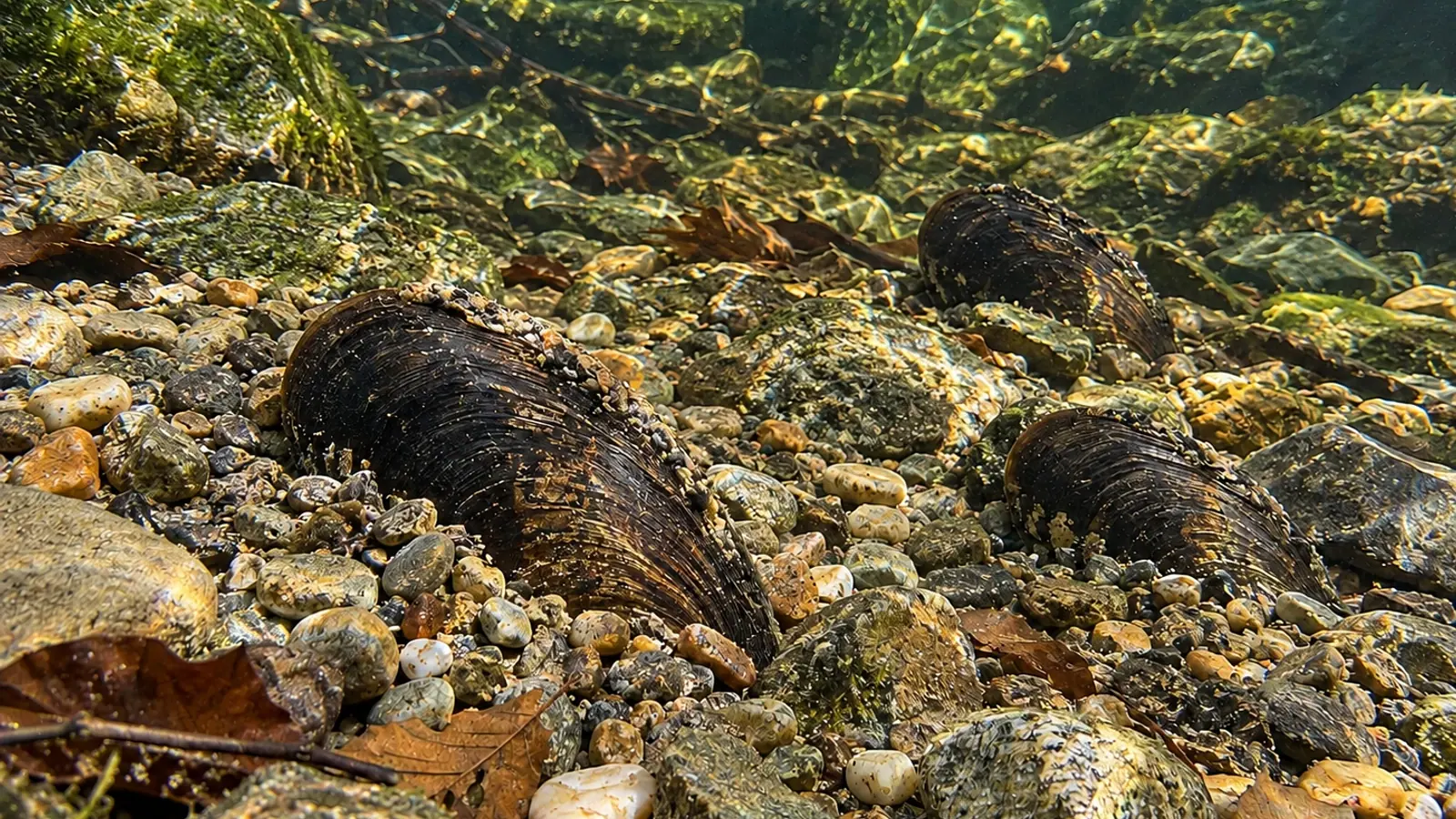
Trout presence alone does not demonstrate renewal of a freshwater pearl mussel population. A March 2026 update on conservation breeding for rivers in Creuse, France, highlights a linked sequence: a suitable fish host followed by young mussels able to establish in the riverbed.
- Content type
- Practical guide
- Sector
- Environment
- Animal group
- Corals and invertebratesSalmonids
- Keywords
- ReproductionOxygenTransport
Recruitment requires a sequence of successful stages
The freshwater pearl mussel, Margaritifera margaritifera, has a life cycle connecting fish with the riverbed. Its larva, known as a glochidium, spends part of its development on a host fish’s gills. The young mussel then detaches and enters the bottom substrate. Seeing adult mussels and trout in the same reach does not establish that the whole sequence is working.
Recruitment here means the arrival of new individuals that contribute to population renewal. Young mussels must pass through the preceding stages and survive in their habitat. Adult counts describe presence, while observations of host fish describe another part of the cycle. Both are useful, but they answer different questions.
A monitoring programme should state which life stage it seeks and what an observation can establish. A survey may confirm adults without measuring how many juveniles have established. Conversely, failure to detect juveniles during a visit can reflect survey difficulty. The record needs to separate what was observed from what remains unresolved.
A documented conservation-breeding stage in France
In a 5 March 2026 update, the Conservatoire d’espaces naturels de Nouvelle-Aquitaine described conservation breeding for pearl mussels originating from rivers in Creuse, central France. The work takes place at the Favot station in Brasparts, Brittany, with the Finistère fishing federation. A conservation programme covers the Thaurion valley and its tributaries; this breeding collaboration became possible from 2024.
The CEN reports that larvae from the Béraude and Grandrieux rivers were brought to Brittany in August and September 2024. Juveniles that detached in early 2025 were growing in troughs when the update was published. Young brown trout serve as hosts during the larval phase. The example makes the biological connection between mussel conservation and fish clear.
The update says that return to Creuse is planned only after several more years. It documents a breeding stage, rather than an already completed reintroduction or demonstrated renewal in the source rivers. Keeping that chronology prevents a programme milestone from becoming a final ecological outcome. Numbers produced in captivity and subsequent establishment in the wild require different follow-up.
Host fish and riverbed habitat have complementary roles
In January 2020, the Loire-Bretagne water agency presented a habitat-restoration project in the Blavet catchment, Brittany. Its management plan links water quality and quantity, reduced particle inputs and conditions supporting brown trout. This connects several catchment processes with the mussel’s cycle rather than focusing only on where adults are present.
Ecological connectivity can support host-fish movement, but it does not replace suitable substrate for young mussels. Suspended particles can settle and contribute to clogging in the bed. Conditions between gravel particles cannot be read from the surface appearance of the water. Visually clear water is therefore an incomplete description of interstitial habitat.
Assessment needs to consider conditions at the relevant location and life stage. Oxygen availability between particles is not automatically represented by a measurement in the water column. This distinction helps frame a question for specialists working on the site. It does not supply a universal threshold or an identical measurement programme for every river.
Keep breeding and restoration outcomes separate
A monitoring register benefits from three distinct parts: progress through captive life stages, host-fish status and juvenile establishment in the river. Each needs its own date and method. Progress in one part should not be copied across as success in the other two. This allows a genuine achievement to be recognised without making it answer a different question.
The water agency document describes a management plan and intended actions at its publication date. It does not, by itself, provide a measured assessment of their effects in 2026. Likewise, the CEN update follows young mussels at the station without establishing their future survival after return to the wild. Both provide concrete examples of conservation work with clear time limits on what they show.
Comparisons between surveys require records of effort, target stage and observation conditions. A series designed to find adults does not become an estimate of recruitment merely because it is repeated. If the method changes, that break needs to remain visible. Otherwise a change in tools could be mistaken for a change in the population.
The same care applies to the language used in project updates. “Juveniles growing in a station”, “host fish present” and “young mussels established in the river” identify different observations. Stating the stage makes the information useful to programme partners without implying that an unmeasured step has already succeeded.
Link life-cycle indicators with catchment decisions
Connect each indicator to a life-cycle stage to show what is working and what still needs documenting. Host fish, captive juveniles and young mussels established in the river describe different parts of conservation. Bringing them together helps identify the next useful observations. It does not, on its own, justify moving animals or intervening in the riverbed.
Vetofish can contribute to this interpretation through its advisory and support service, alongside programme managers and habitat specialists. Our work in the environment sector helps frame questions about aquatic animals and their habitats. The aim is monitoring whose findings address the decisions actually being considered, with breeding milestones and field evidence kept clearly distinguishable.


