

Clogged spawning gravel: monitor the bed and the eggs
A river can run clear while fine sediment remains within its gravel. An OFB research synthesis published in 2020 also shows why measured clogging does not explain every salmonid egg loss in the field. Monitoring needs to connect the condition of the bed with embryo outcomes.
- Content type
- Practical guide
- Sector
- Environment
- Keywords
- ReproductionOxygenTemperature
A river can run clear while fine sediment remains within its gravel. An OFB research synthesis published in 2020 also shows why measured clogging does not explain every salmonid egg loss in the field. Monitoring needs to connect the condition of the bed with embryo outcomes.
Look beneath the clear water
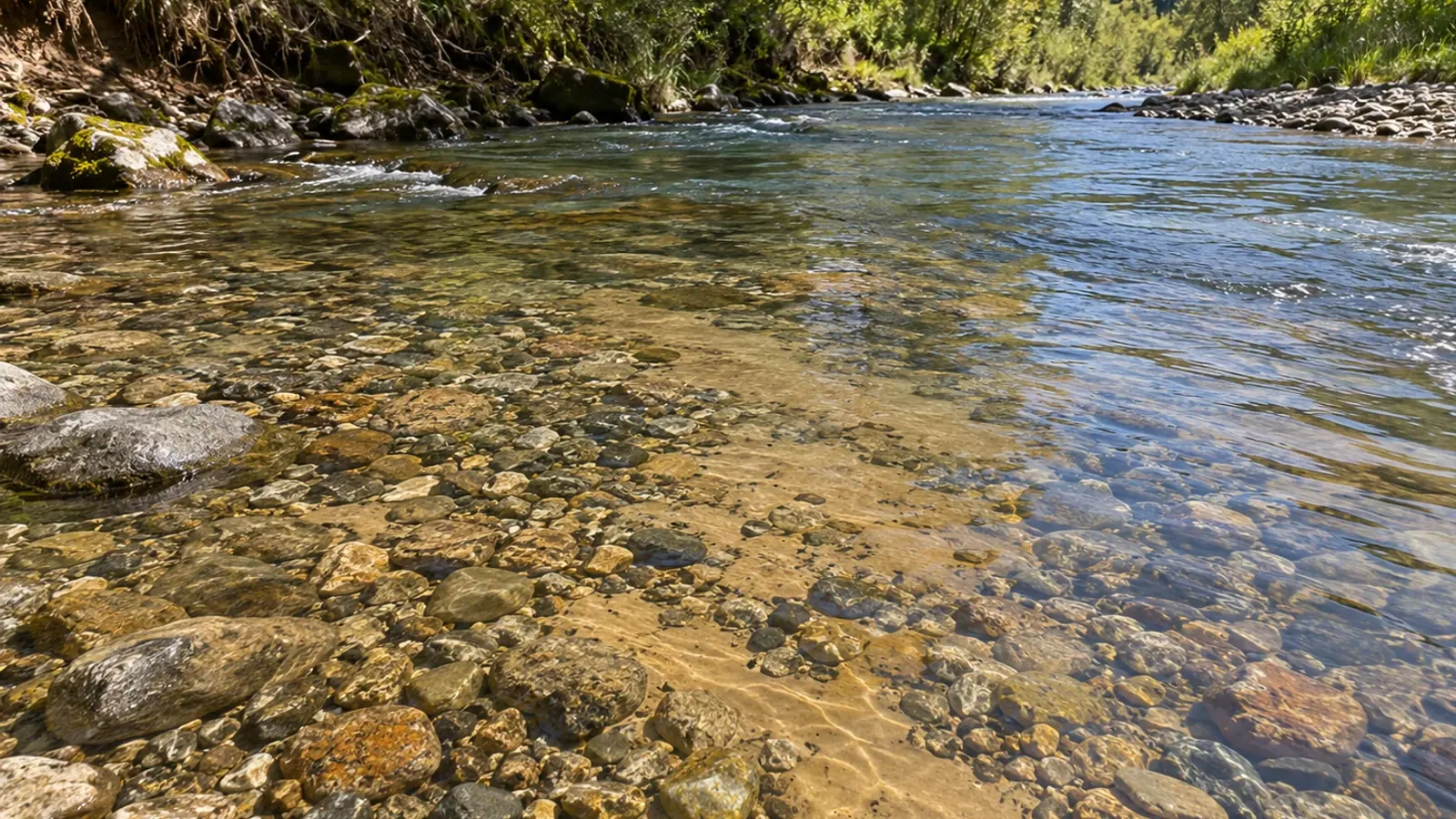
A spawning site provides the setting for reproduction. For salmonids using gravel, conditions within the bed matter during egg development. Water visible above the bed does not necessarily describe the water moving through spaces between its particles. A clear surface view is therefore an incomplete description of the incubation environment.
Suspended material can be transported and subsequently deposited. Its temporary presence in the water column and its accumulation within gravel are different observations. Eaufrance’s account of erosion explains that arriving and settling particles can degrade habitats. It does not provide a way to diagnose the condition of a spawning site from river colour alone.
Erosion and sediment movement are also natural processes. Fine particles are not automatically evidence of pollution, and gravel beds are not uniformly affected. A useful record identifies the location, timing and nature of the observation. Calling a site clogged without describing what was examined limits the comparison that can be made later.
Understand the mechanism without inventing a threshold
Fine sediment accumulation can alter water exchange within the bed. Oxygen supply to eggs and removal of metabolic products are relevant mechanisms to consider. Their local importance depends on site conditions. The presence of deposits alone cannot be converted into a predicted percentage of egg mortality.
Two questions are worth keeping separate: is there a physical alteration of the incubation environment, and is there an associated biological outcome? The first requires a description of the bed. The second needs observations suited to egg or early-life outcomes. Combining them into a single indicator may hide uncertainty that matters to management decisions.
Photographs have the same limitation. An image from the bank can document a surface deposit, but it does not directly measure exchange within the gravel or each embryo’s exposure. Monitoring reports should distinguish what was visible from what was measured. Otherwise, a persuasive image may carry a conclusion that the investigation did not test.
Field evidence does not always follow the simple prediction
The OFB synthesis published in 2020 reports research on migratory fish. Its discussion of clogging describes monitoring begun in 2010 in three tributaries of the Nivelle. Annual field comparisons did not show an obvious relationship between clogging and egg mortality, although a relationship was found under semi-natural conditions.
That contrast establishes neither that fines are harmless nor that a single alternative factor caused the field losses. Experimental conditions and river processes do not automatically align. Other influences may be possible, but naming them does not demonstrate that they explain a particular site’s outcome. The limits of the evidence need to remain part of the account.
For a local programme, the lesson is to retain results that do not fit the initial expectation. Poor incubation success alongside little measured clogging calls for investigation, rather than a revised narrative that forces all observations into one explanation. Equally, a favourable year cannot guarantee that the risk has disappeared.
Design monitoring around the actual question
Sampling needs to address variation across the bed. An easily reached patch may not represent the areas used for spawning. Locations, dates and hydrological conditions should therefore remain attached to results. Those records make it possible to discuss both changes between surveys and conditions that were not observed.
Temperature and flow events can help place biological observations in context. They do not replace substrate measurements. Several information streams may be combined, provided each has a stated role and temporal coincidence is not presented as causal proof. The monitoring design should match the question and the practical constraints of the river.
Investigations also need to account for the sensitivity of spawning habitats. This article gives no instructions for handling eggs or disturbing the bed. Any intervention requires an appropriate framework and competent personnel. A wish for more data does not justify an action that could compromise the habitat being assessed.
A useful review can begin with the limits of the existing record. If only surface observations are available, state that clearly. If egg outcomes were assessed at another location or period, keep that difference visible. A precise statement of missing evidence helps shape the next investigation more effectively than assigning an uncertain cause to the whole reach.
Evaluate action beyond its immediate appearance
After work on a catchment or riverbed, a visual improvement is not itself a biological outcome. Clearer water or an exposed gravel surface may be useful observations without guaranteeing egg survival or later recruitment. Success criteria need to be defined before the action is judged, rather than chosen to match the most favourable available image.
Pair physical descriptions of spawning habitat with biological indicators selected for the question. Differences between them should remain explicit. Reading the evidence together supports discussion of mechanisms and further investigation without attributing every loss to clogging.
Vetofish can help interpret spawning-site monitoring, examine its limitations and define further investigations with managers. A useful file brings together methods, locations and the sequence of observations. It allows conclusions proportionate to the evidence, rather than searching for a universal threshold in a river that varies across space and time.
To move from evidence to action, explore our advice and support service and our expertise in aquatic environmental health.


