

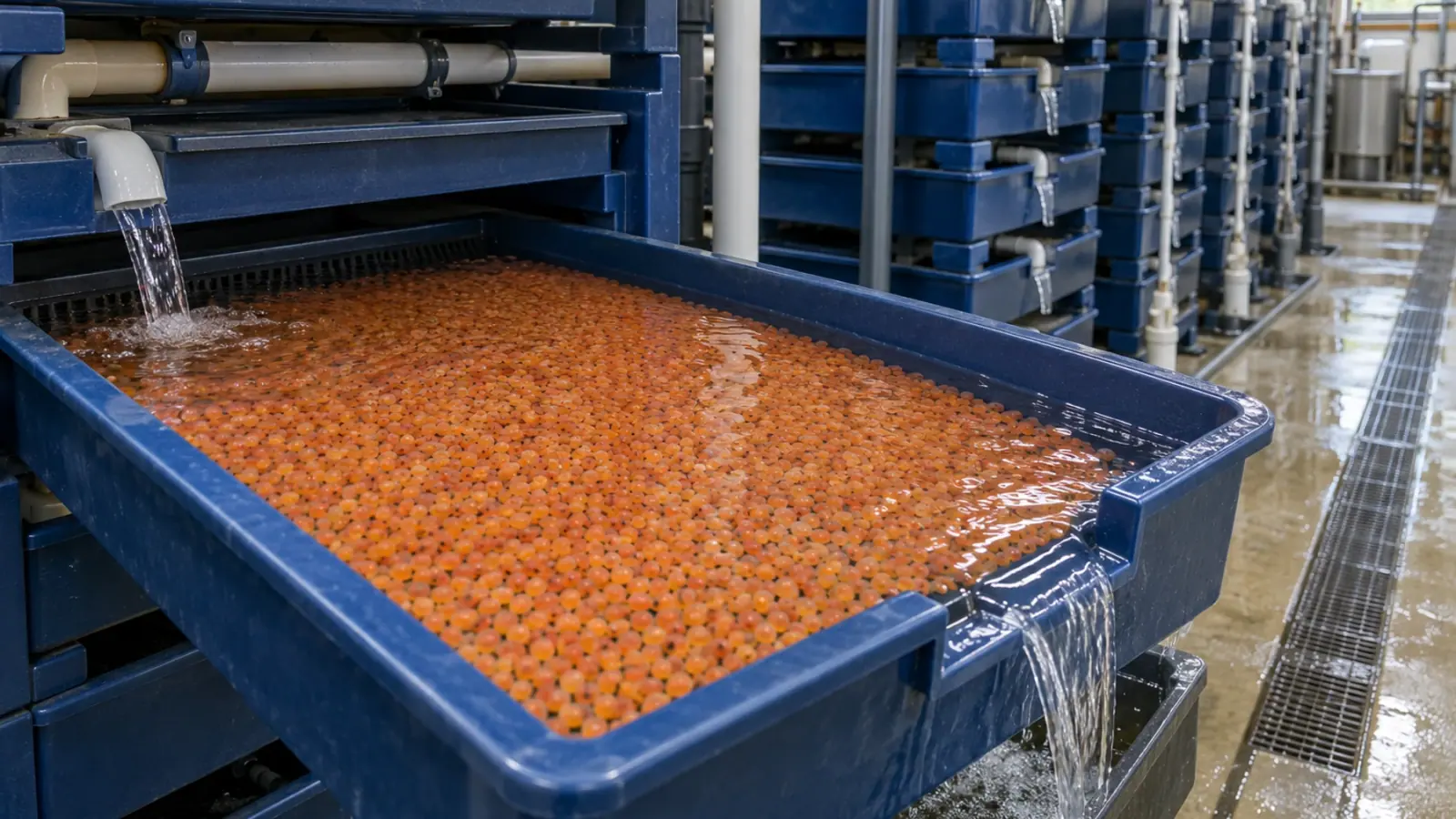
Egg quality: follow development beyond fertilisation
A high fertilisation rate does not guarantee a successful hatchery batch. Egg assessment needs to follow development and distinguish broodstock influences from sperm quality and incubation conditions.


- Content type
- Practical guide
- Sector
- Aquaculture
- Animal group
- Fish
Follow the batch beyond fertilisation
A fertilised egg is an early result in hatchery production, not proof of a successful batch. Development can subsequently stop, abnormalities may emerge and larvae may fail to progress normally. Julien Bobe’s 2015 review explains why “egg quality” covers several outcomes rather than a single measurement.
The production question should determine the assessment. Comparing spawning batches only by fertilisation rate leaves later development unexamined. Investigating losses from a late observation alone may also miss when the problem first appeared. A useful recording scheme follows identifiable stages and defines the categories before the batch is assessed.
Every percentage needs a denominator. Fertilised eggs as a proportion of eggs collected, surviving embryos as a proportion of eggs incubated and survival among fertilised eggs are different measures. If a report changes denominators without making that clear, apparent improvement may simply reflect which eggs were excluded from the next calculation.
Make observations repeatable
Batch records should connect spawning with broodstock identity, collection date, fertilisation conditions and incubation units. Developmental stage matters alongside clock time. Comparing embryos at different stages can combine biologically different situations, even when the observations were made on the same day after collection.
Observers also need workable definitions. The record should explain how living, dead, unfertilised and abnormal eggs were distinguished, and how uncertain cases were handled. An unresolved category can be more useful than forcing every egg into a definitive group. Reference photographs and discussions between staff can improve consistency without implying that visual classification is infallible.
Sampling needs its own description. Eggs selected from one position may not represent conditions throughout an incubation unit. Recording location, the number examined and the selection method makes the result easier to interpret. Where several incubators hold eggs from one spawning batch, retaining their identities helps separate variation within the installation from variation between parents or collections.
The same distinction matters when results are reviewed. Many eggs from one incubator do not automatically provide independent repetitions of an incubation treatment. The comparison should say whether it concerns individual eggs, separate spawning batches or independently operated units. That choice affects what can reasonably be concluded about a management change.
Keep incubation conditions in the investigation
Bobe notes that assessing developmental potential becomes difficult when incubation or larval rearing conditions are themselves harmful. Temperature, water conditions and the rearing system therefore belong in the batch record. Poor survival alone does not establish that the eggs had poor intrinsic developmental capacity.
A practical investigation can start with a shared timeline: collection, fertilisation, entry into incubation, interventions and the first observed losses. Problems affecting several batches in the same unit suggest checking equipment and the local environment. A batch that behaves differently across otherwise comparable units raises another set of questions. Neither pattern, by itself, identifies a cause.
Sperm also contributes to the outcome. Automatically attributing failure to female broodstock overlooks fertilisation conditions and the male contribution. Records should retain sperm origin and the available information on its use. Changing every aspect of the procedure at once may improve an immediate operational problem, but it weakens the next comparison unless the combined change is explicitly recorded.
Connect each batch with broodstock history
The 2015 review describes nutritional and environmental influences during the reproductive cycle, including temperature and light regimes. These are part of the history of the eggs, not merely conditions on the day of spawning. Photoperiod describes the duration of light and dark periods, and its relevance extends beyond the collection itself.
For the hatchery team, useful traceability means being able to retrieve earlier changes in feed, lighting, temperature, handling and health. Such records provide hypotheses for an investigation. A sequence in which a change precedes poorer development does not, on its own, prove that the change caused the outcome.
Historical comparisons also need information about assessment methods. Introducing a stricter definition of abnormality or examining embryos earlier may increase recorded defects without a deterioration in production. Marking that change in the dataset prevents improved observation from becoming a misleading warning about broodstock performance.
Records are most valuable when staff can recover them quickly enough to inform the next decision. A concise batch sheet linked to fuller husbandry information is often easier to use than disconnected notebooks. The appropriate format depends on the installation; consistency in identifiers and definitions matters more than the software chosen to hold them.
Treat proposed markers as evidence to evaluate
A visible characteristic, a molecular result and eventual larval survival are not interchangeable outcomes. A marker associated with success in one setting still needs evidence of predictive value for the species, stage and conditions in which it will be used. Bobe’s review sets out these difficulties rather than offering a universal test for accepting batches.
The paper is a historical synthesis and should not be read as an account of every technology available today. It supports neither a universal acceptance threshold nor automatic transfer of a measurement between species with different egg characteristics. A summary indicator can help operations, provided raw results, timing and methods remain available behind it.
Use the record to choose the next check
A useful batch assessment connects fertilisation, subsequent development, abnormalities and production outcomes with their conditions. It separates observations from possible explanations and states what remains to be checked. This allows comparison with genuinely similar batches rather than with an average assembled from incompatible methods.
For aquaculture facilities, our consultancy and support service can help organise batch records, choose interpretable observations and structure investigations of departures from expected performance. The purpose is a clearer basis for decisions, without promising that one indicator will predict juvenile output.


