

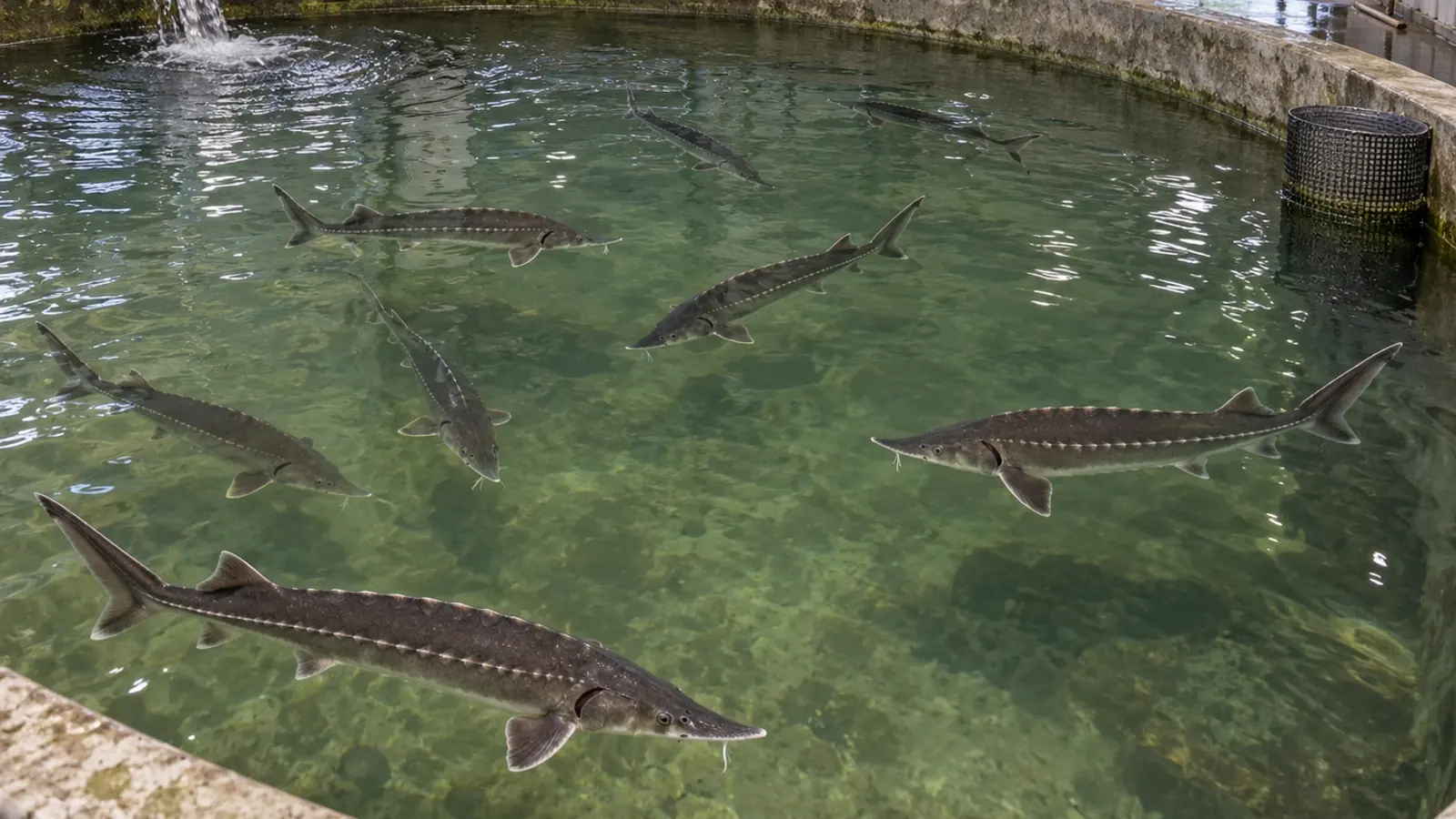
Sturgeon breeding: prepare the system before induction
Artificial sturgeon breeding requires coordinated checks on broodstock, gametes and incubation equipment. FAO manuals support that planning, while species, maturity and system design determine whether a particular procedure applies.
- Content type
- Practical guide
- Sector
- Aquaculture
- Animal group
- Sturgeons
Breeding starts with the whole hatchery pathway
An artificial breeding campaign starts well before gametes are collected. Broodstock identity, maturity, thermal history and the hatchery’s capacity to accommodate eggs and larvae all affect the plan. Having an empty incubator is not enough if the facility cannot support the resulting larvae through their transition to feeding. That capacity needs to be checked before an operation that may be difficult to pause.
Chebanov and Galich’s FAO manual, published in 2011 and reprinted in 2013, describes the sequence from broodstock management to juvenile production. The 2011 FAO guidelines add organisational considerations, particularly for hatcheries producing fish for release. These older technical documents support planning; they are not new research findings or current veterinary prescriptions. Their examples need to be matched to the species, equipment and purpose of the facility using them.
For a hatchery team, the practical starting point is to assign responsibility, equipment and a usable record to each stage. A problem first noticed during incubation may have originated during broodstock holding. Fertilisation rate alone cannot describe the success or failure of the whole campaign.
Confirm maturity and retain individual identity
Sturgeon farming involves different species and hybrids with different maturation patterns. Preparation should identify each breeder’s species and origin and connect the animal’s history with the examinations performed. Body size, presumed sex and external appearance do not establish the correct time for gamete collection.
The manual treats gonadal assessment, holding before spawning and induction as separate decisions. Examination of oocytes provides information that is not supplied simply by demonstrating the presence of a gonad. Ultrasound may contribute to monitoring when interpreted alongside the other findings; it does not automatically replace every assessment of reproductive readiness.
The record should retain examination dates, water temperatures, animal identifiers and the criteria used to proceed or postpone. This avoids reconstructing an uncertain timeline after a poor outcome. It also makes comparisons between campaigns more meaningful, because breeders exposed to different conditions are not combined without explanation.
Prepare the sequence before collecting gametes
Hormonal induction is not a single recipe. Product choice, indication, timing and handling arrangements belong within an adapted protocol and its veterinary oversight. Historical doses from the manual are not reproduced here. An older technical publication cannot establish a product’s current availability, legal status or suitability for a particular animal.
Before intervention, prepare containers, batch separation, identification and the order of operations. Staff need to know when to defer a stage if a breeder does not respond as expected. Animal protection, moisture and suitable restraint are part of the protocol, with equipment scaled to the fish being handled.
Collection, assessment and fertilisation serve different purposes. A large volume of gametes does not demonstrate quality. Sperm and eggs need to be assessed before conclusions are drawn about a batch’s suitability. Contamination, undocumented mixing or poorly controlled waiting times can make it impossible to identify which stage contributed to a failure.
Match incubation to the actual batch
Fertilised eggs require equipment suited to their properties and developmental stage. The FAO manual describes tray systems and incubation jars, among other arrangements. Water renewal and egg movement cannot be set from container volume alone: egg loading, condition and the changing demands of development also matter.
Where the chosen protocol includes removal of adhesiveness, that step precedes incubation. Clumped eggs behave differently from a batch distributed in a suitable water flow. Before loading, check inlets, outlets, obstruction risks and continuity of supply. Requirements change during embryogenesis, so an initial setting needs monitoring rather than merely being entered in a record.
Temperature, dissolved oxygen and flow should be assessed together. Faster development after warming is not sufficient evidence of better production. The species-specific ranges in the manual should not be combined into one instruction for all sturgeons. Backup water and the response to a supply failure must be planned around the equipment actually used.
Separate fertilisation, hatching and larval outcomes
Fertilisation, normal development, hatching and larval survival describe different stages. Every rate needs a measurement time and a defined denominator. A percentage calculated from an egg sample is not the final yield of the whole batch. Keeping these measures separate helps identify where losses become apparent.
Samples should represent the incubator and be collected comparably across checks. Undeveloped eggs, visible abnormalities and loss of developmental synchrony need to be interpreted with water records and logged events. A temperature change, flow interruption or handling event may suggest an explanation; the sequence alone does not establish causation.
Prepare larval transfer and first feeding as well. Yolk supports a developmental period before external feeding, but that transition does not justify the same timetable for every species. Checks should address the stage actually observed, the availability of suitable food and evidence that larvae are ingesting it.
Recognise the limits of a technical manual
The FAO publications assemble experience from different settings and periods. They do not certify a particular facility, authorise a medicine or establish the health status of an individual breeder. Hatcheries producing fish for release also face genetic and environmental objectives that cannot be assumed to match commercial production goals.
Biosecurity should be considered throughout movements of animals, water and equipment. A documented cleaning operation does not, by itself, prove freedom from an infectious agent. Results need review at campaign level, including explicit identification of stages for which evidence was not collected. Missing records should remain visible rather than being replaced by a plausible account of what probably happened.
Conclusion: make each decision traceable
Effective preparation connects broodstock, gametes, incubation and larval accommodation. A campaign record should distinguish decisions, measurements and reasons for postponement. An unsatisfactory final yield calls for investigation across that pathway, rather than an isolated change in hormonal induction. This gives the team a clearer basis for deciding what to adjust before the next campaign.
Vetofish support
Our consultancy and support service can help review campaign planning, batch records and control points between breeding and incubation. Within our work with aquaculture facilities, that review identifies technical and veterinary priorities without promising a fertilisation or hatching rate.


