

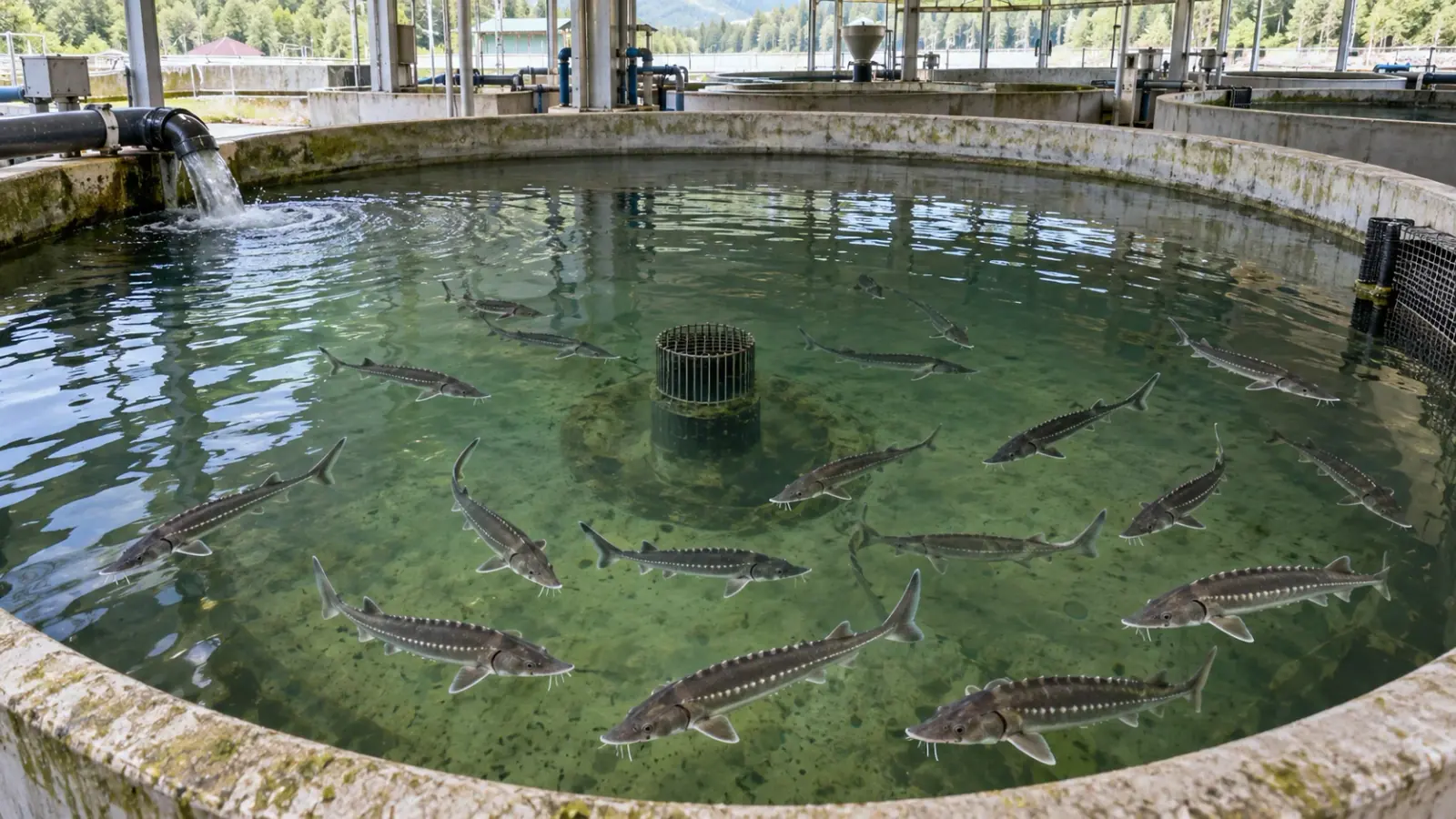
Choosing a sturgeon species starts with the farm
Meat, caviar and broodstock replacement call for different production plans. Selecting a sturgeon means matching stock identity and biological timing to the site and its intended market.
- Content type
- Practical guide
- Sector
- Aquaculture
- Animal group
- Sturgeons
Begin with the production decision
A sturgeon purchase commits a farm to more than a species name. Meat production, caviar production and broodstock management call for different decisions about live holding, stock records and the time before a product can be sold. The first useful question is therefore what the business intends to produce, rather than which fish appears fastest in a supplier comparison.
FAO’s open sturgeon hatchery manual and its cultured-species account for Acipenser baerii provide a biological starting point. They are older technical documents, not evidence of present-day costs or a statement of the permissions needed in a particular country. The planning steps below are Vetofish’s proposed way of organising a farm assessment. They should not be read as a universal ranking of species.
Establish what stock is being offered
Sturgeons include several species as well as hybrids used in farming. A commercial description needs to be accompanied by a declared identity, an origin and the records available for the consignment. Photographs may support a delivery check, but an uncertain identity, especially a claimed cross, needs more than visual reassurance.
The FAO account describes Siberian sturgeon, Acipenser baerii, as a cultured species and discusses both meat and caviar production. That establishes a relevant example, rather than a promise that every farm will obtain the same performance. Confirming identity and assessing suitability are separate tasks. Neither should be treated as complete because the other has been addressed.
Build the purchasing record around identifiable batches. Include the supplier, declared species, origin, arrival date, number of fish and life stage, with gaps marked explicitly. Ask which information comes from the supplier and which has been checked independently. A correctly spelled Latin name on an invoice does not by itself establish traceability or health status.
Turn biological timing into explicit assumptions
Caviar planning depends on female maturation and on how the stock will be assembled. Age, known sex and observed reproductive stage are different pieces of information. A schedule achieved at another site cannot simply become the delivery calendar for a new operation.
Separate biological milestones from financial assumptions in the project plan. Possible entries include juvenile arrival, growth reviews, sex assessment where relevant, stock allocation and eventual breeding. Each entry should say how it will be verified and which decision follows from it. An estimate of sexual maturity then remains an estimate, rather than quietly becoming a guaranteed harvest date.
A broodstock operation also needs reliable individual and batch histories. Decide who maintains identities, where observations are held and how those records follow fish through transfers. If the intended system cannot preserve that information during routine work, increasing the number of tanks will not resolve the underlying problem.
Assess the site when it is under pressure
Water temperature and dissolved oxygen are important measurements, but an annual average offers little insight into a difficult afternoon or an equipment outage. A preliminary review can bring together available water records, observation schedules, known interruptions and emergency arrangements. It should identify where there are measurements and where there are only assumptions.
Calling a tank suitable for sturgeon is not the same as assessing it. Review usable depth, water movement, deposits, access to the fish and cleaning arrangements. Proposed stocking density needs to be considered alongside the volume animals can actually use and the operation of the water system. A generic number is not a substitute for examining those conditions.
Ask the team to describe an equipment failure from detection to response. Who notices it, how are they alerted and what can they do at that time of day? A written scenario can expose a need for monitoring, training or backup capacity. It does not establish that the farm is safe; its value lies in making weaknesses visible enough to address.
Plan arrivals before stocking begins
Species selection does not remove the need for biosecurity. A consignment brings fish, transport water and equipment into an existing working system. Receiving arrangements should therefore be designed alongside opportunities to observe and separate batches and obtain veterinary support, rather than added after the tanks have been commissioned.
For a new farm, map the route from the vehicle to the holding area. For an expansion, identify possible contact with existing stock and equipment that will be shared. This practical map can support a discussion of procedures. It cannot demonstrate freedom from infection or determine an appropriate quarantine period on its own.
Health information also needs a clear scope. Retain the batch history and, where warranted, the details of suitable examinations. A negative test remains tied to its method, the animals sampled and the sampling date. It does not certify every fish of that species as risk-free or replace investigation of a later problem.
Compare complete options
A useful comparison table covers the intended product, stock identity, site requirements, batch organisation and documented market route. Within each option, distinguish observed information, supplier claims and working assumptions. This makes uncertainty part of the comparison rather than concealing it behind a single growth or yield figure.
The FAO documents support the biological discussion. They are neither a current quotation nor updated legal advice. Commercial and regulatory requirements need a separate check with the relevant authorities and advisers. Presenting any species as automatically permitted, profitable or easy to farm on the strength of a technical manual would overstate what the documents establish.
Before finalising the purchase, turn unresolved questions into actions. Name the information needed, the person responsible for obtaining it and the decision that cannot yet be made. An option may remain viable while awaiting a site measurement or stock record, but it should not be presented as validated until that evidence is available.
Conclusion: make the choice auditable
A sound sturgeon choice connects documented identity, a defined production objective and an assessed installation. Where one element is missing, keep the comparison provisional. Finding a way to check the missing information is more useful than borrowing a performance claim from another farm.
Vetofish’s advice and support service can help organise the project dossier and its health questions. Our aquaculture expertise supports a discussion of stock selection in the context of how the proposed farm will actually operate.


