

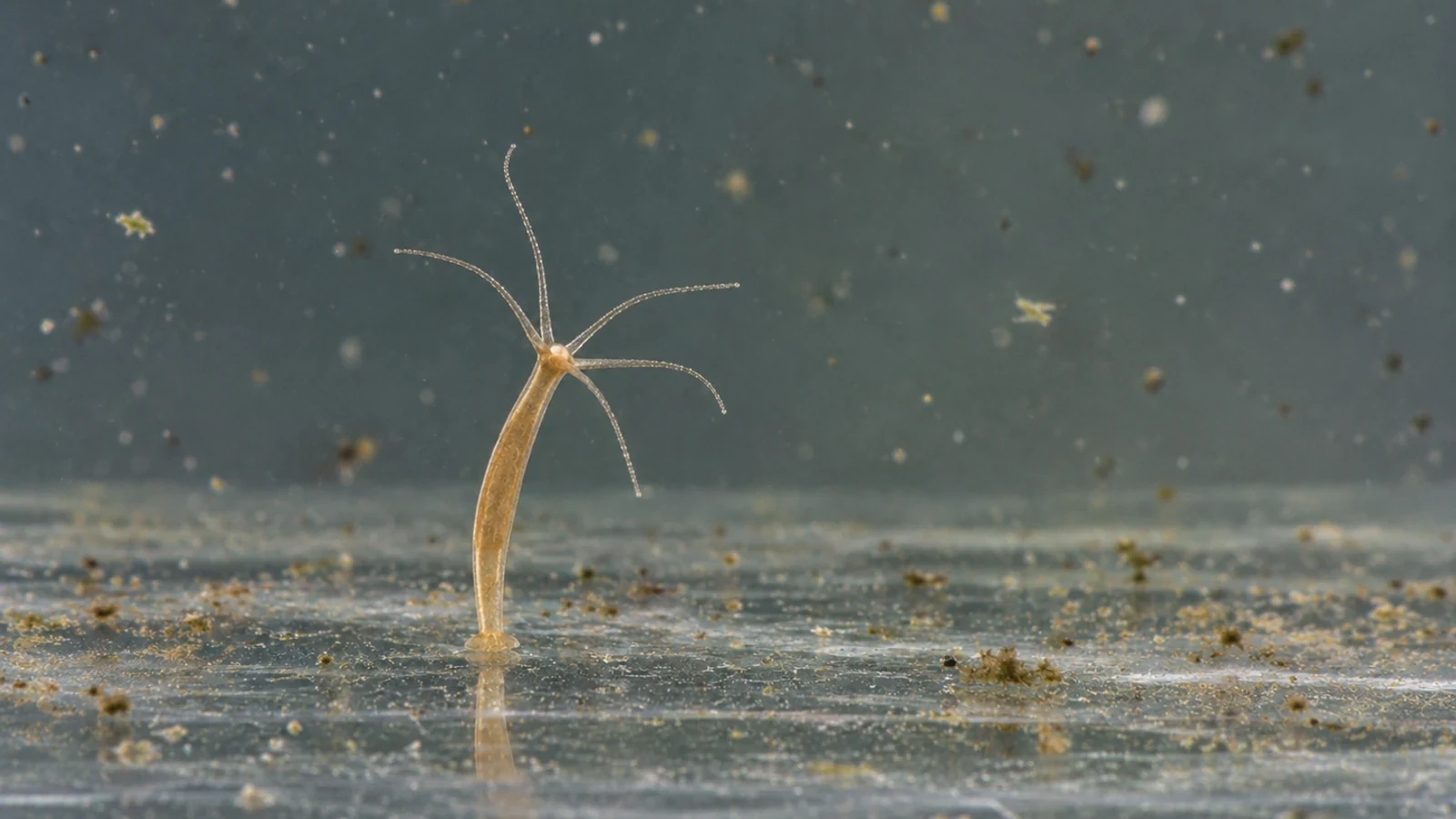
Hydra phototaxis depends on feeding history
A hydra that makes less progress towards light does not necessarily perceive the light less effectively. A 2024 experiment in Hydra vulgaris linked feeding state mainly to movement rate. Separating the components helps research teams interpret a group difference.
- Content type
- Scientific news
- Sector
- Research facilities
- Animal group
- Corals and invertebrates
- Keywords
- LightingTemperatureEthogram
Reaching an illuminated area is a combined behavioural outcome. An animal must orient, move and repeat the action. A difference between experimental groups can arise from only one of these components, even when the final positions look very different. Treating the endpoint as one ability can conceal that distinction.
Kim and colleagues examined this problem in Hydra vulgaris in a 2024 study of phototaxis, movement guided by light. Their results show why feeding history belongs in the experimental record and why a trajectory needs to be broken down before it is assigned a sensory or cognitive explanation.
How a hydra changes its position
Hydra is a freshwater cnidarian with an adhesive basal disc at one end and an oral region surrounded by tentacles at the other. It can move its attachment point by somersaulting: the oral region makes contact with the surface, the foot detaches and then attaches again at a new location.
The paper calls this translocation a jump. It does not mean that the animal leaps out of the water. Tracking head and foot positions allows the investigators to measure the distance between successive attachments and the animal’s orientation relative to the light source.
Hydra does not have eyes equivalent to a fish’s eyes. Its response to light does not require that type of visual organ. Describing the movement itself avoids borrowing a sensory arrangement or cognitive interpretation from another model animal.
Feeding groups with defined histories
The experiments used the AEP strain. The investigators compared animals without food for 14 days with animals last fed two days before recording. The group termed fed was therefore not a group filmed immediately after a meal. That distinction matters when reporting what the experiment actually compared.
The main comparison included 24 hydras in the food-deprived group and 31 in the other group. Recordings continued for 48 hours. Analysis of movement components focused on the first eight hours, a period sufficient to observe the food-deprived animals progressing towards the light.
These intervals define experimental conditions. They are not recommended fasting periods for laboratory cultures, nor evidence that an identical interval produces the same physiological state in every strain. Stock size, maintenance conditions and previous history remain part of the context needed to interpret the comparison.
Movement rate accounts for the contrast
Food-deprived hydras moved towards the brighter region more consistently. Responses in the other group were more variable: some animals moved, while others changed location very little. Reporting only a group mean for final position would obscure that variation between trajectories.
The researchers separated head orientation, distance per translocation and the number of translocations. They found no statistically significant group difference for the first two parameters, whereas movement frequency differed. The combined outcome could therefore change through the rate at which actions occurred, without every component showing the same change.
A non-significant result does not prove identical perception or motor performance. It remains a finding within the data and analysis used. The narrower conclusion is that, in this experiment, a difference in movement rate could account for much of the overall phototaxis contrast. That is more informative than simply labelling one group less responsive.
What the simulated trajectories contribute
The team generated trajectories from orientation, step distance and movement rate. Varying the rate between groups while keeping the other distributions common reproduced features of the observed movement. This provides a way to test whether the component-level explanation is sufficient to generate the combined pattern.
The model does not identify the neurons or molecular processes responsible for the feeding-state effect. The paper leaves those mechanisms for further investigation. A simulated path resembling a real path is not a direct recording from the circuit that produced the animal’s behaviour.
The behavioural phenotype therefore needs to be defined by the endpoint actually measured. Moving less often and detecting light less effectively are different propositions. Choosing between them affects which follow-up measurement is useful and how a treatment-associated change should be discussed. The model helps sharpen that question without supplying every biological answer.
Keep the comparison reproducible
A research facility can retain strain identity, feeding events and the exact interval before recording on the stock sheet. Maintenance temperature and photoperiod belong beside the conditions used during the test itself. Those details should remain attached when videos are pooled or transferred between analysts.
The apparatus also needs a description: confinement, starting position, recording duration and tracking method. The study included a control addressing whether heating associated with the lighting apparatus, rather than light itself, could explain the direction of movement. Comparable alternative explanations should be considered before an endpoint is attributed to the intended stimulus.
Repeated images of one hydra remain observations from that individual. They do not increase the number of independent animals. Tracking corrections and sequence-selection rules need to be documented so that readers can understand how the analysis dataset was prepared. A large number of frames cannot substitute for a clear account of the subjects and comparison.
Choose the endpoint to match the question
The study encourages teams to examine the actions behind a final position. Feeding history can change how often an action occurs and thereby alter a whole trajectory. Stock state, test conditions and the level of explanation supported by the evidence need to remain connected throughout interpretation.
Vetofish can help teams formalise maintenance records, observable endpoints and interpretation limits through its training programmes. This work with research facilities supports comparisons that are documented and suited to the model, without presenting one experimental arrangement as a universal behavioural assay.


