

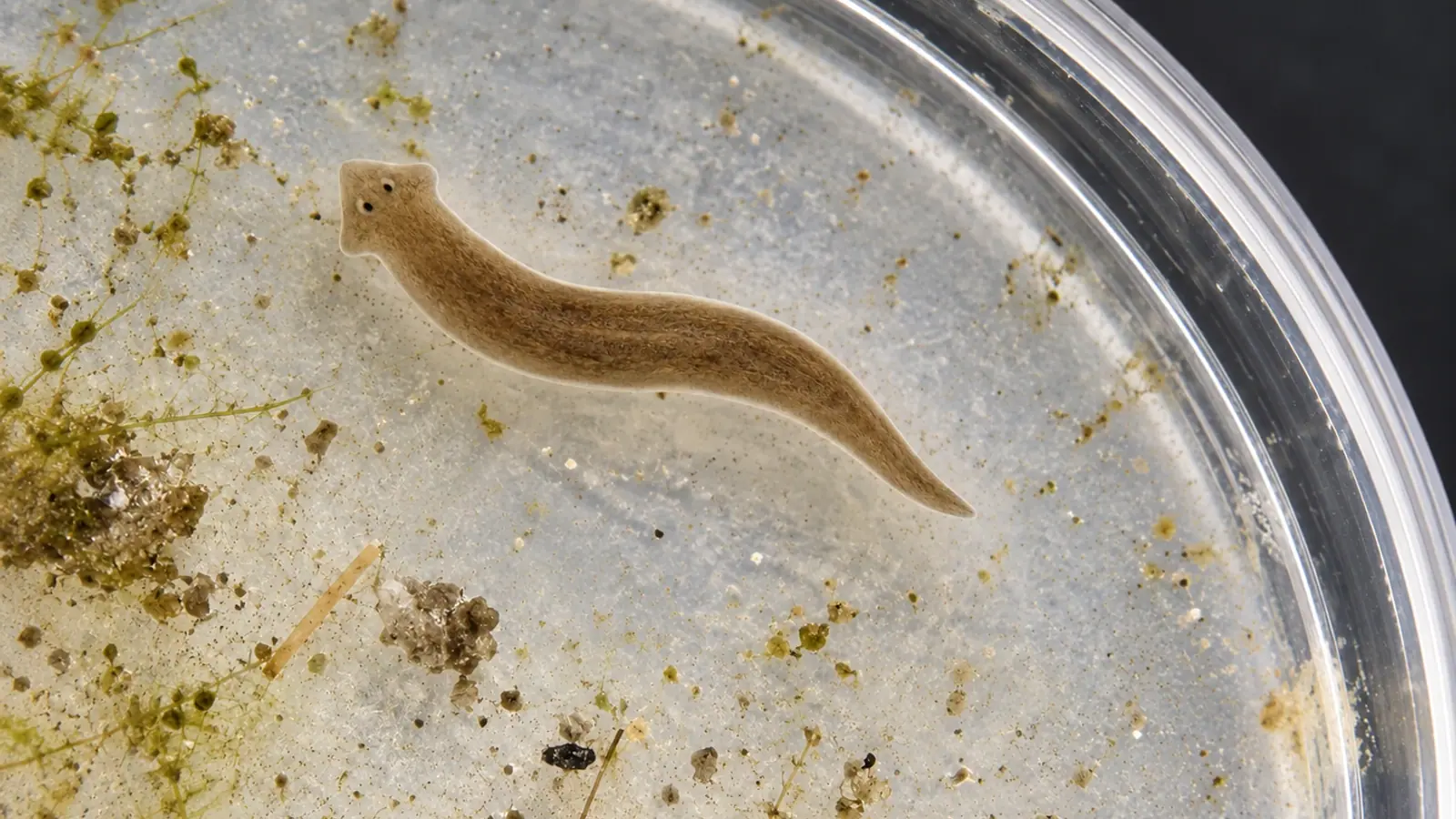
Planarians: light wavelength changes the observed response
In Schmidtea mediterranea, initial escape and final position can give different answers. A 2014 study compared responses to several light wavelengths. The findings show why teams need to document both illumination and observation time in behavioural experiments.


- Content type
- Practical guide
- Sector
- Research facilities
- Animal group
- Corals and invertebrates
Calling an experiment a test of light avoidance leaves important details unstated. Which light reaches the animal? When is its position recorded? Does the endpoint concern departure from one area or arrival in another? A 2014 study by Taylor Paskin and colleagues demonstrates the importance of these choices in Schmidtea mediterranea.
This freshwater planarian is a research model, but its behaviour cannot be reduced to a permanent preference for darkness. The paper offers a methodological example for teams discussing behavioural observations. It is not a new finding from 2026, or an instruction to reproduce every experimental exposure described.
Illumination has more than one relevant property
The researchers studied asexual planarians six to nine millimetres long. The head bears two eyespots, light-sensitive structures that should not be treated as equivalent to fish eyes. Directed movement in response to light is described as phototaxis. The task was to characterise that movement under different illumination conditions.
The experiments compared several wavelength bands and white light. Wavelength identifies a component of radiation; colour as perceived by a human observer does not fully describe what an animal receives. Two lamps that look similarly bright may have different spectral outputs, and could therefore present different experimental stimuli.
Intensity, room lighting and the geometry of exposure also formed part of the setup. The authors attempted to bring photon fluxes into a comparable range between sources. This does not make those sources interchangeable with any lamp used elsewhere. Equipment documentation remains necessary to understand what a comparison actually tests.
Repeated observations did not create additional animals
The main assay used 60 worms in ten groups of six, with repeated runs contributing to the analysis. Repeating a recording or position measurement did not create a further independent population of 60 animals. This distinction matters when describing the strength and scope of the evidence.
Worms began in the illuminated region of a vessel divided into four analysis zones. Their positions were recorded over two minutes, with intermediate observations. The setup allowed the researchers to assess both distribution across zones and departure from the starting region. Those measurements described related, but different, aspects of behaviour.
An animal may leave the light quickly and subsequently return. Its final location does not provide a complete account of the earlier movement. An escape measure and a final-distribution measure can consequently support different conclusions without being mutually inconsistent. A report needs to state which one it uses.
Red light exposed the importance of observation time
Green, blue and ultraviolet illumination produced responses different from the condition without an additional source. Ultraviolet exposure elicited the fastest initial departures. This pattern concerns the bands and conditions tested, rather than a ranking that applies to every intensity, species or exposure duration.
Red light produced an initial departure response that weakened with time. By two minutes, the distribution across the four zones did not differ significantly from the control. Summarising the finding as an inability to see red would discard the earlier response. The time window changes the statement that can reasonably be made.
Infrared findings require a different qualification. The departure index suggested a tendency to remain in the exposed area, whereas overall distribution across the four zones was not significantly different from the control. The authors considered alternative explanations. They did not demonstrate a specific infrared receptor in these worms.
The apparatus constrains the interpretation
Ambient lighting, the available wavelength bands and intensity measurements belong to the study’s 2014 setup. They do not establish a universal calibration standard. Exposure order and the recent experience of animals tested repeatedly also need consideration when interpreting a sequence of responses.
Additional beam-avoidance experiments examined another aspect of movement. They should not be treated as identical to the group assay using four zones. Going around a path and leaving a whole region are different endpoints. Changing the task changes the meaning of an apparently simple term such as avoidance.
The work did not directly assess welfare or clinical condition. Faster departure is not a diagnosis on its own. Equally, ultraviolet exposure does not become a routine observation method because it appeared in an experiment. A project needs to justify its stimuli and consider ways to reduce disturbance while answering its specific question.
Specify the response before comparing sessions
An observation plan can begin by naming the principal endpoint: latency to leave, time in a zone, distance travelled or final distribution. A shared ethogram establishes behavioural categories and recording rules. This reduces the risk that two observers use the same term for measurements that answer different questions.
The record can then describe the source, its position, available spectral information, intensity at animal level, room lighting and duration. Water temperature is also worth documenting where equipment changes could alter the physical context. These are proposed reporting details, rather than variables whose individual effects were all established in this study.
Records should retain animal or group identity, repeated runs and condition order. Without them, a between-session difference could be assigned to wavelength when it also accompanied a different time of day, exposure history or method of coding movement. More observations are useful only when their relationship to the same animals remains clear.
There is also a practical distinction between measuring a lamp and describing its label. A colour name or nominal product specification may help identify equipment, but does not replace a measurement relevant to the animal’s position. Where that information is unavailable, retaining the limitation makes the comparison easier to assess honestly.
Tie the conclusion to the endpoint measured
The study shows why a response to illumination depends on both the stimulus and the way it is observed. Red light illustrates the importance of duration. Infrared findings show that two indices need not carry the same information. The conclusion needs to name the measurement rather than generalise it to the animal’s entire sensory capacity.
Vetofish can help teams formalise observation categories and discuss these distinctions through its training service. Work with research facilities aims to improve descriptions of animals, conditions and measurements, while preserving the separate process of experimental protocol validation.


