

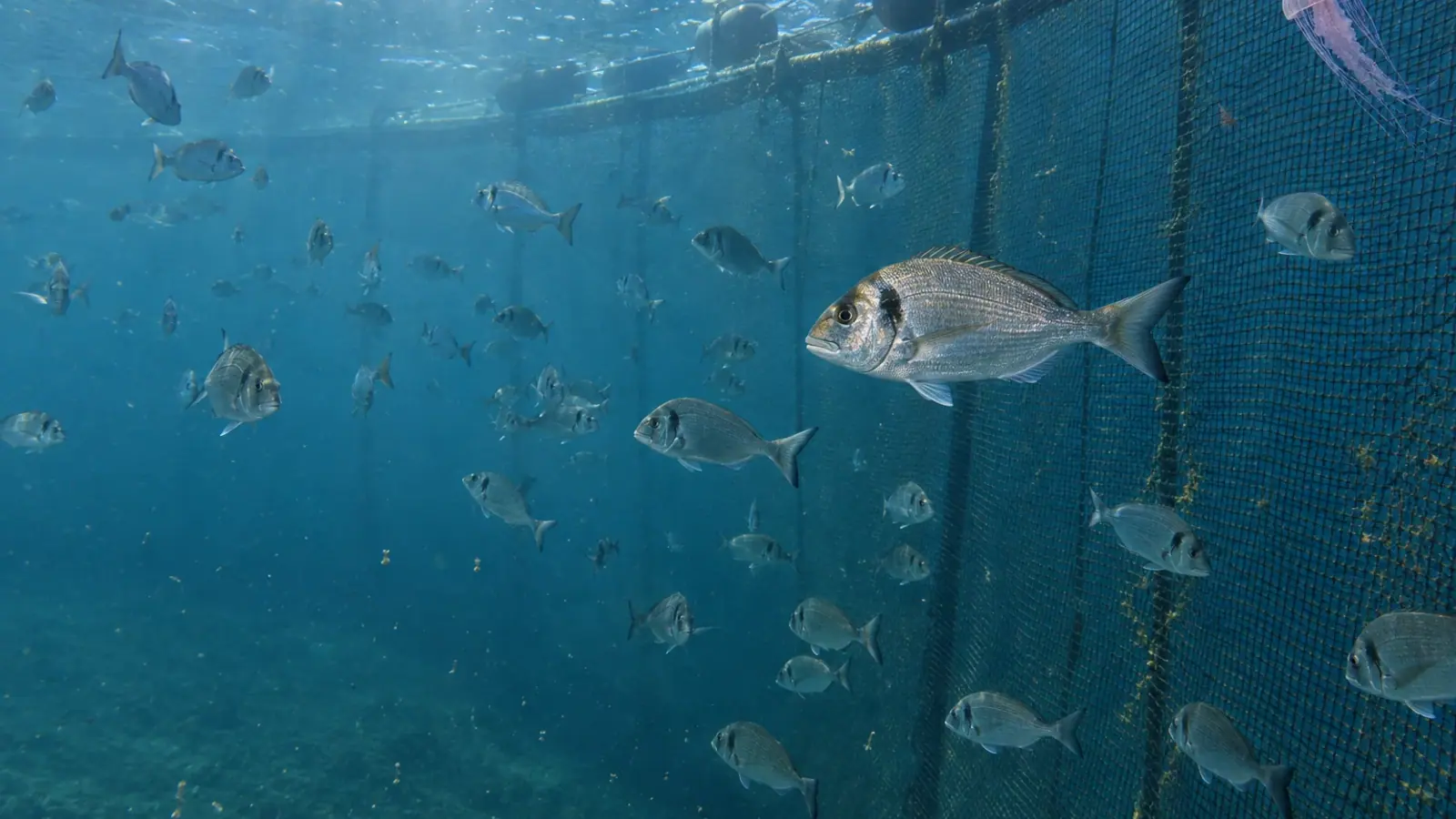
Jellyfish near net pens: follow the gill risk
An experiment in gilthead seabream links Pelagia noctiluca exposure to gill damage and delayed losses. Farm surveillance needs to connect exposure, fish observations and diagnostic findings.
- Content type
- Practical guide
- Sector
- Aquaculture
- Animal group
- Fish
A cage does not exclude every hazard carried by the water
Marine net pens depend on water exchange. That exchange can also bring gelatinous organisms and their fragments into contact with farmed fish. For a gilthead seabream farm, jellyfish near the net should prompt a structured observation of exposure and fish condition, even when no dramatic skin damage is visible. Finding jellyfish and explaining a mortality event are separate steps.
A 2016 experiment by Bosch-Belmar and colleagues examined Pelagia noctiluca exposure in gilthead seabream, Sparus aurata. It provides a useful Mediterranean example of the gill hazard. The following discussion is a practical reading of that experiment, rather than a report of a current outbreak at a French farm or an established treatment protocol.
What was tested
The investigators used 136 fish weighing approximately 200 g in eight 300-litre tanks. Jellyfish fragments were introduced to represent tissue passing through cage nets. Fish were exposed for eight hours at three levels equivalent to 10, 25 or 50 jellyfish per cubic metre, alongside a control group without jellyfish.
Gill alterations were detected three hours after contact began, and tissue changes were followed for up to four weeks. Six fish died in the highest exposure group during the second and third weeks. These observations demonstrate a hazard under the study conditions. They do not predict the proportion of fish that would die in a commercial pen, and they do not establish a safe concentration.
Using fragments rather than only intact animals is relevant to field observations. A count of complete bells at the surface may miss part of the material reaching fish. Equally, the presence of a jellyfish beside a pen does not establish that gill injury has occurred. Timing, fish observations and diagnostic examination are needed to connect the two.
Observe the stock and its water at the same time
Gills support gas exchange with the surrounding water. Injury may therefore affect respiration without producing conspicuous skin lesions. A farm observation should record ventilation, swimming, position within the pen and food intake. Changes should be compared with the usual pattern for that stock and, where informative, with neighbouring pens.
Dissolved oxygen and temperature measurements need a location, depth and time. A surface reading may not describe the water occupied by the fish. Recording those details makes a measurement useful when the incident is reviewed later. An isolated instrument photograph without sampling context is much harder to interpret.
Behavioural and environmental observations help define the problem; they do not diagnose jellyfish injury. Increased ventilation can have several explanations. The first inspection should describe the change consistently and identify what needs checking. Assigning a cause requires further evidence.
Make exposure records useful
An incident record can bring together the first observation of gelatinous plankton, affected pens, observations below the surface, apparent current conditions and work carried out around the nets. Contextual photographs may help identification. Poorly resolved images should remain labelled as uncertain observations instead of being assigned confidently to a species.
Absence observations also matter. A record that includes only positive sightings cannot distinguish a new event from a change in surveillance effort. The same observation points and comparable inspection methods make trends easier to understand. Staff should record where they could not observe, rather than treating an inaccessible depth as free of organisms.
Sampling plankton or working on nets requires a planned method. An operation that breaks up organisms or alters water exchange can modify exposure. Before a major intervention, specify its objective, possible consequences and how fish will be monitored during the work. Visibility of an accumulation alone does not show which intervention will be beneficial.
Worker protection belongs in that preparation. Safe access, equipment and procedures following contact with stinging organisms must suit the actual task. This article does not provide a jellyfish handling protocol or a universal list of protective equipment.
Ask the laboratory a defined question
Gill histopathology can describe the affected tissue and the distribution of alterations. Sample selection, timing, preservation and the accompanying history should be agreed with the veterinarian and laboratory. A report of gill lesions does not, by itself, establish what caused them.
An investigation may also need to examine infectious or environmental alternatives. Three questions should remain distinct: are the gills affected, what alterations are present, and what supports a connection with gelatinous plankton? The same specimen or test may not answer all three.
Keep findings linked to the pen and sampling date. Immediate mortality alone is insufficient for deciding that the incident has ended: the experimental fish showed consequences after exposure stopped. The follow-up schedule must nevertheless be chosen for the actual case, rather than copying the study’s four-week observation period as a mandatory farm protocol.
Limits when applying the evidence
The experiment used tanks, controlled exposure and one fish–jellyfish combination. Commercial pens have different currents, depths and exposure patterns. The tested levels are neither regulatory limits nor general safety thresholds. An apparently unaffected neighbouring pen also cannot exclude less visible injury in the exposed stock.
For farms outside the Mediterranean, the local jellyfish species and stock biology need separate consideration. The seabream result should not be silently transferred to salmon, other fish species or every life stage. It establishes a reason to investigate a specific hazard, not a universal diagnosis.
A decision that can be prepared in advance
Assign an alert contact, agree on repeatable observations and make sure sampling arrangements are available before an incident. After suspected exposure, combine the environmental record with fish examinations and follow-up findings. This offers a more defensible basis for action than jellyfish counts alone.
Vetofish can support that investigation through its diagnostic and analytical services for aquaculture. The work can include observation priorities, sample planning and joint interpretation of water measurements, clinical signs and laboratory findings. It does not presume the cause of an incident or guarantee recovery of the stock.


