

Sparicotyle in seabream: making gill surveillance useful
Sparicotyle chrysophrii can damage gilthead seabream gills and contribute to anaemia. Monitoring needs to connect parasite findings with tissue damage and changes across the stock. A single count provides neither a universal treatment trigger nor a complete diagnosis.
- Content type
- Disease profile
- Sector
- Aquaculture
- Animal group
- Fish
- Theme
- DiseasesDiagnostics
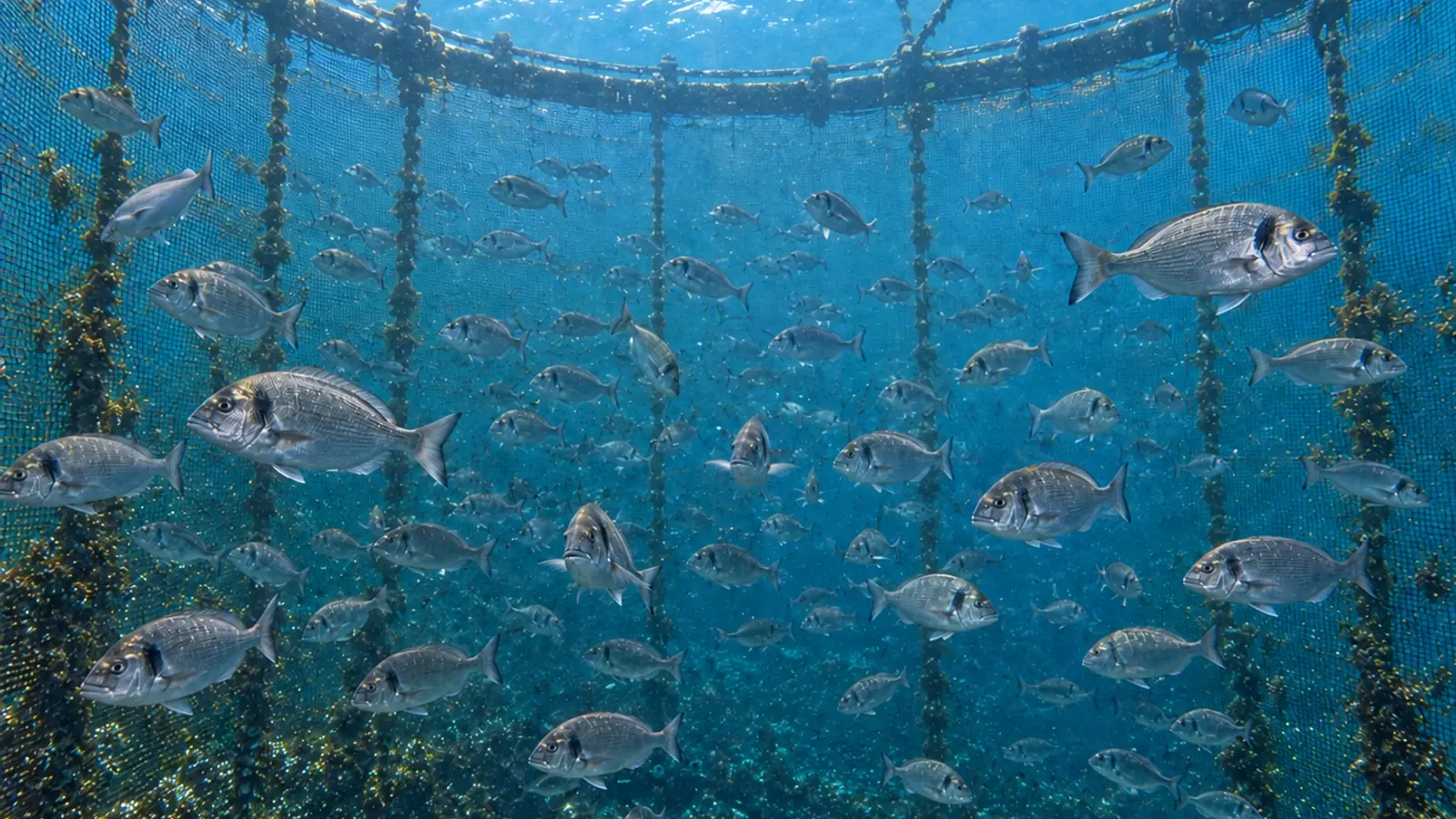
Gill surveillance in gilthead seabream, Sparus aurata, needs to distinguish the presence of a parasite from the damage it causes. Sparicotyle chrysophrii attaches to the gills and can contribute to anaemia and respiratory difficulty. Reduced feeding, unusual ventilation and poor performance are useful warnings, but they are not specific diagnoses. Water quality and other gill disorders can produce similar observations.
This account draws on the review by Mladineo and colleagues, published in the 2024 volume of Reviews in Aquaculture, and a laboratory study from 2021. It concerns marine cage farming and does not announce a new outbreak or provide a treatment schedule. The aim is to make routine observations comparable and to assemble a useful diagnostic record before the stock deteriorates substantially.
Understand the stages that surveillance covers
Sparicotyle is a monogenean with a direct life cycle. It does not require an intermediate host: eggs produce an infective larval stage, followed by development on the fish’s gills. Reinfection within a farming unit is therefore possible. Removing some adults should not be interpreted as interruption of the entire cycle.
Feeding on blood can contribute to anaemia, while attachment and parasite activity damage gill tissue. Respiratory impairment may reflect both processes. Pale gills or reduced activity justify investigation, but neither establishes parasite identity. An examination is needed to distinguish this agent from other causes of gill disease.
The review describes gaps in publicly available epidemiological evidence and substantial geographical differences. It also records infections in certain wild sparids. These observations warrant attention to contact between farmed and wild populations. They do not identify an individual wild fish near a cage as the source of a farm infection.
Define a repeatable counting method
A monitoring record should identify the cage, stock, fish size, date and examination method. Veterinary planning determines how many animals to examine and how to select them for the question being asked. Sampling visibly affected fish can help investigate disease, but it will not necessarily estimate infestation frequency across the entire stock.
Distribution across the gill arches is not uniform. Counts from a limited gill area should not be compared directly with counts from a more complete examination. Retaining the method, or recording exactly how it changes, gives a series of observations a defensible meaning. Otherwise, an apparent increase may partly reflect a different examination.
Separate observation, enumeration and confirmation in the record. A field sheet can connect each fish to the area inspected, parasites seen and tissue appearance. Clear photographs are useful when their origin is traceable to the animal. They support discussion with the laboratory but do not replace parasitological identification when morphology is uncertain.
Avoid combining results from fish collected for different reasons without preserving that distinction. A clinically selected sample and a routine surveillance sample may both be informative. They answer different questions, and their interpretation should remain separate in the report rather than becoming an unexplained average.
Put results on the farming timeline
Examinations should be placed alongside transfers, net changes, handling events and changes in feeding. Temperature affects parasite development, but one temperature reading cannot predict the parasite burden in a cage. Net condition, water movement and the stock’s previous history also matter when assessing a trend.
The review discusses net fouling as a factor that can retain eggs and support reinfection. Net management belongs in an integrated control plan with realistic operational constraints. It does not guarantee eradication. An intervention needs preparation, particularly when additional handling would affect fish already compromised by gill damage.
Dissolved oxygen measurements help interpret respiratory observations. A positive parasite finding is not a reason to overlook poor oxygenation. Equally, adequately oxygenated water does not exclude gill lesions or anaemia. Water measurements and animal examinations address different parts of the problem and should both remain in the investigation.
Use laboratory findings to qualify the conclusion
Parasitology and histopathology can be combined to identify parasites, describe tissue injury and investigate concurrent conditions. Fresh samples and fixed tissues have different preservation requirements. Agreeing these with the laboratory before a visit helps avoid a collection that cannot answer the intended question.
Increasing parasite counts together with reduced feeding do not prove that all growth loss is caused by Sparicotyle. Nutrition, other agents and technical events still require consideration. The report should state what is established: confirmed infestation, compatible tissue damage, or a contribution to production losses that remains uncertain.
Fish movements and shared equipment also belong in the biosecurity assessment. Mapping these connections identifies avoidable transfer opportunities between units. An open cage cannot be isolated from all environmental exposure, but operational contacts can still be managed and recorded. The purpose is a usable account of risk rather than an assurance of complete biological separation.
Laboratory activity is not a farm prescription
The 2021 study tested compounds against isolated parasites under laboratory conditions. Activity against an adult outside its host does not establish safety for seabream, effectiveness against eggs or prevention of reinfection in a commercial cage. Experimental concentrations must not become treatment doses.
An older publication also cannot establish a product’s current legal status in a particular country. Treatment decisions require a diagnosis, an assessment of practical delivery, animal and operator protection, and the applicable framework. A substance described as natural needs the same scrutiny. Follow-up should be planned before an intervention starts, using an examination that can be compared with the baseline.
Conclusion: count to support a decision
Surveillance becomes useful when parasite findings remain connected to tissue damage, fish condition and cage history. A consistent method, confirmation of the agent and veterinary interpretation of the stock’s trajectory take priority over a universal numerical trigger. A short-term improvement should not be reported as disappearance of the underlying risk.
Working with Vetofish
Vetofish can help organise samples, interpret laboratory findings alongside farm observations and define the follow-up record. Our analysis and diagnostic service supports teams working in aquaculture. Providing recent observations, handling dates and previous results allows the investigation to start with a specific diagnostic question, without promising immediate parasite control.


