

Macrophytes: a stable class can conceal community change
A Greek study compares ecological quality classes with changes in aquatic vegetation. Surveys from 137 repeatedly sampled sites show why a stable class or species count does not fully describe community composition.


- Content type
- Scientific news
- Sector
- Environment
- Animal group
- Fish
An ecological class is not the whole community
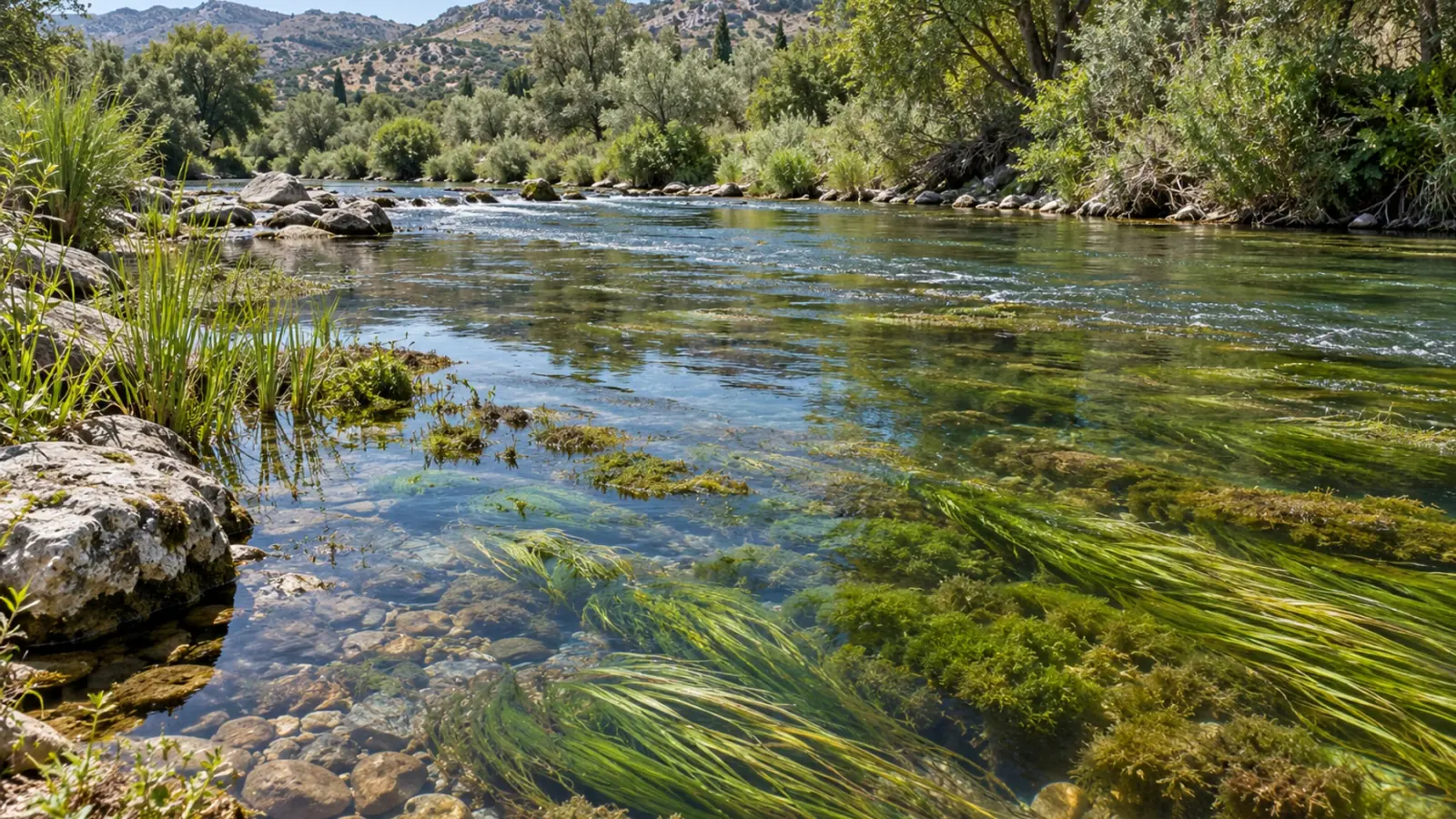
Aquatic macrophytes are plants visible to the naked eye. They contribute to the structure of freshwater environments and are used in ecological assessment. A survey reduced to a quality class can nevertheless leave a different question unanswered: are the same plants present when the site is visited again?
Stefanidis and colleagues address this distinction in a study of Greek rivers and streams published in February 2026. They compare macrophyte-based ecological assessment, taxon richness and community composition. These measures describe related but different features, so they do not necessarily change together or support the same interpretation.
For managers, that difference has practical consequences. An unchanged class does not establish that the environment is unchanged. Equally, a shift in vegetation does not by itself prove overall ecological deterioration. Interpretation needs to identify the component that changed, how it was measured and which conclusions the sampling design can support.
Five campaigns with an uneven revisit history
The monitoring programme includes 261 sites surveyed during five campaigns: 2014, 2015, 2021, 2022 and 2023. Temporal community analyses use a subset of 137 sites visited at least twice, considering 109 taxa. This is not a continuous annual record of every site over a decade. The gaps and varying revisit histories are part of the evidence.
Sampling structure limits interpretation. Not every site appears in every campaign, and the time between visits varies. A comparison between years can therefore reflect both ecological differences and which sites were included. The findings should remain linked to the surveyed network rather than being treated as a census of all Greek rivers and streams.
The study uses survey records in two distinct ways. Ecological index calculations draw on abundance recorded on an ordinal scale. Diversity analyses use taxon presence and absence. The latter do not directly measure vegetation biomass, and a recorded presence alone does not describe the area occupied by that plant.
Separate richness from composition
Biodiversity includes more than the number of taxa in a survey. Two visits can produce the same total while recording different plants. Beta diversity describes differences in community composition and can reveal information that a richness total misses. It is therefore useful to retain the taxon lists alongside summary indicators.
In this study, differences in mean richness between years were not statistically conclusive. Ecological class distributions also did not differ significantly between campaigns. These findings describe the comparisons and their ability to detect differences; they do not demonstrate that no ecological change occurred anywhere in the network.
Community analyses found greater differences when surveys were farther apart in time. Some results also indicated stronger spatial differentiation in 2023. The measures provide complementary information. It would be misleading to turn the paper into a single judgement that the whole network was either stable or deteriorating.
Keep the index within its assessment framework
The authors use IBMRGR, a Greek adaptation of the river macrophyte index originally developed in France. The index’s French origin does not make classification rules interchangeable between countries. A reported class belongs to the authors’ assessment framework, with its reference conditions and ecological context.
For local monitoring, retaining the method and taxon list makes the outcome reviewable. A final class can help communication, but should not replace the observations used to calculate it. Nor does it replace a direct dissolved oxygen measurement when the water quality question requires one. Changes in survey procedure, identification difficulties and conditions during a visit should remain available when subsequent results are compared.
Season, water temperature and hydrological conditions also provide context. Their relevance does not mean that the study establishes one cause for each community shift. Explanations involving climate or local pressures remain hypotheses requiring appropriate evidence. A plausible mechanism should not be promoted to a demonstrated cause merely because an observed change is consistent with it.
Vegetation evidence is not a fish survey
Habitat encompasses the conditions and structures used by organisms. Aquatic vegetation contributes to that structure, making plant monitoring relevant to questions about environments occupied by fish. The Greek study, however, measures plant communities. It does not assess fish populations, reproductive success or fish health.
A macrophyte change therefore cannot be reported as a demonstrated decline in fish abundance. Answering that question would require appropriate fish observations and environmental evidence. Combining complementary monitoring approaches can support conservation decisions, provided the analysis retains what each programme actually measures and where the connections remain uncertain.
The authors also discuss the potential contribution of approaches such as environmental DNA. That is a perspective for further work, not the method that produced the reported community results. Future comparisons would need to clarify what each approach detects and how it relates to field surveys. Different detection methods should not be assumed to yield equivalent records.
Preserve community information in the management record
A useful monitoring report can retain ecological class, richness, composition and visit conditions together. Where the class remains unchanged but taxa differ, examine the underlying lists and the comparability of the surveys. This is a reason to investigate, not sufficient evidence to name a cause or claim that a management intervention succeeded or failed.
The uneven revisit history also calls for care in describing trends. Results from five campaigns should not become an uninterrupted annual trajectory. Keeping the gaps visible allows future work to address them and gives decision-makers a more honest account of what the programme can establish.
Vetofish can help connect environmental monitoring with specific fish-related questions. The aim is to clarify the contribution of each indicator, identify missing evidence and support an interpretation proportionate to the observations before further investigations or conservation actions are chosen. Retaining the communities behind the class makes that discussion more informative.
To move from evidence to action, explore our advice and support service and our expertise in aquatic environmental health.


