

Metals in marine aquariums: assess water and diet
A water test captures only part of a marine fish’s exposure to metals. Dietary inputs, the tissue tested and the chemical form of the contaminant also matter when investigating a public aquarium.


- Content type
- Practical guide
- Sector
- Public aquariums
- Animal group
- Fish
Start with the exposure question
A metals investigation in a public marine aquarium should begin by identifying the suspected route of exposure and the evidence needed to examine it. Seawater intake is one possible input. Diet and contact with materials in the system also deserve consideration where they provide a plausible route. Testing only the water can leave an important part of the investigation unresolved.
Andra Oros’s 2025 review in the Journal of Xenobiotics brings together evidence on metal accumulation and trophic transfer in marine fish. It explains uptake routes, tissue distribution and dietary transfer. These principles help frame an aquarium investigation. The review does not measure exposure in a zoological collection. It does not establish safe concentrations for individual aquarium systems.
Keep exposure, accumulation and harm separate
Bioaccumulation describes a substance accumulating in an organism through its various exposure routes. A concentration measured in a tissue records the burden in that tissue at the time of sampling. On its own, it cannot establish when exposure occurred, identify the source or prove that the substance caused disease.
Metals also differ biologically and chemically. Some elements support essential functions yet can become harmful under particular exposure conditions. Others have no established nutritional role in fish. Treating all analytical findings as a single category of “heavy metals” obscures differences that matter to interpretation.
Dietary transfer does not necessarily mean that concentrations increase at every step of a food chain. Biomagnification depends on the substance and its properties. An investigation should therefore identify the element, the fraction being measured and the units used before comparing samples or species. A broad screening result is a starting point for questions rather than an explanation of the clinical picture.
Water and food represent different pathways
The gills form a major interface between fish and their surroundings. Contaminants can also enter through the digestive tract when food or prey carries them. The balance between these routes depends on the metal, its chemical form, the species and environmental conditions.
A single water sample may miss an intermittent input. Conversely, finding an element in the water does not show that this route accounts for the entire burden in the animals. Intake records, food batch changes and relevant technical events can help establish which possibilities to investigate. A temporal association helps direct further work; it does not independently establish causation.
The review concerns marine fish and natural food webs. Aquarium diets and hydraulic arrangements differ from those environments. A species’ feeding position in the wild should not be treated as a complete description of its exposure in a collection. The useful adaptation is to investigate inputs that actually exist in the system, including the feeds that the animals receive.
Make the analytical result answer a defined question
Bioavailability concerns the accessibility of a substance to an organism. Chemical form and interactions with the surrounding matrix influence that accessibility. A total concentration and a result for a dissolved fraction answer different questions. The laboratory needs to know the matrix and purpose of the investigation before sampling arrangements are finalised.
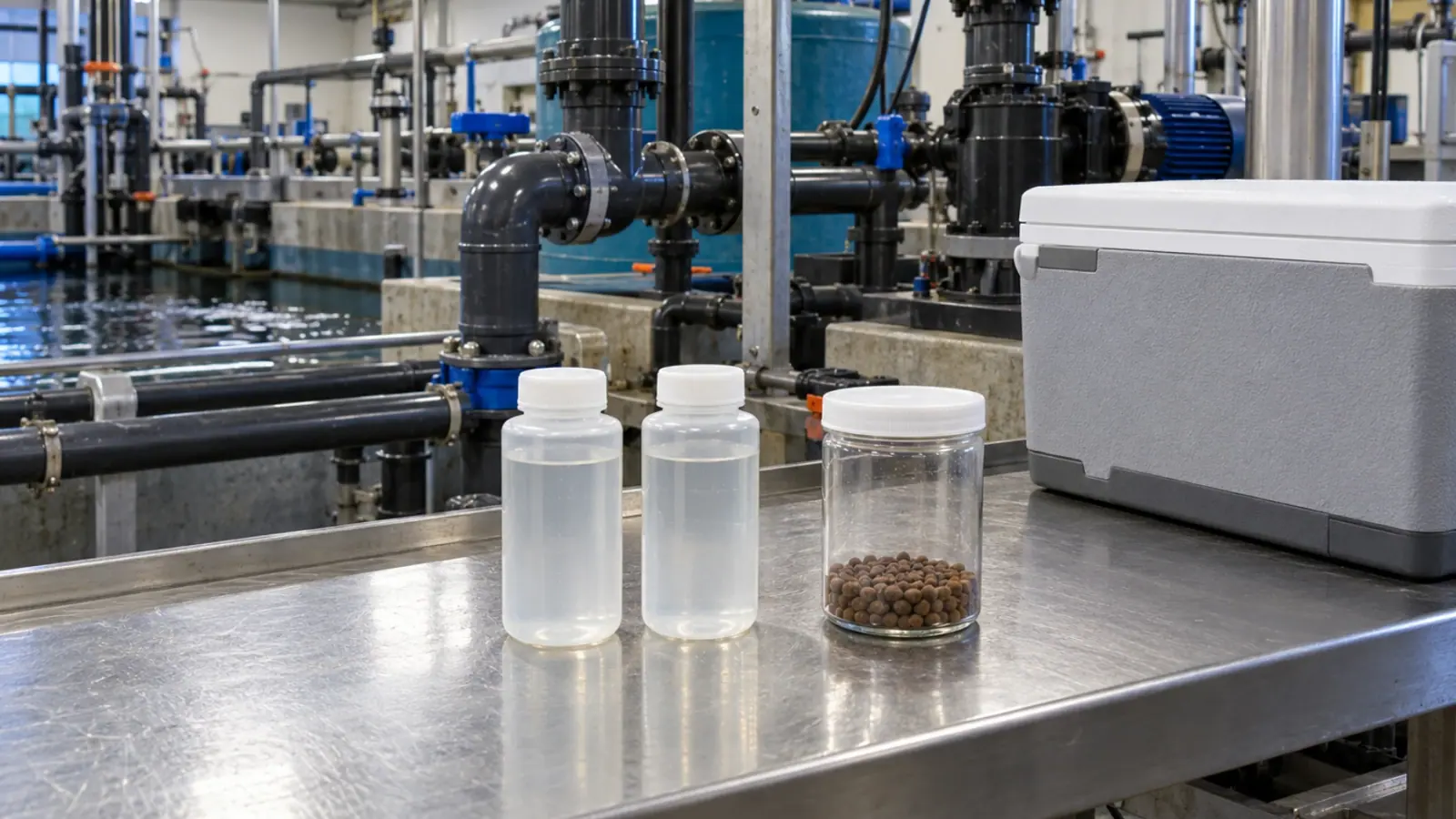
Seawater salinity and matrix composition must be addressed by a suitable analytical method. Containers, preparation, storage and transport should be agreed with the laboratory. A bottle that happens to be available beside a tank may be unsuitable for trace analysis. Poor sampling arrangements can make an otherwise precise measurement difficult to interpret.
Reports should retain quantification limits, units and analytical qualifications. A result below the quantification limit does not establish absolute absence. When comparing successive campaigns, keep changes in methods or measured fractions visible. An apparent trend may otherwise reflect a change in the analytical approach.
Select tissues for the clinical purpose
Metal distribution differs among gills, liver, kidney and muscle, depending on the element and the organism. Muscle is often studied in food safety work, but it is not automatically the most informative matrix for an animal health investigation. Meeting a food consumption standard is not evidence that the fish is clinically healthy.
Sampling decisions also need a welfare justification. A living fish should not undergo an invasive procedure merely to fill an additional row in a monitoring table. The veterinarian and laboratory can discuss the expected information, possible alternatives and the value of samples obtained during an investigation that is already clinically indicated.
Species, life stage, body condition, diet and husbandry history belong beside a tissue result. Comparisons are most useful when matrices and reporting conventions are compatible. Concentrations reported on a wet-weight basis cannot be compared directly with dry-weight values without the information needed for conversion.
Connect chemistry with observations of the animals
Ecotoxicological interpretation connects exposure with biological effects under defined conditions. Reduced appetite or altered behaviour in an aquarium remains non-specific. Infection, oxygen problems and other environmental changes can produce similar observations. Detecting a metal does not remove the need to assess these alternatives.
An investigation becomes stronger when a plausible source, compatible chronology, interpretable measurements and biological observations point in the same direction. An isolated finding is insufficient grounds for choosing a treatment or changing the entire system abruptly. The response should reflect the animals concerned and the strength of the evidence.
The review also identifies gaps in knowledge about species and regional differences. Results from another marine setting can inform the questions asked in a collection without supplying a ready-made diagnostic threshold. Keeping this limit explicit is especially useful where several species share water but differ in diet and exposure history.
Conclusion and Vetofish support
For a marine collection, the most useful first step is a clear question rather than a longer list of tests. Water, feed and tissue measurements provide complementary evidence. None independently summarises exposure and its consequences.
Vetofish can help teams structure an investigation, select informative matrices and assess results alongside the fish examination. Our analysis and diagnostic service supports this work within our expertise for public aquariums, in coordination with the laboratories involved. Sampling and interpretation can then be matched to a defined clinical or surveillance purpose.


