

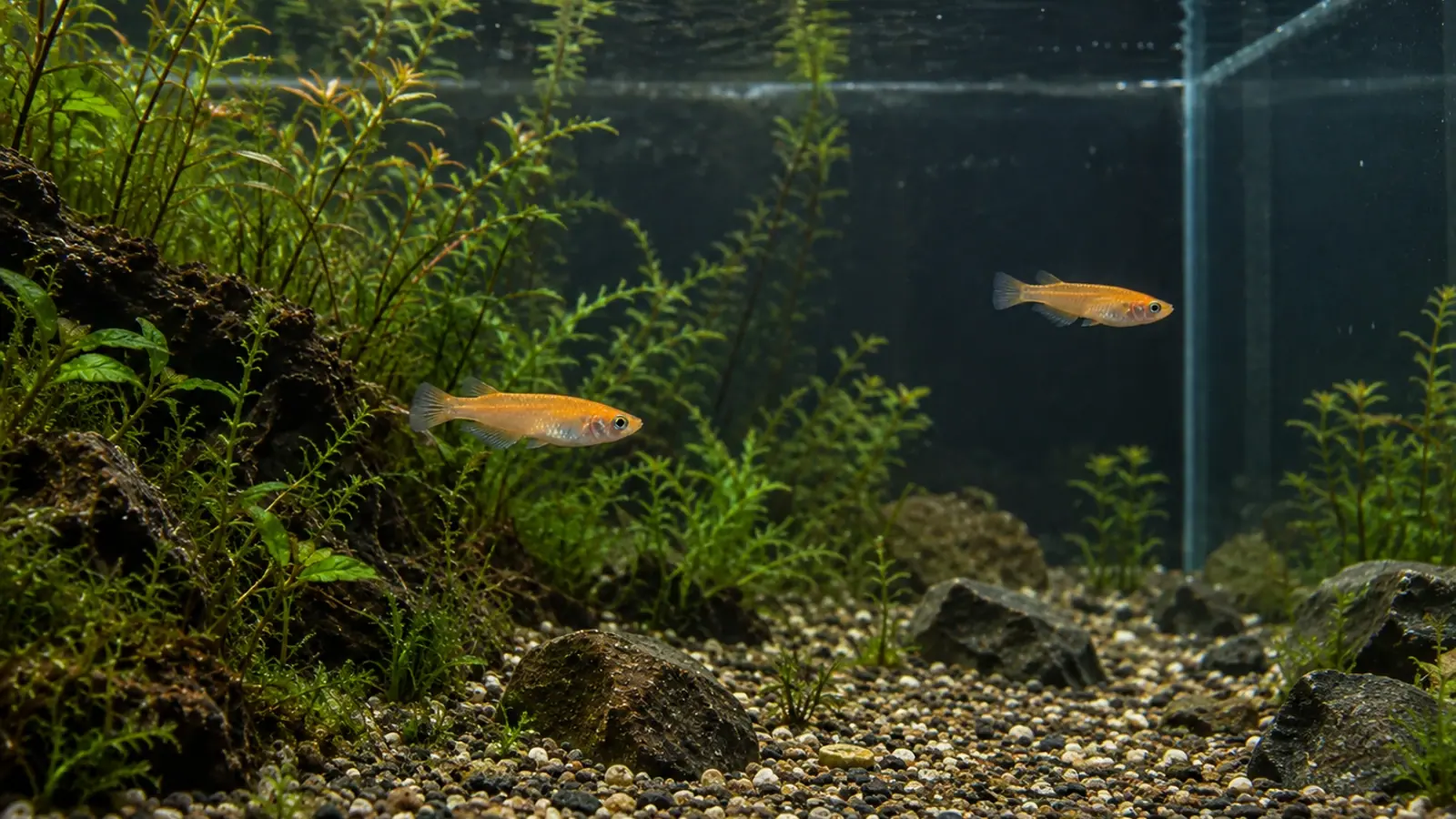
Medaka courtship starts before lights-on
In laboratory medaka, courtship increased before lights-on while most observed spawning events followed it. A 2025 video study of 35 pairs explains why observations confined to the start of the light period can miss part of the reproductive sequence.
- Content type
- Scientific news
- Sector
- Research facilities
- Animal group
- Fish
A medaka study that begins observing only after lights-on may miss the start of courtship. Kondo and colleagues filmed Oryzias latipes pairs over 24 hours to distinguish different stages of the reproductive sequence. Published in 2025, their work concerns a commercial Himedaka strain under defined laboratory conditions. The observation window determines which part of the behaviour enters the measurement.
A specified laboratory day
Before the experiments, the fish were maintained for a month at 26 ± 1°C with 14 hours of light and 10 hours of darkness. Lights came on at 08:00 and went off at 22:00. The researchers studied 35 male–female pairs in February 2025. Continuous video covered each 24-hour period, with an infrared recording mode during darkness.
This schedule is not a natural reference timetable for every medaka colony. Photoperiod describes the imposed light–dark alternation, while clock time locates observations within the facility’s day. Both are needed to compare a report of “morning spawning” between laboratories. Temperature, animal origin and the observation setup also accompany the result. Sharing a species name does not establish that two colonies organise their reproductive activity in exactly the same way.
Courtship and spawning had different time profiles
The 35 recorded spawning events occurred between 07:23 and 13:47. Of these, 25 took place between 08:00 and 11:00, and 31 occurred after lights-on. Most observed spawning therefore belonged to the light period, with a peak shortly after its start. A smaller number of events preceded the lighting transition.
Courtship extended further into the preceding dark period. The time males spent following females and the frequency of rapid circling increased before lights-on. Both profiles peaked between 07:00 and 09:00 and then declined. Starting observations at 08:00 could consequently record spawning without capturing all of the preceding activity. These endpoints need separate names: finding eggs, identifying spawning initiation and measuring courtship intensity are not interchangeable observations. Their timing cannot safely be reduced to one general “breeding time”.
Continuous recording and continuous annotation are different
To quantify courtship, the authors extracted a ten-minute clip from each hour, covering minutes 20–30. That produced 24 clips per pair and 840 observations from 35 males. The 840 observations were not 840 independent fish. Statistical models accounted for male identity when analysing the repeated measurements.
Temporal sampling must therefore be distinguished from recording duration. Retained video makes it possible to revisit events, but analysis based on hourly windows describes the behaviour coded within those windows. Determining spawning time and quantifying courtship were presented as separate analyses. When a protocol says only “24-hour video monitoring”, asking which portion was actually analysed helps establish the coverage of the endpoint. A long recording does not automatically provide equally detailed annotation for every behavioural event occurring throughout it.
Comparisons across environments do not isolate one cause
The authors compared their laboratory findings with their previous field and semi-natural observations. They described a delay of roughly three to four hours in the laboratory. This comparison broadens the biological question, but it was not a randomised experiment changing only one lighting variable while holding all other environmental features constant.
Abrupt lights-on, gradual natural dawn and temperature fluctuations were among the explanations discussed. The findings do not assign the whole timing difference to any one of these factors. Circadian organisation offers a framework for understanding daily activity, but this experiment alone does not separate internal clock effects from immediate environmental influences. The reported delay is consequently not a time correction to apply automatically in other facilities. The timing difference should remain attached to the environments and observations being compared.
Match the observation window to the endpoint
A courtship study needs defined behavioural categories before comparing groups. Following, rapid circling and initiating spawning are different criteria. Reporting their definitions, window lengths and positions relative to lights-on makes a result easier to interpret. Actual temperature and lighting events deserve a record rather than being copied only from a nominal controller programme.
The work used one commercial strain and did not establish each individual’s day-to-day repeatability. Pair observations also differ from activity in a group maintenance tank. Those limitations accompany any proposed transfer to another study. Experimental tank dimensions, feeding restrictions and handling procedures are not presented here as husbandry recommendations. Changing an observation schedule does not in itself justify changing the light regime or maintenance conditions of an entire colony. The first task is to establish what the existing sampling window can and cannot describe.
Conclusion: locate the behaviour before comparing it
The useful finding is the separation between courtship that increased before lights-on and spawning observed mainly afterwards. It supports explicit reporting of the event sought, the time window chosen and the statistical unit. Keeping that information in the experimental record helps distinguish a biological difference from a difference in observation schedules or annotation. The number of clips cannot substitute for the number of animals.
Vetofish training can help research teams define behavioural criteria and examine video observation records. Our support for research facilities places this preparation within the animal facility’s operation and the project’s aims, without promising that a change in observation time will explain a particular experimental result.


