

Microplastics: fish molecular responses differ by sex
Following prolonged polyethylene exposure, fathead minnows showed changes in liver gene expression. The study separates female and male responses, while providing neither a river safety threshold nor a direct estimate of risk to wild fish.


- Content type
- Scientific news
- Sector
- Environment
- Animal group
- Fish
- Keywords
- MicroplasticsEcotoxicologyStress
Biological response is a separate question from presence
Finding plastic in an aquatic environment does not establish how an exposed fish responds. Ecotoxicology examines, among other questions, whether contaminants alter biological function. Connecting exposure with a response requires clear descriptions of the particles, the exposure conditions and the biological measurement. Particle counts alone cannot predict a health consequence.
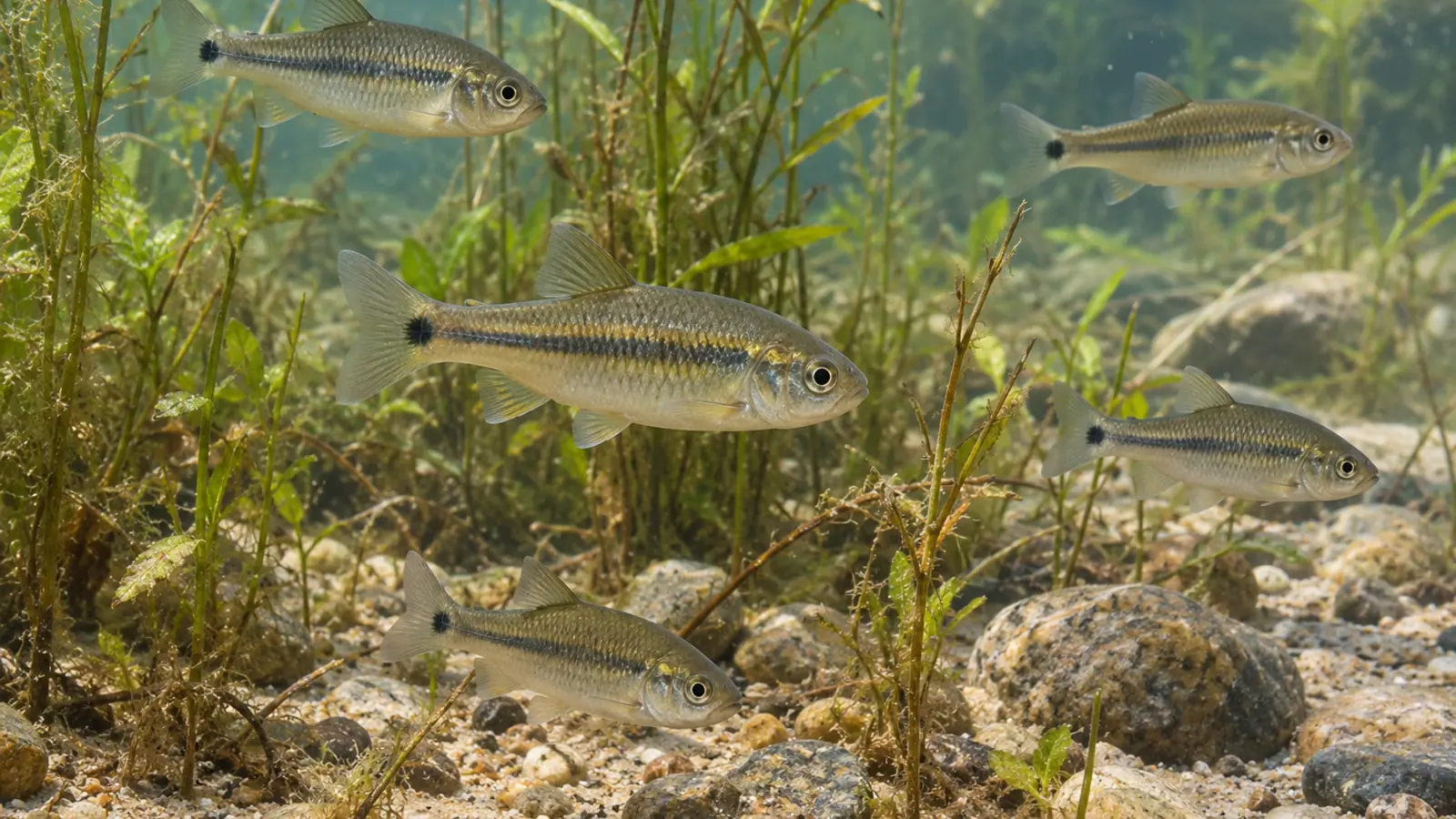
Wade and colleagues’ 2026 paper in Environmental Toxicology and Chemistry examines liver gene expression in fathead minnows, Pimephales promelas. This small North American fish is widely used in ecotoxicology. The work investigates responses by sex, polyethylene concentration and plastic origin. It does not diagnose contamination in a French river or measure effects in a wild European fish community.
Four polyethylene treatments and an untreated control
The experiment used preconsumer polyethylene and polyethylene collected from Lake Ontario, each at two concentrations, alongside a control without added plastic. Prepared particles measured 100–500 micrometres. Fish were maintained from the egg stage until 178 days after hatching, with five aquaria per condition.
Nominal concentrations were 100 and 2,000 particles per litre. The authors describe the lower level as environmentally relevant and the higher level as a future scenario. Those descriptions refer to the study’s exposure framework. They are not measurements from France or universal descriptions of inland waters, particle sizes and exposure patterns.
Livers were initially sampled from 75 fish. After data-quality filtering, molecular analyses included 58 individuals: 21 males and 37 females. Distinguishing the number sampled from the number retained matters when assessing sex comparisons. Aquaria also remain a relevant replication level; several fish collected from one aquarium are not several independent exposure systems.
What altered gene expression can tell us
Cells vary the expression of genes according to their state. Transcription produces RNA molecules from genetic information, and their measurement provides evidence of activity at that level. A change in gene expression is not a mutation in the genome. It is also insufficient, on its own, to establish disease or lasting organ impairment.
The researchers analysed networks of genes whose expression varied together. Several networks were associated with exposure and cellular functions, including metabolism and protein handling. Responses differed by sex and treatment conditions. However, associations and expression differences were not consistently present across every network examined, so the findings should not be reduced to a uniform response to all polyethylene treatments.
Network analysis can help generate biological hypotheses. It does not make each associated gene a specific marker of microplastic exposure. Some implicated functions contribute to stress responses shared by several types of disturbance. Before such measurements could support environmental alerts, their specificity, reproducibility and relationship to relevant biological consequences would need to be established.
Sex and material history affect interpretation
The female-only analysis produced more significant associations. This supports considering sex in the design, rather than combining all fish without examining it. Different retained sample sizes for males and females also matter. The result cannot rank females as universally more susceptible to every type of plastic under every environmental condition.
The environmentally sourced material was washed and processed before exposure. It was therefore not identical to every weathered particle circulating in a lake. The researchers did not chemically analyse substances associated with the plastics used in the experiment. Responses cannot consequently be assigned to a particular additive, an adsorbed contaminant or the physical effects of the particles themselves.
Neither concentration nor origin produced a uniform progression across all measurements. Two concentrations cannot define a complete dose-response relationship. A molecular measurement in one organ after several months also cannot directly predict the survival, reproduction or long-term trajectory of a wild population. Those outcomes require evidence at the relevant level of biological organisation.
Design monitoring around a specific decision
Environmental managers first need to define whether they want to characterise exposure, compare locations or investigate a biological response. These aims may complement one another, but call for different methods and resources. A programme based on a single measurement type should not promise health conclusions that the method cannot deliver.
Sampling records should identify species, life stage, sex where relevant, season and the compartment examined. Particle characteristics and analytical quality controls must remain available alongside results. Otherwise, identical counts may conceal different size fractions or polymers. Biological observations also need to be considered against other environmental pressures, without automatically attributing every change to plastic.
For communication, distinguish an exposure measurement from a biological association and from a demonstrated adverse outcome. A report can acknowledge a response worth investigating while explaining that its population significance remains unresolved. This preserves the useful finding without implying that uncertainty makes the exposure harmless or that a molecular change establishes a local ecological emergency.
The OECD’s 2021 report provides a complementary prevention perspective, particularly for emissions from textiles and tyres. It considers action at different stages, from product design to wastewater and runoff management. This is a policy analysis, rather than a toxicological safety threshold or a new French legal obligation arising from the 2026 fish experiment.
Keep the findings connected to their conditions
Molecular responses strengthen the case for investigating biological effects of microplastics. To interpret them, retain the connection between material, exposure, organism and measurement. In natural waters they can inform further investigation, alongside environmental characterisation and assessment of other pressures, rather than replacing those parts of the evidence.
Our advice and support service can help define a monitoring question, suitable analyses and the limitations that need to be communicated. Through our work on aquatic environmental health, we help connect findings with management decisions while keeping conclusions within the evidence available.


