

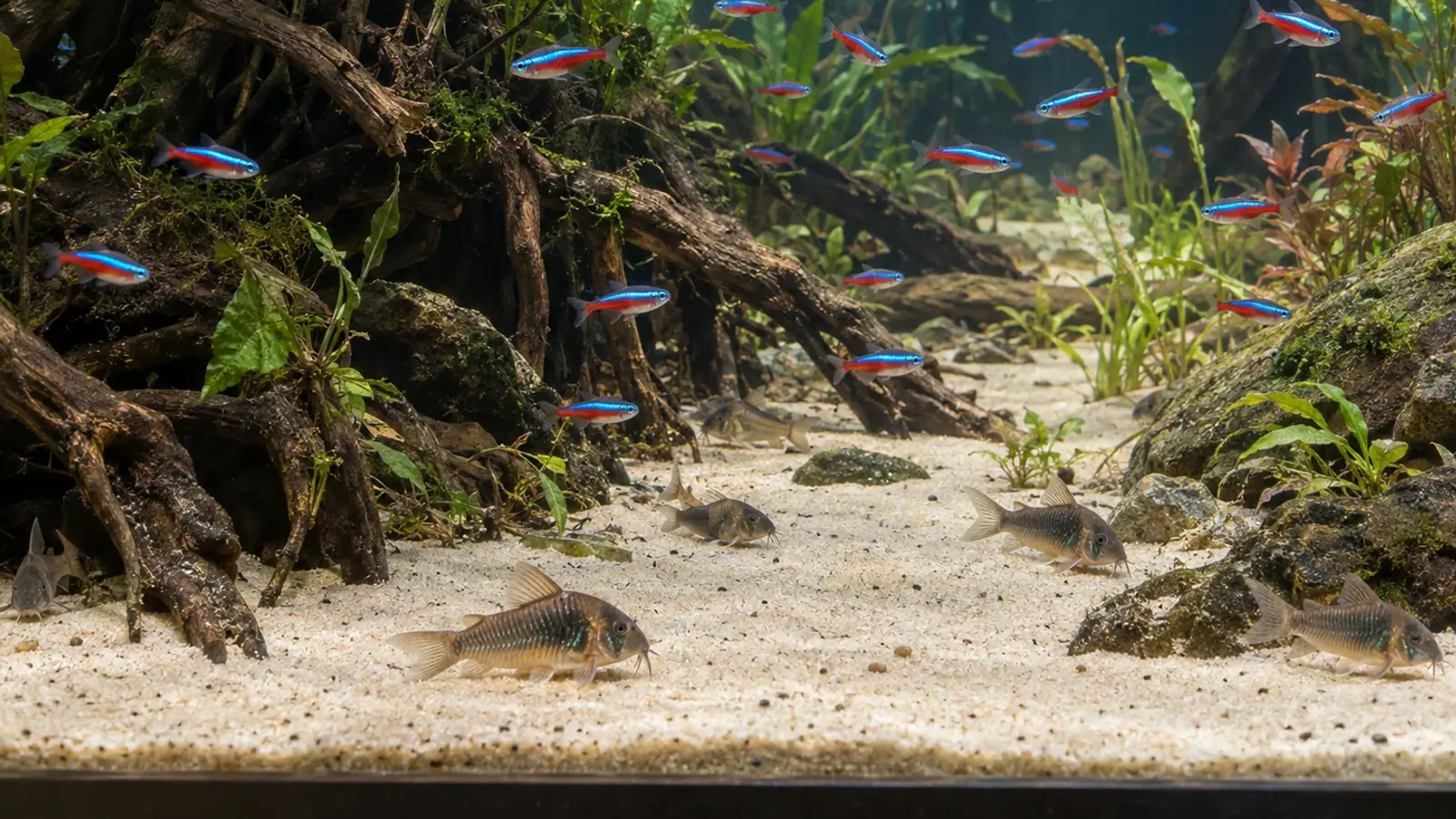
Mixed-species exhibits: decide before fish arrive
A shared exhibit must provide suitable conditions, food access and ways to avoid harmful encounters. A compatibility decision needs evidence, observation criteria and a workable separation plan.


- Content type
- Practical guide
- Sector
- Public aquariums
- Animal group
- Fish
Make the decision before the fish arrive
A mixed-species exhibit is a shared environment. Introducing fish changes access to shelter, feeding opportunities and encounters with existing residents. A visually attractive collection is not evidence of lasting compatibility. The proposal should explain what each species will be able to do in the exhibit, and how the team will respond if the association becomes unsuitable.
Stephen A. Smith’s 2023 review provides a general framework combining the environment, behaviour, physical condition and performance of fish. It does not supply a universal compatibility chart. This guide applies that framework to one management decision: whether an introduction to a public aquarium should proceed, be delayed or be declined.
Establish a record for each species
Confirm species identity and life stage first. A juvenile’s current size and behaviour do not fully describe the adult animal. Separate the size observed today from the size expected later. Missing information should be recorded as a gap rather than replaced with an assumption that makes the proposal easier to approve.
Bring together the information needed on habitat, feeding, activity patterns and social behaviour. Identify the sources and their limitations. Experience at another aquarium can be useful, but differences in group size, exhibit structure and husbandry routines should accompany the report.
Compare these records against the conditions the proposed exhibit can actually provide. Incompatible temperature, salinity or habitat needs cannot be resolved simply by promising more observation. Address those differences before delivery, while another housing option remains available.
Map the encounters the exhibit creates
Predation and aggression cannot be reduced to labels such as peaceful or territorial. Relative body size, shelter access and narrow passages influence how fish meet and whether they can avoid one another. An exhibit plan can show places where an individual may be pursued without a usable escape route.
Smith discusses refuges and opportunities to avoid dominant residents in mixed collections. The review also notes that too few shelters can increase competition. Adding structure is therefore not automatically beneficial enrichment. Its value depends on how the animals use it and whether it creates new constraints.
A behaviour record should use observable descriptions: pursuit, biting, withdrawal, persistent occupation of a location, interrupted feeding or avoidance. Frequency and context make the record useful. A single pursuit does not describe the same situation as sustained exclusion from a necessary part of the habitat.
Where normal behaviour is poorly documented, state that limitation. Familiarity with a related species can help formulate a question, but it should not be presented as a validated baseline for the proposed residents. The record must distinguish the team’s observations from the assumptions used to plan them.
Check that each species can obtain suitable food
Detailed nutritional monitoring is a separate task. Before mixing species, the immediate question is whether each can receive and consume an appropriate diet. Plan delivery points and observation positions so that less conspicuous residents can be assessed during the first feeds.
Smith describes how rejected food can break down in the exhibit or be eaten by other fish. Food delivered to the water is therefore not evidence that every intended recipient has eaten. The introduction plan should identify which individuals or groups require direct attention during feeding observations.
A fish that does not yet accept the intended food may need separate dietary acclimation. Mixing it into an established collection should not conceal that difficulty. Agree on reassessment criteria before introduction, rather than waiting for obvious weight loss to reveal inadequate access.
This assessment is about feasibility, not a promise that one feeding method will work indefinitely. Growth, reproduction and changes in the collection can alter encounters at feeding points. Keep the original reasoning available so that later changes can be compared with it.
Keep health status separate from behavioural compatibility
The proposal also needs quarantine and biosecurity arrangements. Fish sharing an exhibit share water and opportunities for contact. Behavioural compatibility does not establish an acceptable health risk for the existing collection.
Record the available history, planned observations and examinations, water connections and shared equipment. A test result belongs to a specific stock, method and date. No visible disease signs are not a substitute for this information, and a negative result should not be treated as a general guarantee.
Smith also points out that quarantine conditions need to address welfare. Housing that permits observation and cleaning should still consider the needs of the fish. Discuss animal requirements and health precautions together, rather than assuming that a bare holding tank is always adequate.
Provide a practical way to reverse the introduction
Before the move, assign observers, observation times and a method for recording changes. Include periods relevant to the residents, rather than only public opening hours. Cameras may extend coverage, provided their blind spots and observation limits are understood.
An appropriate alternative enclosure and a feasible separation method are essential. A written plan requiring capture of an inaccessible fish deep inside a complex display is not operationally complete. Staff capacity, equipment and access must be considered while the introduction is still being planned.
Keep observations, interpretation and action distinct. A record that a fish did not feed at the observed location is more useful than a general statement that it failed to settle. The next observer can then check other feeding locations or investigate exclusion.
Limits and the decision to retain
The review provides a general assessment framework. It does not compare every possible species combination experimentally. Knowledge is uneven across aquarium fishes. A decision record cannot guarantee that conflict will never occur; it makes uncertainty and reassessment criteria visible.
Check shared environmental requirements, anticipated encounters, food access and health information before introduction. Afterwards, observations must be capable of triggering a real adjustment or separation. Compatibility remains a condition to review as the animals and exhibit change.
Vetofish supports public aquariums through its animal welfare services. Assistance can include reviewing a proposed association, selecting useful observations and preparing reassessment criteria that fit the species and the team’s practical resources.


