

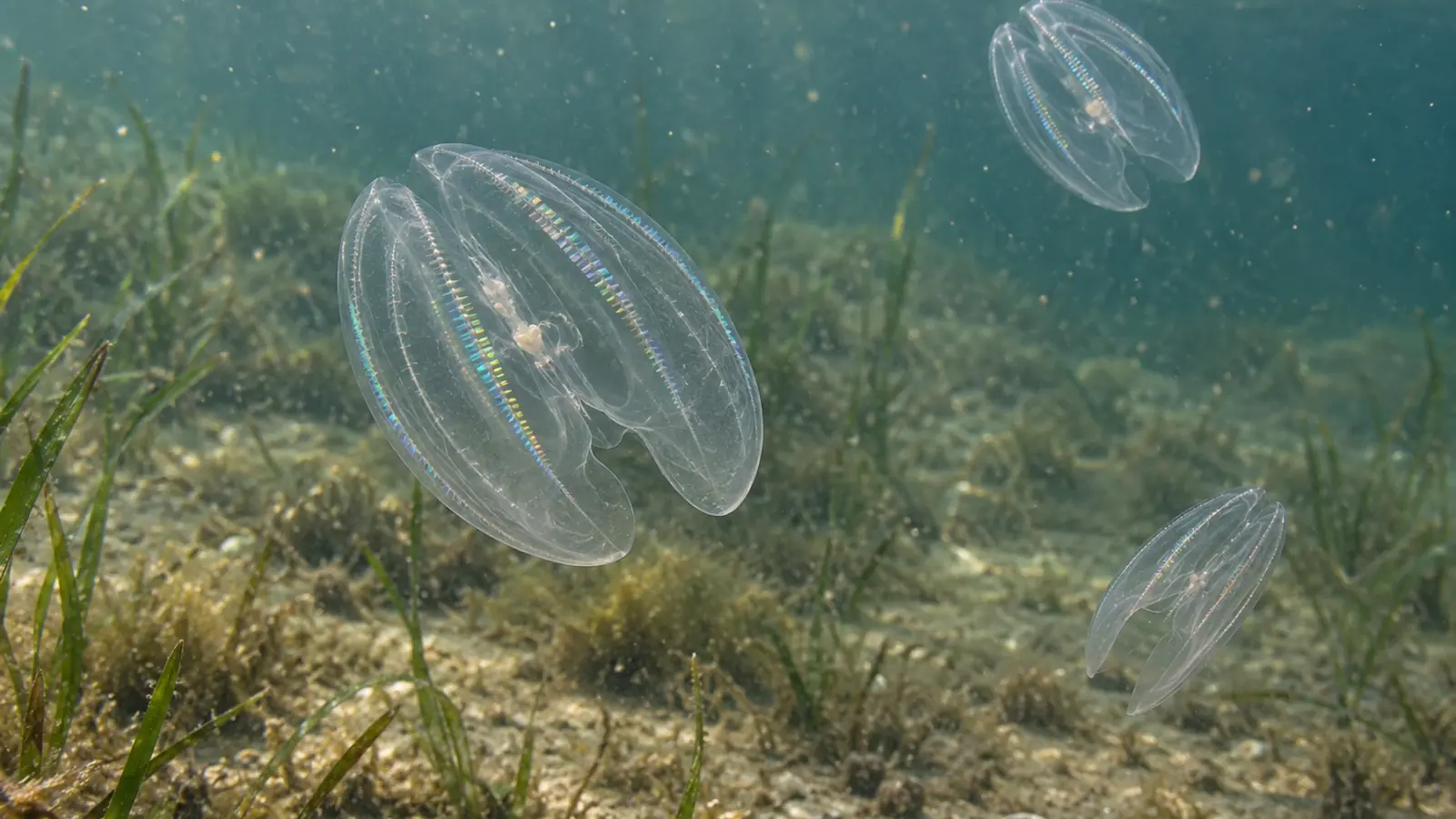
Mnemiopsis in lagoons: making observations comparable
Mnemiopsis leidyi may go unnoticed even where it occurs. A July 2020 survey of French Gulf of Lion lagoons illustrates the value of combining sightings with documented sampling, and why a non-detection is not proof of absence.


- Content type
- Practical guide
- Sector
- Environment
- Animal group
- Corals and invertebrates
- Keywords
- SalinityTemperatureReproduction
A fisher’s report of a gelatinous animal can provide valuable information about a lagoon. Its value depends on preserving the date, location, identification evidence and observation conditions. With Mnemiopsis leidyi, comparing occasional sightings directly with a standardised sampling campaign can lead to misleading conclusions about distribution or abundance.
The animal is a ctenophore, or comb jelly, rather than a true jellyfish. Its transparent body bears rows of ciliary combs and two large oral lobes. Distinguishing gelatinous organisms is the first monitoring task. A silhouette seen from the shore or in an unclear photograph may leave the identity uncertain.
A survey of French Mediterranean lagoons
Marchessaux and Belloni investigated Gulf of Lion lagoons in July 2020 and published their study in 2021. Their approach combined interviews with 16 local stakeholders, field observations and plankton-net sampling. Access restrictions affected how many transects could be completed at particular sites.
They observed Mnemiopsis in seven lagoons and the Rhône–Sète canal. Some detections came from lagoons where interviewees had not previously recognised the species. Conversely, a report concerning a different season did not guarantee that animals would be detected during the summer campaign.
These findings describe observations from 2020, rather than an updated distribution map for 2026. An established presence, a first local observation and a new introduction are different claims. The available information does not always distinguish between them.
Preserve evidence for identification
The study used the extent of the oral lobes among the features distinguishing Mnemiopsis from similar ctenophores. Photographs should therefore show relevant structures and, where possible, provide a scale. An image establishing only that a transparent animal was present may be insufficient for species identification.
A reporting record can separate proposed from confirmed identifications and retain who examined the evidence. This prevents multiple reports of one episode from accumulating under different names. It also allows an identification to be revised without discarding the original observation.
A lagoon manager needs information that can be used again. A photograph without a date or a precise location rarely supports comparison between sectors. A documented series can help identify a sampling station or a period when verification would be useful.
Presence, abundance and impact are separate questions
A positive observation establishes occurrence at a place and time, subject to reliable identification. It does not necessarily measure density across the lagoon. Estimating abundance requires information about sampling effort, the volume examined and the limitations of the collection method.
Ctenophores feed on zooplankton and can alter trophic interactions. Nevertheless, finding abundant Mnemiopsis alongside fewer potential prey does not, by itself, quantify a causal effect on fish populations. Environmental influences and differences between sites also need assessment before drawing that conclusion.
A fishing net clogged by gelatinous animals records an operational problem. Fish mortality requires a separate investigation. Neither the presence of the species nor the appearance of a sample proves disease, oxygen depletion or the cause of falling catches. Health conclusions need to be connected with relevant observations and analyses.
Make the sampling conditions explicit
Salinity, temperature, depth and exchange with the sea help explain what was observed. Lagoons are not uniform water bodies. A temporary connection, freshwater input or sheltered area can change how well one station represents the rest of a site.
A monitoring plan can combine repeatedly sampled stations with additional visits prompted by sightings. These data types should remain distinguishable. Moving all sampling effort towards places where animals are already visible would weaken comparison with earlier surveys and could produce an apparent increase through changed observation effort.
Time of day, visibility, route, equipment and access difficulties belong in the record. A non-detection in turbid water, from a restricted shoreline or after limited searching has a different meaning from a well-described campaign. It means that the species was not observed using that method; it does not establish absence.
Use local reports with their historical context
In September 2019, GIPREB, the public body responsible for monitoring the Berre lagoon, introduced the participatory Mnemiop’See programme. The notice illustrates a way to involve lagoon users in locating animals. It does not establish that the original reporting form or programme timetable remains unchanged today.
Before directing new sightings to a particular service, managers can check the route currently offered by the relevant local organisation. Reports can then be retained with their limitations and compared with samples or an identification assessment. Local experience helps target verification, while a consistent method supports comparisons over time.
Reproduction and size structure may require a more specific protocol. Repeated photographs of conspicuous adults do not automatically measure either. If those are the management questions, the plan should explain which life stages can be detected and what measurements the field method can support.
Turn a sighting into comparable evidence
The practical lesson is to document the observation before inferring a trend. A well-described sighting helps decide where to verify occurrence; repeatable sampling helps assess change. Ecological and health impacts require their own evidence rather than being attached automatically to the species name.
Vetofish’s advice and support service can help organise records, sampling questions and interpretation criteria. For aquatic environmental managers, the goal is monitoring that supports decisions while keeping historical observations separate from new alerts.


