

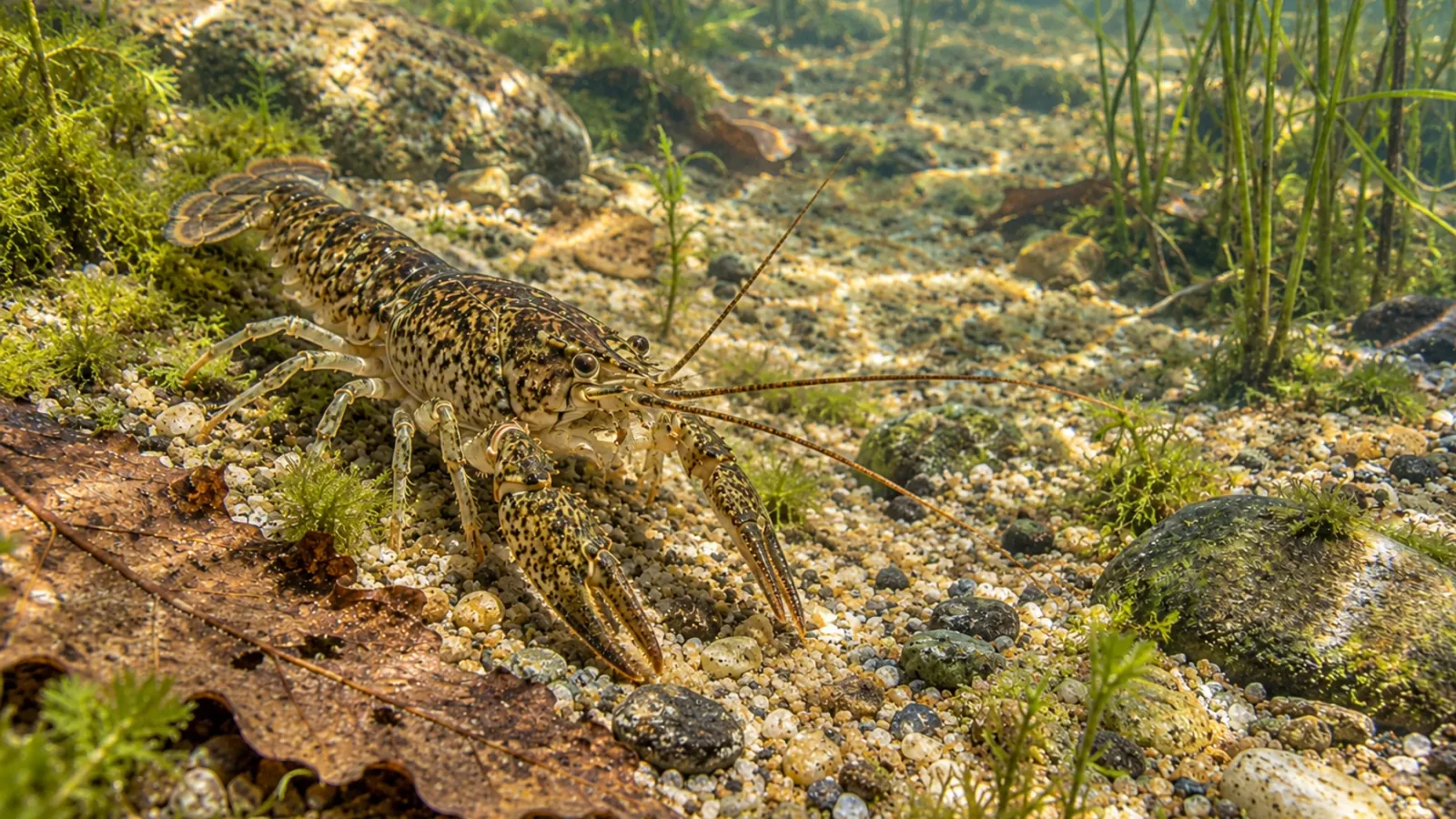
Marbled crayfish: monitoring reproduction without males
Marbled crayfish can reproduce without fertilisation. A single observation therefore calls for reliable identification, site records and prevention of transfers, rather than an initial search for a breeding pair.


- Content type
- Practical guide
- Sector
- Environment
- Animal group
- Crustaceans
- Keywords
- ReproductionBiosecurityPCR
Finding one crayfish does not reveal the size or extent of a population. For marbled crayfish, Procambarus virginalis, the absence of a male does not rule out reproduction, because females produce offspring through parthenogenesis. This changes the questions that follow a reliable first observation.
Vogt and colleagues’ 2015 research investigated this biology through behavioural and genetic comparisons. A 2019 report by the French biodiversity agency provides a field example of identification and follow-up. These dated sources support a practical interpretation of reproductive biology; they are not a new alert or an updated distribution map.
Offspring without fertilisation
Parthenogenesis produces offspring from an unfertilised egg. It is obligatory in marbled crayfish and produces females. A female can therefore generate offspring without locating a male partner. This does not mean every isolated animal survives or inevitably establishes a population.
The 2015 study compared marbled crayfish with the closely related, sexually reproducing Procambarus fallax. Researchers observed mating between P. fallax males and marbled crayfish females. In broods followed to juvenile stages, however, the tested markers matched the mother, without a detected paternal contribution. Observing mating did not establish fertilisation.
Measurements of DNA quantity and genetic markers also supported triploidy, meaning three chromosome sets. This characterises the studied material; a field photograph cannot establish ploidy. The different forms of evidence should remain separate when communicating an identification.
Clonal origin does not mean identical appearance
Genotype refers to genetic constitution, whereas phenotype concerns observable characteristics. Laboratory lineages and populations examined in the study shared closely similar or identical profiles at the markers tested. Marbled patterns and other visible traits could nevertheless vary between individuals.
Two shortcuts would weaken identification: different appearances do not necessarily indicate different species, and similar animals do not prove genetic identity. The marbled pattern is useful descriptive information, but reliable confirmation may require specialist examination and molecular markers.
Similarity to P. fallax makes that distinction especially relevant. Observers should preserve clear photographs, location information and a description of features they can actually distinguish. Failure to find males during limited observations is not, on its own, a taxonomic identification method.
Keep the French record in its historical context
In August 2019, the French invasive alien species resource centre reported the first French record from a waterbody near Metz in the Moselle catchment. Morphological identification had been confirmed by molecular analysis. A trapping operation on 25 July 2019 captured twelve marbled crayfish in the investigated waterbody.
That number describes an operation, not the full population or all neighbouring waters. The account states that work covered one site within a complex of waterbodies and proposed extending searches to clarify distribution. Presence had reportedly been known for several years, without an established introduction history.
For an international reader, the case illustrates why an unknown introduction date, a capture date and a report’s publication date are different facts. It cannot establish current occurrence in another catchment or a recent arrival on the Mediterranean coast.
Make monitoring answer a defined question
Once an observation is confirmed, managers need to know where animals are detected, under what conditions and with what search effort. Location, date, method, duration and habitat information should accompany findings. Incomplete sampling can underestimate distribution; no catch does not by itself demonstrate absence.
Size records and observations of eggs may improve the description. They do not automatically provide a reproduction rate, age estimate or expansion trajectory. Comparisons between visits require reasonably consistent methods and effort, with changes recorded rather than hidden.
PCR or other molecular work should address an identification question agreed with the laboratory. Confirming a species does not simultaneously establish the source of an introduction, its timing or infection status. Those questions require distinct evidence and, where relevant, different analyses.
A monitoring plan should also distinguish newly sampled sites from repeated visits to the same location. Otherwise a larger count may reflect greater search effort rather than a biological increase.
Prevent transfers while arranging an appropriate response
Biosecurity concerns equipment, water and organisms moved between sites. Clear handling routes and cleaning arrangements help limit unintended connections. Reproduction without a male makes an assumption that a few animals are harmless particularly unhelpful.
A documented observation should be passed to the site manager and the responsible territorial authority to agree follow-up. Moving live animals to test their reproduction privately or releasing them elsewhere would create another transfer. Capture and handling arrangements need to be agreed with the relevant organisations under the applicable local framework.
The French example does not create a universal procedure for other countries. Responsibilities and permitted interventions depend on jurisdiction and site arrangements. The biological reason for preventing avoidable transfers can be explained without inventing an international legal obligation.
Finding an invasive crayfish is also not a diagnosis of crayfish plague. In the 2019 French case, animals were intended for testing on that question. A plan to analyse specimens must not be reported as a positive result.
Confirm identity, locate the record, then follow change
Parthenogenesis explains why an absent breeding pair is not reassuring by itself. A useful decision nevertheless requires reliable identification, a well-described site and monitoring proportionate to the question. Neither population size nor health status can be inferred from reproductive mode alone.
For aquatic environmental management, our aquatic health expertise service can help plan sampling, organise equipment pathways and distinguish species identification, population monitoring and health investigation.


