

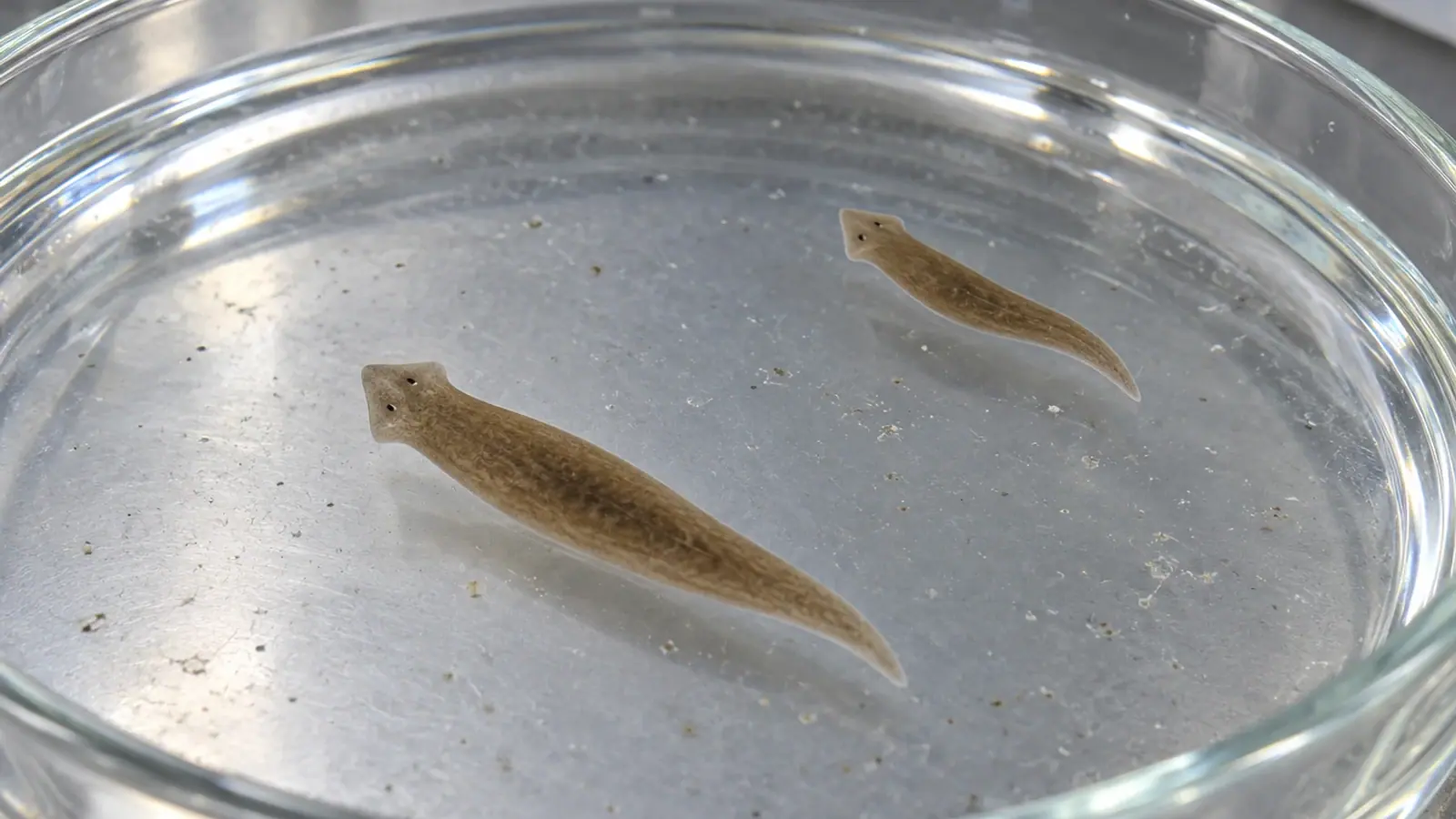
Planarian body mass also reflects energy stores
Body mass is not a simple cell counter in a planarian. A 2019 study of asexual Schmidtea mediterranea combined imaging, cell estimates and energy measurements to explain how larger animals store more energy per cell. Researchers need to choose a size measure that matches their biological question.


- Content type
- Scientific news
- Sector
- Research facilities
- Animal group
- Corals and invertebrates
- Keywords
- TemperatureStressReproduction
Body mass seems a straightforward description of animal size. In a planarian, however, it combines water, cells and stored energy. A difference on the balance does not establish which component differs between animals.
Thommen and colleagues investigated these relationships in a 2019 study of asexual Schmidtea mediterranea. They brought together imaging, cell-number estimates, energy stores and metabolic measurements. Research teams therefore need to choose their denominator deliberately: a result expressed per animal, per unit mass or per estimated cell number can answer a different biological question.
Live size measurements depend on body shape
A moving planarian repeatedly stretches and contracts. Length in an arbitrary photograph can reflect posture as much as animal size. The researchers therefore used multiple movie frames showing extended animals and followed projected body area as a nonlethal measure of size change.
Area is still an image measurement. To relate it to cell number, the team established a calibration within its experimental system. Two complementary approaches gave closely agreeing estimates: counting nuclei after animal dissociation and quantifying histone H3. The data supported changes in cell number as the predominant contribution to size change, while not excluding every possible change in cell size.
A calibration from this study is not a universal conversion formula for any colony. Comparisons need the animals’ identity, the imaging method and the rules used to select frames. Area, length and body mass should remain separately named variables. Calling all three “size” can hide the assumptions that connect them.
Metabolic measurements came from groups of animals
The team measured heat production by cohorts of similarly sized planarians and divided the result by the number of animals. Cohort size varied to obtain a usable signal. An experimental point was consequently a group measurement, rather than an independent metabolic record for every individual in the vial.
Metabolic rate increased with mass according to a power relationship whose estimated exponent was 0.75 ± 0.01 (standard error). Across the studied range, total metabolism therefore rose more slowly than body mass. The value does not describe a 75% reduction or a food-conversion efficiency of 75%.
The conditions of measurement are central to interpretation. The microcalorimetry used animals starved for two to three weeks. It did not directly characterise metabolism immediately after feeding. That interval belongs to the experimental context; it is not a fasting recommendation that another facility should adopt without assessing its own project and animals.
Energy stores contribute to mass per estimated cell
The study combines measurements with an energy-balance model. Estimated average metabolic rate per cell changed little with the size of the starved animals, whereas average mass per cell increased. The latter is an organism-level ratio, not the result of directly weighing every cell.
Biochemical measurements supported a size-dependent increase in energy stores. Storage lipids and glycogen both contributed. In the small-versus-large groups compared, triglycerides normalised to cell number were about 88-fold higher in the larger planarians, and glycogen was more than eightfold higher.
These analyses used pooled animals and separate biological replicates. They do not mean that any particular animal must pass through those exact ratios during an individual growth record. The results support a physiological explanation for the mass–metabolism relationship under the study conditions. They do not, on their own, establish every mechanism directing energy into reserves rather than new growth.
This distinction matters when interpreting the paper’s broader scaling argument. An explanation of a measured relationship is not a demonstration that the same relationship applies to every nutritional state, lineage or animal model. The authors themselves identify metabolism during the feeding response as an area requiring further investigation.
Match the denominator to the biological question
A result per milligram may change because the process of interest changes, because body composition changes, or because both change. Decide first whether the question concerns a total signal from an animal or a quantity relative to mass or estimated cell number. Those choices should be visible in the analysis plan and results.
The experimental record should retain the size-measurement method, time since feeding, temperature and colony origin. Asexual S. mediterranea does not automatically represent all planarians, all lines or all nutritional states. Smaller size alone is not a diagnosis of stress or poor health.
Repeated live observations also need to be distinguished from terminal sampling. Body area can be measured on several dates in the same living animal. Dry mass and biochemical assays require a different sampling strategy. Repeated readings of one animal do not create an equal number of independent biological replicates.
For facility teams, these distinctions belong alongside husbandry records rather than being reconstructed after a result is obtained. A technically precise measurement can still be normalised to a variable that does not answer the intended question. Keeping the underlying measurements allows the reasoning to be checked later.
State what “size” means before data collection
The practical decision is to define the quantity, animal state and normalisation method in advance. The 2019 study shows why that definition can change a physiological interpretation even when the measurements themselves are sound. It provides a methodological example, not a general maintenance rule.
Our training programmes can help teams distinguish analytical units, repeated observations and husbandry variables in their protocols. Through our research-facility expertise, we support explicit indicator choices and clear records of the model’s limits, so that a body-size comparison retains its biological meaning.


