

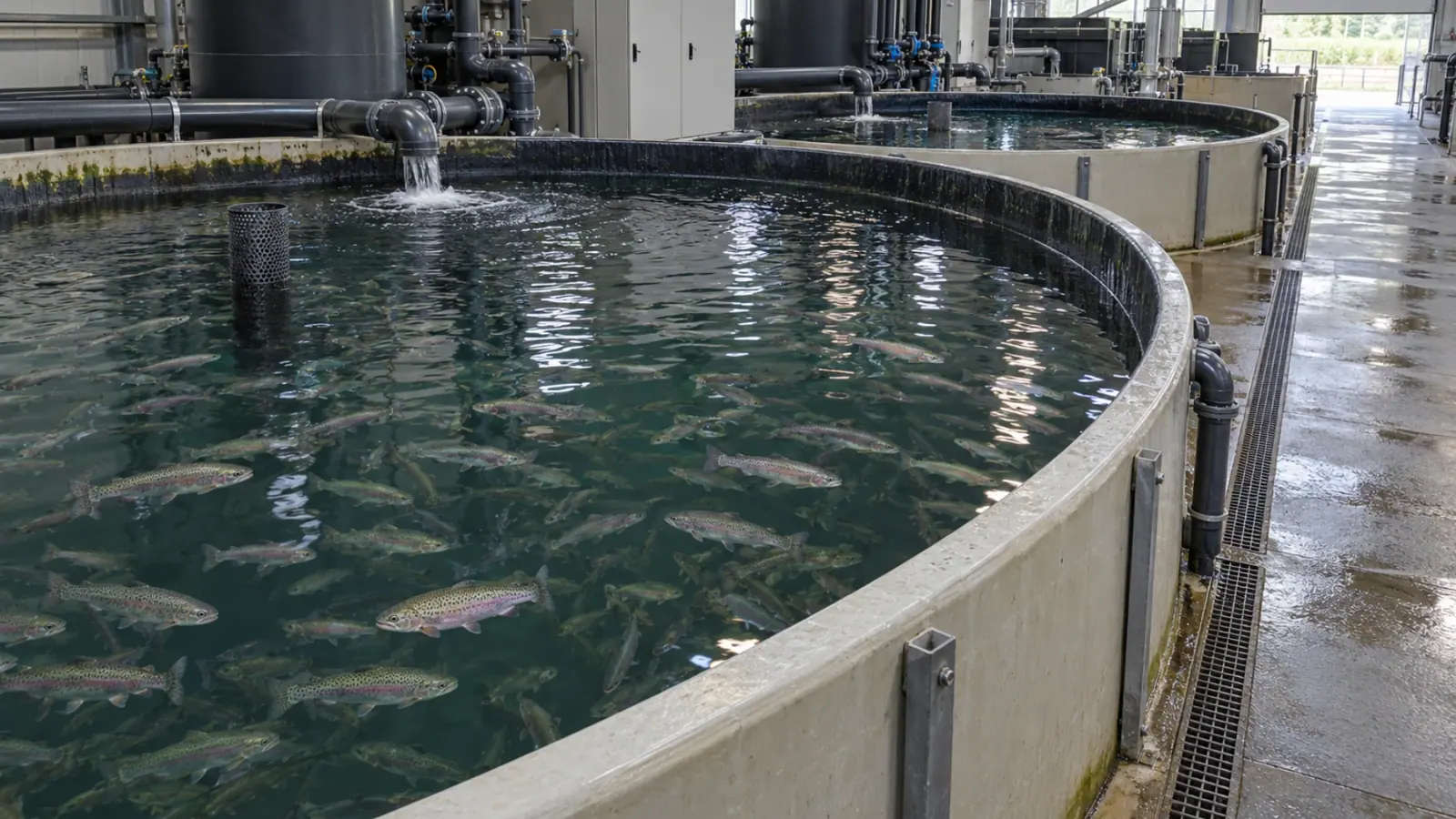
Plasma in RAS: what farm validation still needs to show
A 2025 experiment reduced fish-pathogenic bacteria using plasma combined with cavitation. The tests involved bacterial suspensions; fish safety, biofilter compatibility and performance in operating farms still need assessment.


- Content type
- Practical guide
- Sector
- Aquaculture
- Keywords
- DisinfectionUVpH
A water-treatment unit in a recirculating farm has to answer two separate questions. Does it reduce the microorganisms being targeted, and is it compatible with the fish and biological processes that keep the system running? A large reduction in bacterial counts answers only the first. This distinction guides the assessment of a plasma system proposed to improve RAS biosecurity.
CaviPlasma combines an electrical discharge with cavitation in moving water. Cavitation involves the formation and collapse of cavities within the liquid. The resulting physical conditions help expose cells to potentially damaging processes. These occur inside a reactor, rather than in a tank occupied by fish.
The experiment used suspensions, not stocked tanks
Palíková and colleagues published a 2025 experiment involving three strains: Aeromonas salmonicida, Aeromonas hydrophila and Flavobacterium psychrophilum. Cultured bacteria were resuspended in tap water. Batches of 2.5 litres circulated through an experimental loop containing a pump, reactor and reservoir.
The reported flow of 1 m³/h describes that loop. It does not mean that a whole operating farm was continuously disinfected at this rate. The same water could pass through the active zone several times. Hydraulic flow, energy delivered per litre and passage number therefore need to be distinguished. None provides a stand-alone specification for a commercial installation.
The researchers cultured samples immediately after treatment and again following incubation. The strains differed in susceptibility. Under some treatment conditions, colonies of F. psychrophilum disappeared sooner than colonies of the two aeromonads. For the latter, part of the reduction developed during subsequent storage of the treated suspension.
A negative culture has a defined meaning
No colonies under the test conditions means that the target culturable bacteria were not recovered by that method. It does not establish general sterility or demonstrate that fish are protected against infection. Other bacterial taxa were recovered after treatment. The authors discuss release from a biofilm within the apparatus as a possible source, without demonstrating that it was the only explanation.
This is relevant to the layout of a farm’s water circuit. Effective treatment inside a reactor may be followed by contamination from a downstream pipe or holding vessel. Sampling locations must therefore be explicit. An inlet sample, an immediate outlet sample and water at the point of animal exposure answer different questions.
Treatment can continue after the water leaves the reactor
Plasma produces reactive species involved in oxidation. Some are short-lived, while others, including peroxides, can persist. The researchers measured peroxides in treated liquids. A delayed reduction in culturable bacteria is consequently consistent with residual activity in the water, rather than with exposure to the discharge zone alone.
An absence of added disinfectant does not mean an absence of reactive chemicals. Dilution, organic loading and storage conditions may change the activity that remains. Findings from a simple suspension cannot establish a universal waiting period before fish exposure, or a residual concentration acceptable for every species.
The biofilter also needs consideration. Its microorganisms perform nitrification and contribute to nitrogen removal. A biocidal process is not automatically selective for pathogens. Continued biological performance has to be assessed; an absence of short-term fish mortality would not, by itself, establish that the biofilter was unaffected.
Define the evaluation before considering installation
A farm considering a trial can first request a technical dossier describing the treated matrix, flow, repeated passages and measurement methods. A reported reduction without information about the water used is difficult to compare with particle-rich farm water. Immediate results and reductions obtained after storage should be presented separately.
The evaluation plan should distinguish microbiological performance from biological compatibility. It needs defined sampling points, controls, genuinely independent repetitions and stopping criteria. Water measurements, including pH, are considered alongside residual oxidants, animal observations and biofilter performance. Any proposed exposure of animals requires technical and veterinary planning appropriate to the site.
The design also has to address operating disturbances: falling flow, changes in power, fouling, shutdown and restart. Equipment that performs under stable conditions may behave differently after maintenance. Responsibility for checks, alarm responses and record keeping should be settled before commissioning, rather than added after an unexpected event.
Match the purchasing decision to the evidence
The study demonstrates an effect on three bacterial strains in suspension. It does not provide a fish-safety trial or a complete evaluation of a functioning farm biofilter. Nor does it compare the economics of all available disinfection methods under the same commercial conditions.
For a farm manager, this means that a reactor result should remain one part of the assessment. A useful proposal explains how performance will be checked under representative conditions and how unwanted effects would be detected. Claims about reduced antibiotic use or disease losses need their own evidence; they cannot be inferred from a plate count alone.
Plasma combined with cavitation is therefore a technology to evaluate against a defined problem. The practical decision depends on representative water, a relevant circuit configuration and monitoring able to identify both a microbiological benefit and an adverse consequence.
Planning an assessment with Vetofish
Vetofish’s advice and support service can help turn an equipment proposal into testable questions, a sampling plan and explicit follow-up criteria. For aquaculture facilities, the aim is to connect reactor performance with animal health and system function before drawing wider conclusions.


