

Pond amphibians: adults and breeding need separate records
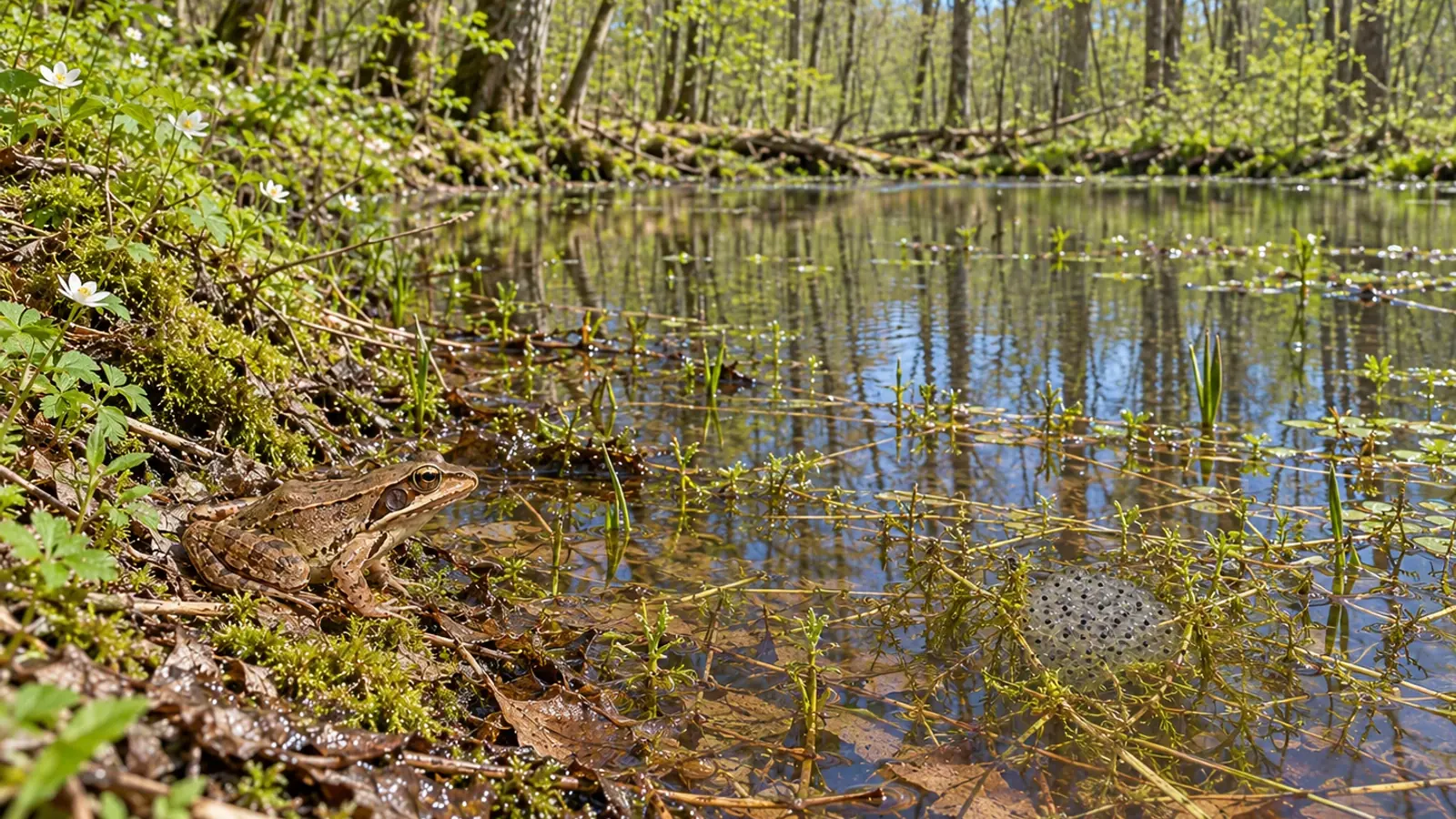
An adult amphibian at a pond does not establish that the site will produce young. A study of 207 waterbodies in northern Italy separated adult occurrence from breeding evidence. Monitoring teams need to define the life stage they are looking for and what their observations can demonstrate.
- Content type
- Scientific news
- Sector
- Environment
- Animal group
- Amphibians
- Keywords
- ReproductionTemperatureStress
An adult amphibian and an egg mass document different events. The first establishes that an animal was detected; the second supplies evidence of reproduction. Neither alone proves that young reached metamorphosis or that the population will persist over time. A monitoring conclusion needs to identify which of these questions the observations address.
Lo Parrino and colleagues examined this distinction in Lombardy, northern Italy. Their study appeared online in 2024 and in a 2025 issue of Conservation Biology. It examines the information provided by adult and breeding observations in relation to habitat and survey effort.
Record distinct states rather than one general presence label
The researchers monitored 207 waterbodies between 2017 and 2022. Visits distinguished nondetection, adult occurrence without breeding evidence, and breeding evidence defined by eggs or larvae. A calling male counted as adult presence; it did not automatically demonstrate successful egg production.
Multistate occupancy models allowed the situations to be examined separately while accounting for imperfect detection. A species occupying a site can go unnoticed during a visit. Treating every nondetection as certain absence would therefore change the meaning of the observations before habitat relationships were even investigated.
The detailed models covered seven sufficiently documented taxa. The programme combined repeat visits, visual searches, listening and investigation of aquatic stages. Its conclusions need that context. A single opportunistic listening visit does not provide the same information as the organized survey design.
Adult habitat associations do not summarize breeding requirements
Relationships with environmental features varied between species and stages. In the Italian agile frog, Rana latastei, surrounding forest cover was positively associated with adult occurrence without an equivalent direct relationship with the conditional breeding probability examined. The biological response being modelled matters to the interpretation.
This does not mean forest is irrelevant to that frog’s reproduction. Adult occurrence at a site is a prerequisite for breeding there. Direct and indirect relationships cannot therefore be reduced to a simple list of habitat features to remove or retain.
Fish and red swamp crayfish presence were also included among the recorded variables. Associations differed across amphibian species and stages. The observational study was not an experiment removing predators, and it does not establish that one identical intervention would improve outcomes at every pond.
A life stage needs a corresponding observation
A useful field entry identifies what was detected: an adult, a call, eggs or larvae, together with date and method. A general amphibian-present category preserves some information. It cannot later recreate breeding observations that were never sought or distinguished in the original record.
Detectability depends on phenology, survey conditions and stage. A secretive adult and a conspicuous egg mass offer different opportunities for detection. Suitable periods are not interchangeable across species. The study consequently provides no universal number of visits applicable to every pond and monitoring objective.
No larvae observed can mean an unsuccessful search, an early visit, an unsuitable method or genuine absence. Keeping not searched separate from searched but not detected preserves information for later analysis. It avoids turning an incomplete observation into unwarranted ecological certainty.
Breeding evidence is not confirmed recruitment
Eggs and larvae were grouped as evidence of reproduction in the study. Their presence does not guarantee survival to the point of leaving the water. Subsequent drying, for example, could interrupt development after an earlier visit had correctly confirmed eggs.
Recruitment concerns the entry of new individuals into the population component being monitored, with its operational definition specified for the programme. It cannot be read automatically from an egg photograph. A question about survival through metamorphosis needs an observation window and endpoint capable of documenting that transition.
This does not require indiscriminately increasing capture effort. Monitoring aims and potential disturbance should be considered before methods are selected. The paper compares information and effort; it supplies neither permission to handle a species nor a sanitary procedure applicable to every field site.
Allocate effort around the decision the survey must inform
The authors compared monitoring strategies and resource scenarios using several multicriteria approaches. Rankings depended on species, available resources and the chosen criteria. The approaches did not agree on every result. A favourable ranking in this exercise is therefore not a general management rule.
A manager can start with the intended decision: documenting occurrence, following reproductive use of a site or examining what happens to young. Sampling can then be designed around that purpose, with sufficiently detailed observations and comparable effort. The intended inference should guide data collection before results are available.
Water level, vegetation and intervention records can provide context alongside biological observations. Changes in observer, method or season should remain identifiable in a time series. More detections could reflect a more effective search rather than population growth, while fewer detections could also have more than one explanation.
Keep conclusions aligned with the stage actually monitored
Adult presence, breeding evidence and observed metamorphosis are complementary findings. Distinguishing them makes monitoring more useful and avoids labelling a site as a successful producer of young on evidence that establishes only an earlier stage.
This distinction is especially valuable when comparing programmes with different budgets. A narrower programme can still supply useful information if its purpose and limits are explicit. Expanding the conclusion to unobserved stages does not compensate for limited resources; it obscures which questions remain unanswered and what a later survey would need to add.
Vetofish’s consulting and support service can help define observations, review a monitoring plan and assess its limitations. For teams working in the aquatic environment, the aim is to connect collected evidence with the intended decisions, without promising that any single indicator will summarize population viability.


