

Rainbow trout: feeding anticipation needs more than activity
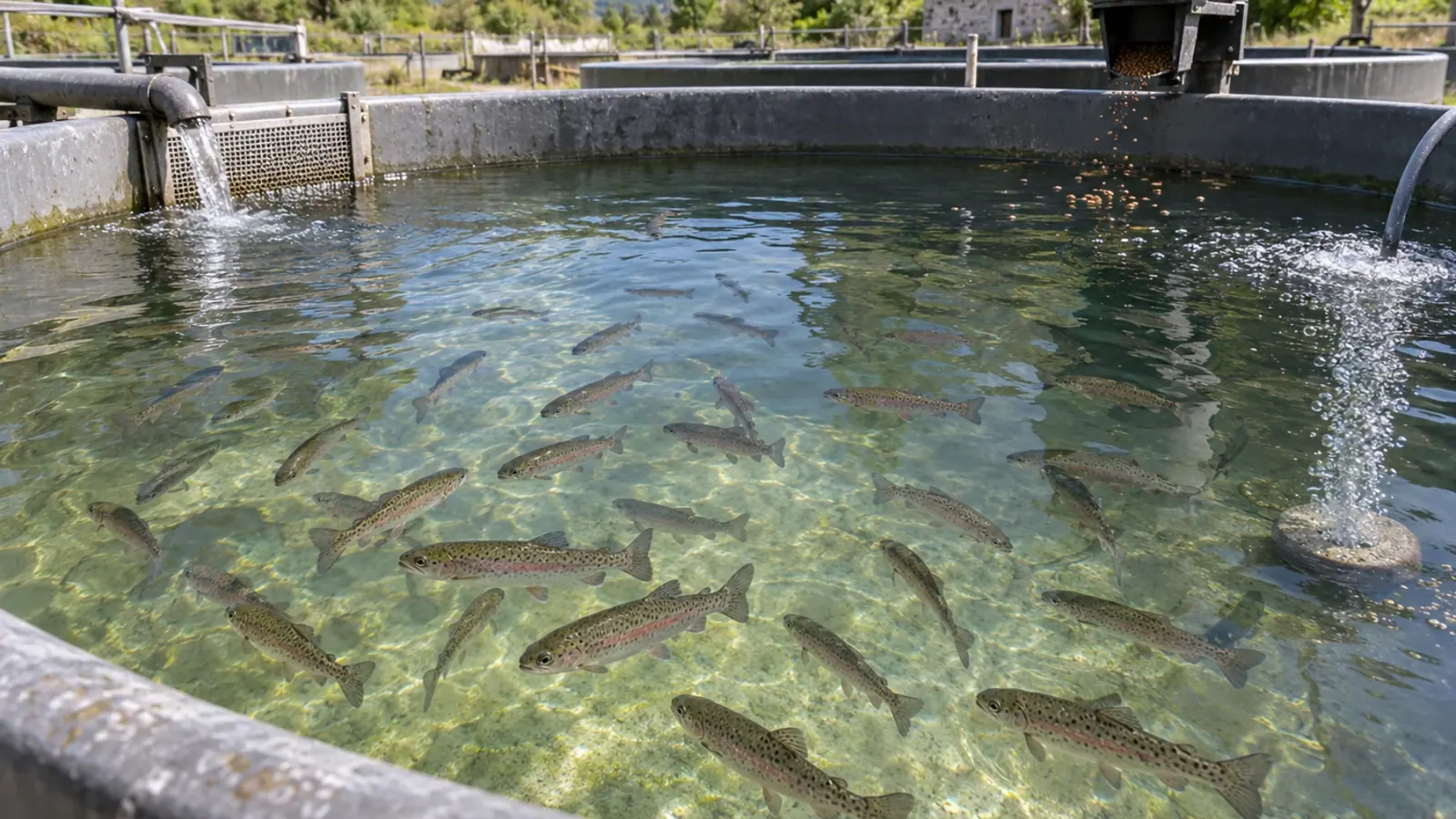
Trout activity around bubbles can reflect attraction to the stimulus as well as learned expectations of food. A French study published in 2022 helps separate these responses and shows why activity alone cannot establish a welfare benefit.


- Content type
- Practical guide
- Sector
- Aquaculture
- Animal group
- Salmonids
- Keywords
- EnrichmentEthogramStress
Read the behaviour around the meal
An active group of trout is not necessarily a group anticipating food, and anticipation itself does not establish good welfare. Fish may gather around an air diffuser because the bubbles attract them. They may also move faster as a meal approaches, compete with neighbours or react to another change in their surroundings. Those possibilities need separate observations.
A French experiment published by Aude Kleiber and colleagues in Scientific Reports in 2022 helps distinguish these responses. It investigated feeding predictability in young rainbow trout, Oncorhynchus mykiss, using time of day and air bubbles as potential cues.
For a farm team, the useful question is whether a change in feeding arrangements produces a response that can be described and assessed. The appearance of movement in a video is only a starting point. Access to food, interactions among fish and the conditions actually reaching the stock remain part of the assessment.
What the four treatments compared
The study involved 1,872 female triploid trout in twelve tanks, with three tanks assigned to each of four treatments. Meals occurred at fixed times, followed a bubble cue at variable times, combined fixed timing with the bubble cue, or had no predictable relationship to time and bubbles. Conditioning refers here to learning the relationship between a perceptible event and food delivery.
Every treatment received bubble diffusions and the same daily frequency of meals. What changed was the relationship between those events. The unpredictable treatment was therefore not an unenriched, bubble-free control. The design cannot establish the overall benefit of installing an air diffuser compared with having none.
The researchers observed twelve days of conditioning and then used food omission tests to investigate whether an expectation persisted after a cue. They also assessed 96 fish individually in a novel tank and measured growth. For group behaviour, tank replication matters: the large number of fish should not be mistaken for an equally large number of independent experimental units.
Attraction can obscure a learned response
Trout were attracted to bubbles across treatments from the beginning. Activity in the diffuser area increased during bubbling compared with neutral periods. A camera recording of fish approaching bubbles would therefore be insufficient to show that the animals had learned to predict a meal.
The omission tests offered a different comparison. Some groups previously given the bubble-food association remained more active in that area after the cue than comparison groups. These contrasts support feeding-related learning under the experimental conditions. The combined time-and-bubble treatment showed a marked anticipatory response, but this does not mean that adding more cues will always improve welfare.
The tests were designed to investigate learning, not to establish food withholding as a husbandry practice. Nor did a persistent response directly measure a positive emotional state. An equipment schedule documents what was programmed; observations are needed to establish what the animals actually perceived and how they responded.
Consider interactions as well as activity
The study also recorded a combined measure of agonistic behaviours, sudden accelerations and jumps. These events do not all have identical meanings, but they add information beyond overall movement. Before meals, the combined measure was higher in the time-only treatment than in some other treatments, including the bubble-only cue treatment.
After food omissions, fish in the bubble-only treatment displayed fewer of these events than those in the time-only and unpredictable treatments. A favourable tendency for the combined time-and-bubble treatment relative to time alone was not statistically established in every comparison. Apparent differences should not all be reported as confirmed benefits.
There was no detected treatment effect on growth or on individual reactivity in the novel-tank assessment. The experiment did not establish reduced cortisol, improved immune function or protection against disease. Welfare and stress require several kinds of evidence; outcomes not measured in this study cannot be added to its conclusions.
Build an observation record before changing the cue
A farm can first describe the existing feeding period. When do fish gather, where does food reach them, and which individuals appear excluded? Recording chases, abrupt movements and the return to usual activity is more informative than a single entry such as “fish excited”. An ethogram with consistent definitions helps different staff describe comparable events.
The record should also include relevant water conditions, biomass, ration and recent operations. Bubbles may serve a technical function as well as a behavioural one. These results provide no reason to reduce aeration that the system needs. A new response after equipment changes calls for checking the conditions around the fish, alongside the programmed settings.
Any proposed adjustment needs evaluation in the production system concerned. This was a short experiment with young female triploid trout, not a validation across strains, ages and farm designs. It provides neither a universal feeding timetable nor a guaranteed benefit from a particular signal duration. Maintaining suitable feeding access and water conditions remains essential throughout an evaluation.
Keep the three questions separate
The practical distinction is between attraction to bubbles, learned anticipation of food and changes in interactions among fish. Evidence for one does not automatically establish the others. This makes it possible to discuss a behaviour change without assuming that a lively-looking tank demonstrates better welfare.
Vetofish can support aquaculture teams in selecting welfare observations, defining consistent records around feeding and reviewing the constraints of a tank or production unit. The aim is to judge whether a proposed adjustment should be retained, modified or stopped on the evidence from the stock, without promising a result from equipment alone.
To move from evidence to action, explore our animal welfare service and our expertise in aquaculture.


