

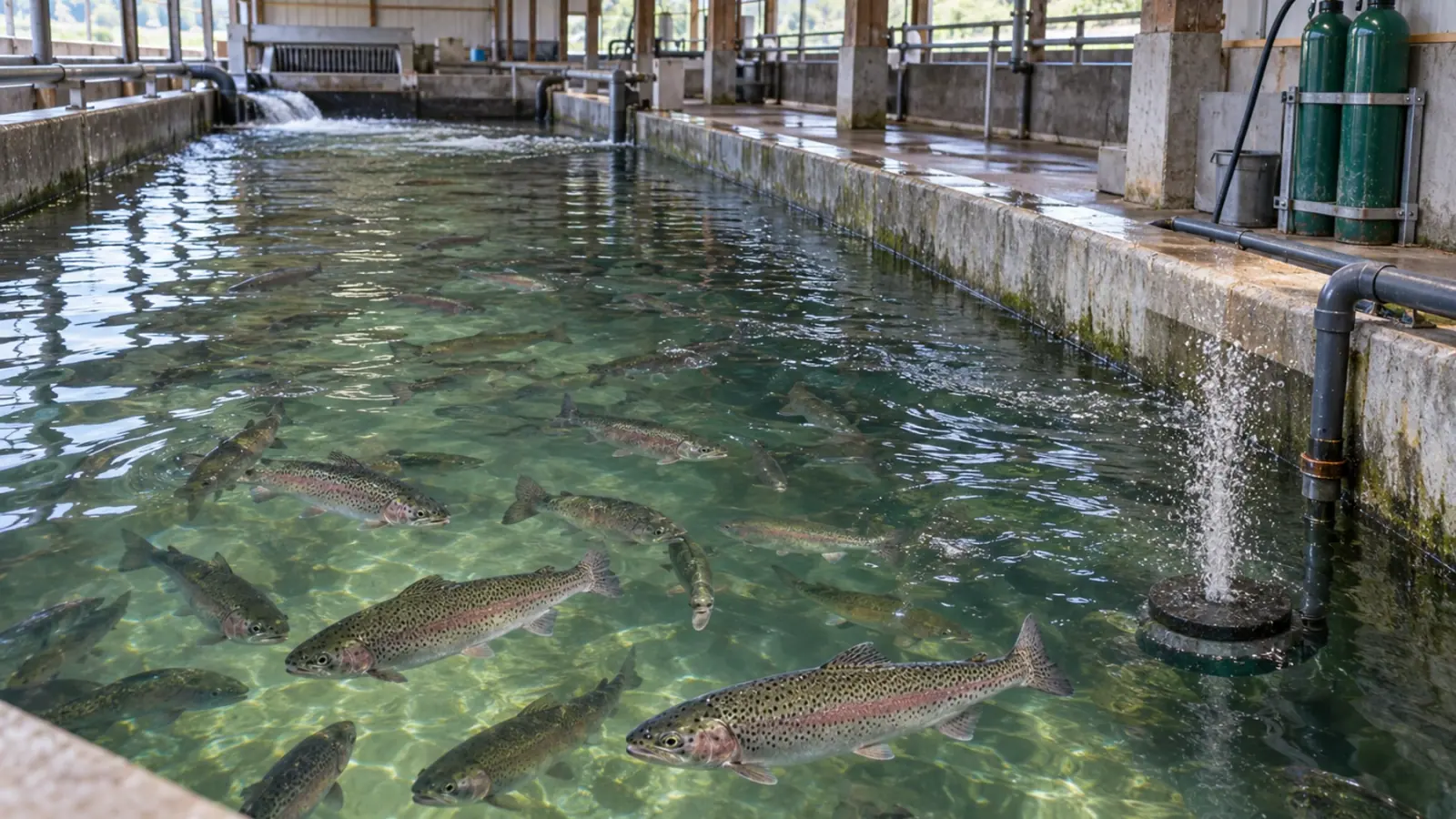
RAS power failure: prepare the backup response
Power failure can interrupt circulation, oxygen delivery and monitoring together. In recirculating aquaculture, autonomy depends on the production group and system; no universal time allowance replaces a verified backup plan.


- Content type
- Practical guide
- Sector
- Aquaculture
- Animal group
- Fish
- Keywords
- OxygenTemperatureCO₂
A power failure in a recirculating aquaculture system can interrupt several functions at once: circulation, oxygen delivery, water treatment and monitoring. Asking how many minutes remain before a crisis sounds practical, but a single time allowance cannot describe what happens to every production group. Preparation needs to identify lost functions, exposed units and the backup resources actually available.
The 2025 Code of good practices on fish welfare and fish welfare indicators, produced through the EU Aquaculture Assistance Mechanism, recommends alarms and backup generators for failures involving power, water supply or equipment. This technical document is not a new French legal requirement. It offers a framework for examining a farm’s preparedness while retaining species and system differences.
Map the functions that can fail together
Dissolved oxygen supports fish respiration. Its availability depends on both supply and distribution within each rearing unit. If circulation stops, an oxygen source that remains operational does not guarantee suitable delivery to every fish. Assessment needs to follow the system into the tanks, including areas where mixing becomes inadequate.
Essential equipment includes sensors, alarm communications and controllers. A common power failure can make a problem harder to detect just when it becomes more serious. The plan should identify measurements available independently of the main supply and explain how staff will confirm actual conditions near the animals.
A functional diagram distinguishes a failed pump, a lost oxygen supply and the loss of an entire electrical circuit. These events need not follow the same course. Having a generator does not establish that every priority device is connected to it, that it starts reliably or that its capacity matches the current installation.
Autonomy depends on the fish and their environment
Biomass is the mass of animals within a defined unit. Together with species, developmental stage, activity and feeding, it contributes to oxygen demand. An estimate based on a lightly stocked tank cannot automatically describe that tank near the end of a production cycle. The underlying information should therefore be dated and linked to the relevant group.
Temperature affects biological requirements and water properties. Initial oxygen conditions, the volume actually available, residual mixing and backup performance also influence the possible course of an interruption. Any autonomy estimate should retain these assumptions. It is not permission to delay action until the estimated time has elapsed.
Hypoxia means that oxygen availability is insufficient for a biological function. It need not begin with immediately visible mortality. Ventilation, distribution and behaviour may change before losses occur, with responses depending on species and circumstances. Monitoring should support early action rather than reveal the failure only once fish are dying.
Oxygen recovery is only part of restarting
The 2025 code emphasises that recirculating systems rely on several processes to maintain water quality. Carbon dioxide, ammonia and pH are among the relevant parameters, depending on the installation. Restored oxygen readings therefore cannot establish that the whole system has returned to satisfactory operation.
Interruption duration, the condition of biological treatment and changes in flow should accompany the assessment. Restarting a pump can change tank conditions rapidly. The sequence should be prepared with technical and animal-health staff, preserving relevant checks before and after the equipment returns to service rather than assuming that energising it completes recovery.
Restored power also differs from a stable supply. Intermittent restarts, equipment remaining in fault or unavailable sensors can prolong uncertainty. Follow-up should confirm the functions supporting the fish, rather than end when the first indicator light comes on. A working central controller cannot substitute for evidence from affected units.
Exercise the response without exposing fish to harm
Preparation can examine generator starting, communications and the availability of consumables separately. Tests should be planned with competent personnel and follow equipment safety requirements. An uncontrolled deliberate interruption in stocked tanks is not an acceptable way to discover the limits of a backup arrangement.
A tabletop exercise can trace a scenario before live equipment testing: who receives the alarm, who confirms the failure, who has access to resources and which units need priority attention. Absences and out-of-hours cover should be included. A procedure known to only one person is vulnerable when that person cannot respond.
Identified gaps should become specific actions, such as a missing connection, unverified autonomy, inaccessible equipment or a lack of independent measurements. The plan then needs review when biomass, circuits or equipment change. Capacity established under an earlier configuration cannot safely be assumed to remain adequate after modification.
Keep a usable incident chronology
Following a failure, known times and uncertainties help explain animal observations. The likely start, alarm receipt, intervention, water measurements and changes in fish describe different events. Detection time should not silently replace an unknown start time. Preserving that distinction helps assess an exposure whose duration cannot be reconstructed exactly.
The review should examine causes, backup performance and observed consequences. It can improve the arrangement without attributing every subsequent abnormality to the power interruption. Continuing or delayed signs in fish may require a separate health assessment rather than an assumption that restarting has resolved the underlying problem.
Conclusion and Vetofish support
A useful failure plan connects essential functions, the production group’s conditions and a response the team can carry out. Our advisory support can help aquaculture sites develop scenarios, select priority indicators and prepare a documented return to operation. Claimed autonomy should remain tied to verified conditions, without promising a universal safe interval.


