

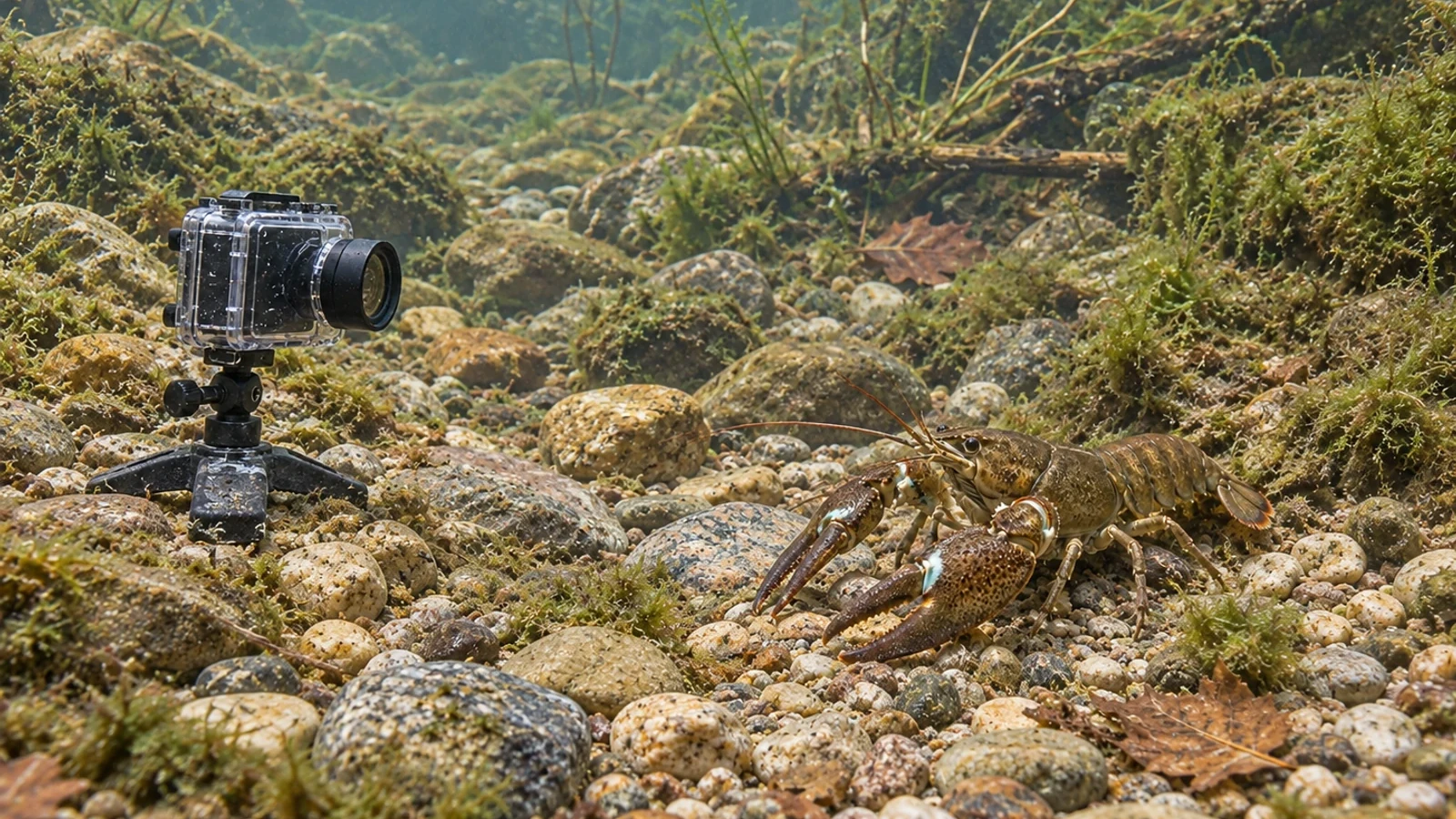
River crayfish: comparing video, traps and eDNA
A negative environmental DNA result may not establish that crayfish are absent. An open 2026 study in England’s River Calder compares water analyses, underwater video and trapping. Its findings show why non-detection needs to be read alongside the conditions in which observations were made.


- Content type
- Scientific news
- Sector
- Environment
- Animal group
- Crustaceans
- Keywords
- Environmental DNAPCRTemperature
When water tests and direct observations disagree
Harwood and colleagues’ 2026 study examines crayfish occurrence in the River Calder and tributaries in England. The main invasive species of interest is signal crayfish, Pacifastacus leniusculus. The researchers combined underwater cameras, with and without bait, trapping and environmental DNA analysis undertaken during a subset of survey events. The methods produced different kinds of evidence about the river system.
Environmental DNA is genetic material collected from the environment, in this case water. Detection of a suitable target can provide evidence of presence when the result is interpreted appropriately. A negative result also depends on the material available for collection and analysis. It does not necessarily have the same meaning as demonstrated absence of the animal, which is itself difficult to establish.
Water analyses in this study produced no crayfish detections, while captures and underwater footage established crayfish presence within the surveyed network. These methods produced different findings within the same survey programme. It does not show that eDNA is ineffective for every crayfish species or waterbody. It does show why decisions resting heavily on non-detection may need supporting evidence from other methods.
Preserve the denominator behind each result
The paper describes twenty-eight site-and-season survey events across autumn 2023, winter 2023–2024 and summer 2024. That does not mean twenty-eight independent sites. Environmental DNA sampling covered only part of the survey series. Nor were all methods applied with identical effort under every condition. Those distinctions matter before comparing the number of positive findings.
A useful field record retains location, date, method and the relevant duration or effort. A winter negative and a summer positive collected elsewhere cannot be combined without qualification into a definitive status for an entire reach. Comparisons become clearer when each line remains a located observation, rather than a permanent label of present or absent assigned to a large area.
Temperature accompanies seasonal changes in activity. A camera records animals only if they enter its field of view and can be recognised. A trap records animals only if they encounter and enter the device. Availability to either method can therefore change even when crayfish remain in the river. A lower observation count need not correspond directly to a smaller population.
Video and trapping do not count the same thing
The video analysis included MaxN, the greatest number of crayfish visible simultaneously. This avoids adding every appearance as though it necessarily represented another animal. It does not identify all individuals passing the lens, however, and it is not a direct estimate of total population size. Repeated appearances and simultaneous visibility present different counting problems.
Trap catches were related to trapping effort. A catch-per-effort measure differs from the largest number simultaneously visible in a video frame. Similar-looking numbers should therefore not be treated as interchangeable estimates of abundance. A comparison needs to retain the definition of each indicator and the observation conditions that produced it, rather than placing all counts on an apparently common scale.
Turbidity created a further limitation. Crayfish sometimes remained visible in poor conditions, but the footage did not always support identification to species. Trapping at the same locations then helped confirm identity. Detecting a crustacean and establishing that it is a signal crayfish are different levels of evidence. A field report should preserve that distinction rather than silently upgrading an uncertain video record.
Consider what may have limited water sampling
A negative PCR result may mean that the target was not present at a detectable quantity in the material analysed. It does not necessarily mean that no crayfish lived nearby. Movement of genetic material through water, its availability at collection and properties of the sample all belong in discussion with the analytical laboratory. The scope of the result should remain tied to the sample actually examined.
The authors discuss particle-rich water, filtration difficulties and possible analytical inhibition among the explanations for the Calder results. These possibilities were not separated experimentally into demonstrated causes of each negative sample. They should therefore be presented as possible limitations, rather than a finding that turbidity caused every failure. Identifying a plausible explanation is different from establishing it with a dedicated test.
Sampling design also depends on the management question. Confirming an already documented population, investigating a distribution boundary and examining a reach with no previous observations require different interpretation. Non-detection can remain informative when its conditions are described. It becomes misleading when converted without qualification into proof of absence, especially where that conclusion would guide an irreversible management decision.
Combine evidence before drawing a management conclusion
The wider study considers river barriers and invasive crayfish spread. Records on both sides of a barrier describe distribution; they do not necessarily document an animal crossing it. Similarly, a reach with no detection is not automatically a protected refuge. Restoration decisions require local assessment beyond the result of one survey method, including the uncertainty around species occurrence.
For environmental managers, the contribution here is an empirical comparison of detection tools. It adds field evidence to general discussion of barriers, while exposing limitations involving visibility, survey effort and identification. It does not establish a universal instruction to retain or remove a structure, or guarantee the absence of other biological risks when signal crayfish are not detected.
Vetofish provides advice and support to interpret field observations, analytical results and aquatic animal health context together. A defensible record distinguishes what was seen, caught, detected and simply not found. That separation helps identify the next useful verification without asking a negative result to establish more than the survey could actually examine.


