

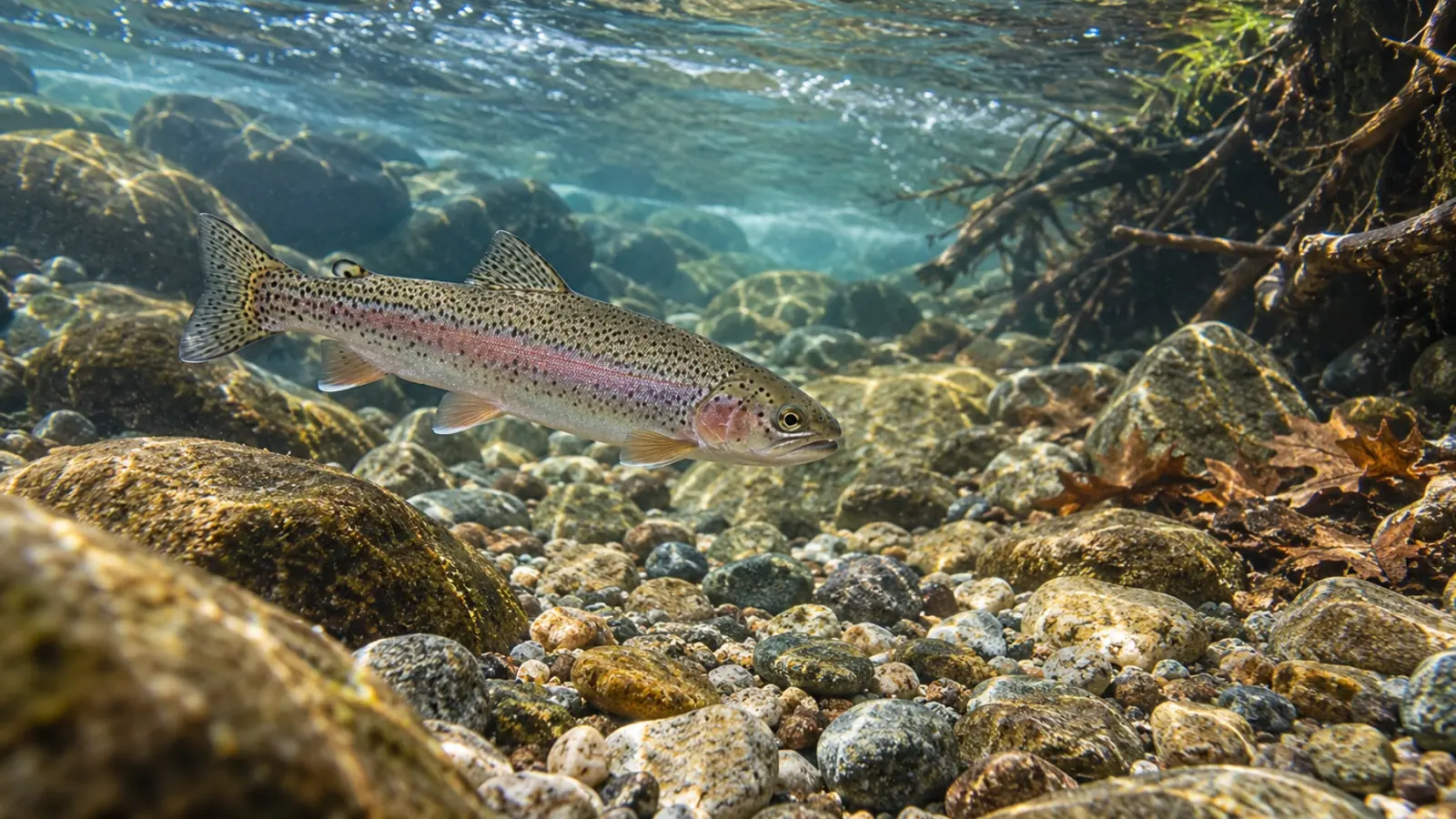
Road salt: newly fertilised trout eggs are more vulnerable
A 24-hour chloride pulse affects trout differently across early development. A study first available in 2025 and assigned to a 2026 volume highlights vulnerability immediately after fertilisation and delayed effects that depend on the surrounding water.


- Content type
- Scientific news
- Sector
- Environment
- Animal group
- Salmonids
Put the pulse on the biological calendar
The maximum chloride concentration does not fully describe the risk from a saline discharge. Exposure duration, surrounding water chemistry and developmental stage can change its consequences. A newly fertilised salmonid egg and a hatched alevin do not have identical capacities to regulate exchanges with their environment.
Carley Winter and colleagues investigated these differences in rainbow trout, Oncorhynchus mykiss. Their article was available online in August 2025 and assigned to a 2026 volume of Comparative Biochemistry and Physiology Part C. It adds experimental evidence on early embryonic vulnerability and delayed effects, extending the question beyond measurements of chloride concentrations in streams.
The experiments used ion-poor Vancouver water. They inform a risk that catchment managers may need to examine, but they do not directly measure mortality in a wild population. They also provide no regulatory limit for France or a universally protective chloride concentration.
Three stages, followed beyond the exposure
The first experiment compared a 24-hour salt pulse beginning less than one hour after fertilisation, at the eyed stage, or seven days after hatching. Each condition had four replicates containing roughly forty eggs or individuals. Survival was followed after the pulse, through the swim-up stage, rather than assessed only when the exposure ended.
A second experiment repeated the earliest exposure in another batch under different thermal conditions. A third tested whether adding calcium carbonate during the pulse changed the response, using five replicates of about one hundred eggs. These experiments provide complementary evidence, not a single comparison performed with identical batches and water conditions throughout.
Food-grade rock salt was used to avoid unknown additives in commercial road salt. The researchers analysed its composition and measured exposure solutions. Applying the findings to runoff therefore requires consideration of other substances and the changing hydrological conditions that can accompany salt in the field.
The earliest exposure produced delayed harm
In the initial experiments, high salt exposures immediately after fertilisation reduced subsequent survival. The corresponding type of pulse applied at the eyed stage or seven days after hatching did not significantly reduce survival under the tested conditions. This establishes a difference between stages, rather than general safety for older embryos or alevins.
Mortality associated with the earliest pulse could become apparent several days after animals returned to water without added salt, around a week later in the second experiment. A return to usual water chemistry therefore does not immediately establish the absence of biological consequences. Monitoring duration and exposure duration are separate decisions.
The mechanisms remain incompletely resolved. The chorion and other egg compartments participate in exchanges with the medium, while osmoregulatory capacity changes during development. Measurements made on whole eggs do not automatically distinguish ions in embryonic tissue from those in the surrounding egg compartments.
Water chemistry changes the interpretation
In the third experiment, adding calcium carbonate improved survival relative to the corresponding saline treatments without the addition. However, calcium, pH and other components of the water changed together. The experiment cannot assign the entire effect to a single calcium-mediated mechanism.
Differences in whole-egg ion composition were also found after the pulse ended. They show the possibility of persistent effects, without demonstrating that every measured difference will cause disease or recruitment failure. A marker, a proposed mechanism and an ecological consequence remain different levels of evidence.
Hardness and individual ion concentrations therefore belong in the interpretation. The finding is not a recommendation to add calcium carbonate to rivers. Such an intervention would alter several conditions and would need its own site-specific assessment. Avoiding a contaminant input and modifying the receiving water are not interchangeable management actions.
Follow the episode and its aftermath
For catchment teams, a useful first step is to compare the timing of inputs with reproduction in the species actually present. Rainbow trout served as the model here. The study does not demonstrate identical responses across salmonids or even across batches of one species. Differences in temperature, gamete quality and conditions between experiments are reasons to retain that caution.
Conductivity can help detect a rapid change in water composition, but it is not a specific chloride measurement. Chemical analysis and knowledge of the sources are needed to interpret the signal. Time, duration, location and hydrological context should accompany samples and biological observations, so that an apparent pulse can be related to an exposure that animals may have experienced.
After an incident, monitoring can look for delayed effects in the exposed stages, using suitable comparisons and avoiding unnecessary disturbance of the site. The absence of immediately visible deaths cannot replace this assessment. Conversely, a later abnormality should not be attributed to salt without examining other causes and documenting the exposure itself.
Connect concentration, stage and timing
The findings connect a very early sensitive window, harm that may emerge after the pulse, and a response influenced by the receiving water. This supports monitoring that connects chemistry with biological timing, rather than assigning risk from one isolated concentration reading.
Vetofish can help environmental managers select health observations, interpret water-quality records and define follow-up after an incident. The aim is to make local comparisons more informative while keeping Canadian experimental findings distinct from regulatory thresholds or prescriptions for restoring a watercourse.
To move from evidence to action, explore our advice and support service and our expertise in aquatic environmental health.


