

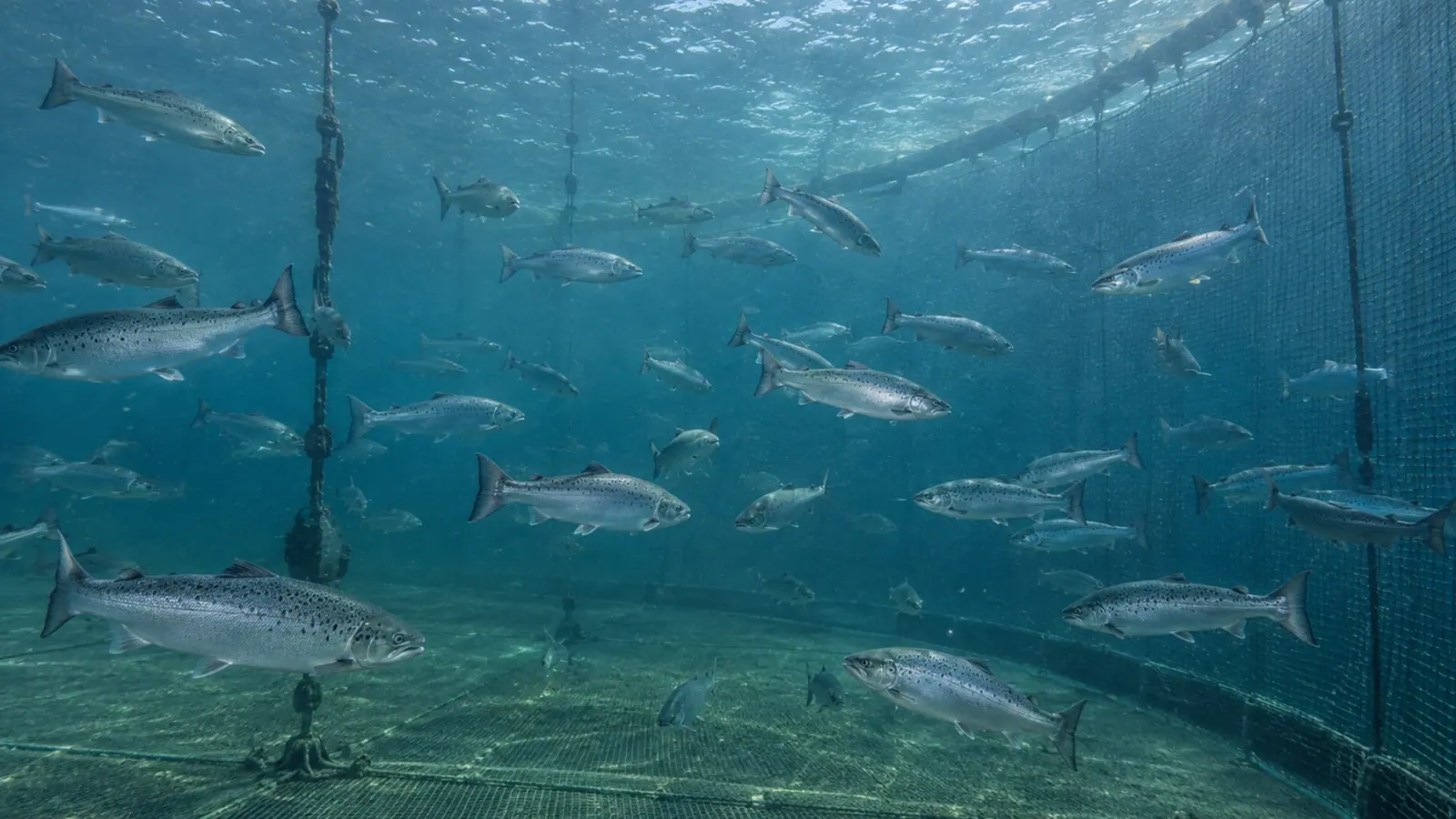
Salmon Moritella vaccination: evidence from sea cages
A Norwegian field trial links an additional vaccine against variant Moritella viscosa to lower mortality during winter ulcer outbreaks. Cage-level comparisons, local reactions and commercial production constraints are central to interpreting the findings.


- Content type
- Scientific news
- Sector
- Aquaculture
- Animal group
- Salmonids
- Keywords
- VaccinationImmunityBiosecurity
Match the prevention question to the circulating strain
Winter ulcer disease affects both fish health and welfare in Atlantic salmon, Salmo salar. Damage to the skin compromises a protective barrier, and infection may also involve internal organs. Finding ulcers in vaccinated fish does not, by itself, show that vaccination as a whole has failed. The pathogen, its variant and the time available for immune protection all matter.
Furevik and colleagues report a commercial field trial in 2026 of a monovalent vaccine targeting variant Moritella viscosa. The test vaccine was given alongside commercial core vaccines. Controls received the same underlying vaccination programme without the additional product. The study therefore assesses an incremental intervention, rather than comparing vaccinated fish with an entirely unvaccinated population.
A large population does not remove the need for replication
Approximately 4.2 million fish received the additional vaccine and 4.1 million served as controls. The original production network comprised seven freshwater vaccination facilities and eleven seawater sites. Fish were followed from vaccination until harvest, with cohort identities and transfers recorded through the production cycle.
The total number of fish is not the number of independent experimental replicates. Animals shared tanks and then sea cages, where exposure, husbandry and operational interventions can influence outcomes together. Comparisons must retain the cage and cohort structure. Millions of animals cannot compensate automatically for a limited number of independent production units.
Treatment assignment and allocation to production units were randomised, but commercial logistics introduced imbalances. One seawater site was excluded after severe parasitic infection unrelated to the trial vaccines. A cohort affected by a vaccination machine malfunction was also excluded from statistical analyses. Those exclusions are part of the evidence and should remain visible when considering its practical relevance.
Lower mortality during confirmed outbreak periods
Variant M. viscosa winter ulcer outbreaks occurred at three marine sites, during both winters of the seawater phase. Diagnostic investigation combined clinical observations, bacterial culture and molecular confirmation with isolate typing. The appearance of an ulcer alone was not sufficient to identify the bacterium responsible for an event.
Across the two outbreak periods, the estimated mortality rate ratio for test versus control cages was 0.57, with a 95% confidence interval of 0.45–0.74. This represents an estimated relative reduction of 43%. It is not a reduction of 43 percentage points, and it does not promise the same benefit at another farm.
The endpoint was total mortality during the designated outbreak windows. Cause-specific mortality was not recorded consistently enough to attribute every death to winter ulcer disease. The result is therefore a favourable association in cages experiencing confirmed outbreaks, rather than a count limited to individually proven Moritella deaths.
Time at risk also differed between sites and harvest periods. Comparing raw cumulative percentages without their observation windows would obscure those differences. The statistical analysis addresses aspects of this structure, but it cannot reconstruct information that commercial monitoring did not capture.
Acute mortality and local reactions answer different questions
During the 21 days after vaccination, estimated mean mortality was 0.156% in controls and 0.159% in the test group, after the stated exclusions. A rate ratio of 1.02 did not demonstrate a statistically significant difference. That finding concerns a defined period and endpoint; it does not establish the absence of every possible adverse effect.
Local tissue assessments provide another part of the safety picture. Abdominal adhesions and visceral melanisation were slightly more frequent in fish receiving the additional vaccine. The authors describe reactions as mild to moderate, with no adhesion score above 3 on the 0–6 scale used. Low short-term mortality is therefore not a substitute for examining tissue reactions.
Antibody titres were higher in the test group, but antibody measurements do not replace clinical outcomes. Harvest grading results were descriptive because grading procedures and harvest schedules varied. The trial was not designed to establish a growth advantage, and the reported findings should not be converted into a claim of improved weight gain.
Conditions that constrain use beyond Norway
The evidence concerns commercially reared Atlantic salmon in Norwegian production systems. It does not validate the intervention for another species, another environment or every organism associated with skin ulcers. Nor does a published field trial establish permission to use a product in a different country.
Cages can differ in infection pressure, hydrodynamics, biomass and concurrent health problems. Reports of other disease events were not fully standardised. Vaccination dates and the time available for immunisation before seawater transfer also varied between some groups. Statistical adjustment cannot remove all potential confounding from these differences.
Funding and affiliations are relevant to interpretation. PHARMAQ funded the study, with additional support from the Research Council of Norway, and most authors were affiliated with PHARMAQ. These relationships do not make the measurements unusable. They do make it especially useful to distinguish observed outcomes, the authors’ conclusions and a farm veterinarian’s decision for a particular site.
Build a prevention review around the farm record
A practical starting point is to retain the diagnostic findings from previous ulcer outbreaks and, where feasible, preserve isolates for further characterisation. This allows the veterinarian to assess whether the pathogens encountered are consistent with the antigens in the prevention programme. Product availability, authorised conditions and the local legal framework must be checked separately.
Monitoring should connect cage-level mortality with lesion observations, handling events, water conditions, transfer dates and post-vaccination reactions. Biosecurity and protection of the skin barrier remain necessary alongside vaccination. Changing a vaccine programme does not replace investigation of an active outbreak or measures to reduce avoidable injury.
The comparison should also be planned before the next production cycle. Agreeing which outcomes will be recorded, how units will be identified and how transfers will be traced makes later interpretation more credible. A retrospective comparison assembled from incompatible records may be unable to distinguish a programme change from differences in exposure.
Conclusion and support from Vetofish
This trial provides favourable commercial evidence for additional protection against variant M. viscosa. Its value lies in the combination of confirmed outbreaks, cage-level outcomes and safety observations, interpreted within the limits of a field study. The appropriate decision depends on the pathogen and the production context.
Vetofish can help connect ulcer histories, laboratory findings and prevention monitoring through our aquatic health expertise, tailored to aquaculture operations. We work with teams to develop a documented review of their programme without promising that future outbreaks will be eliminated.


