

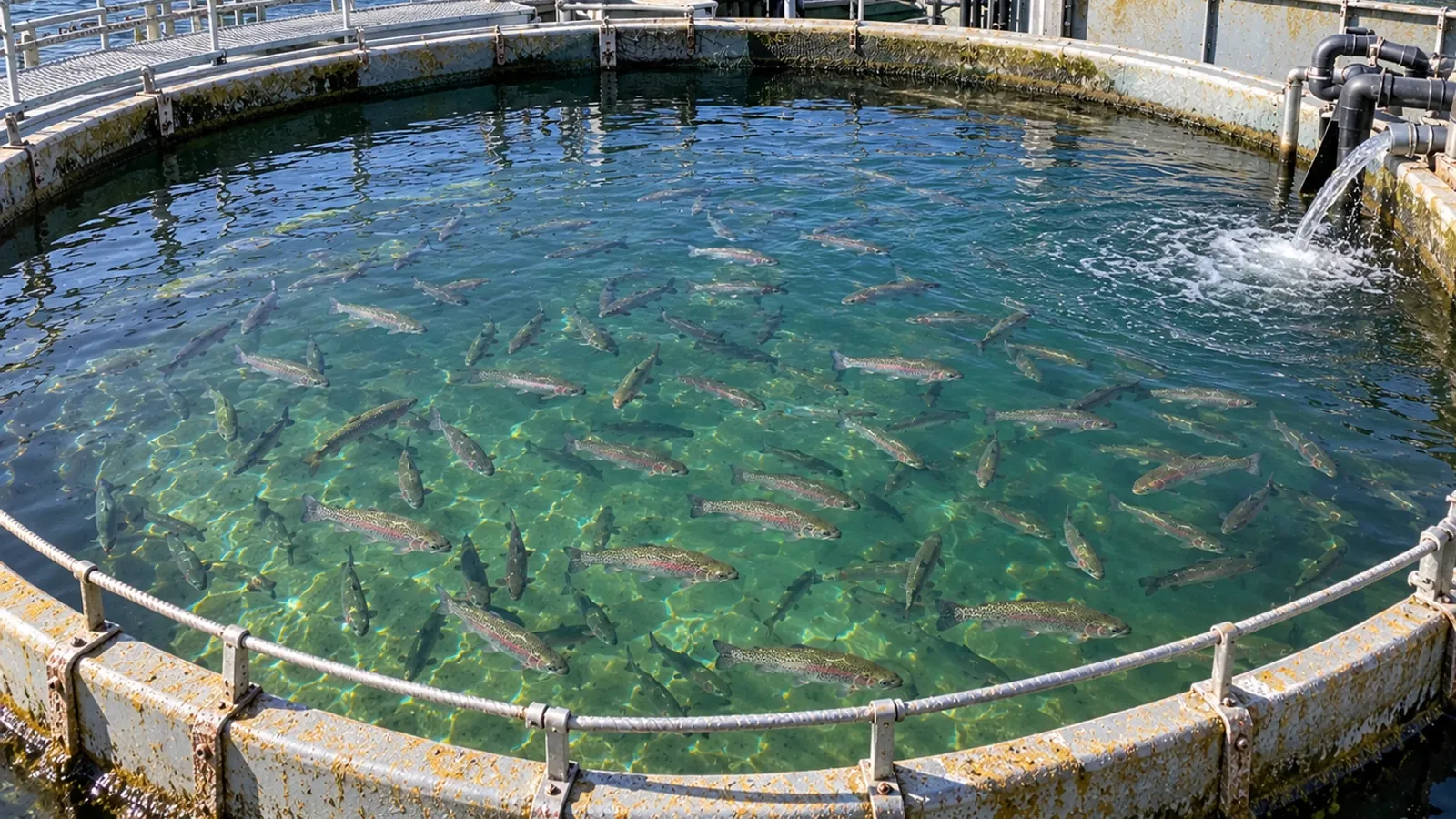
Salmonid cataracts: species matter as well as temperature
A shared feed and water supply do not guarantee the same lens health in different salmonids. A 2017 experiment compared Atlantic salmon with rainbow trout in seawater. Its findings help farm teams separate species, pre-existing opacities and lens metabolism when investigating cataracts.


- Content type
- Scientific news
- Sector
- Aquaculture
- Animal group
- Salmonids
- Theme
- DiagnosticsNutrition
- Keywords
- TemperatureSalinityTransport
An apparent opacity in a fish’s eye needs a more precise description before it can guide a farm investigation. A cataract affects the lens. An external photograph may document an abnormal appearance, but it cannot reliably locate every ocular opacity. Recording the examination method and the animals examined is therefore part of establishing what the problem actually is.
A study published by Remø and colleagues in 2017 offers a useful comparison between Atlantic salmon, Salmo salar, and rainbow trout, Oncorhynchus mykiss. The researchers investigated lens metabolism in fish held in seawater. The experiment itself took place in 2010.
Start with the condition of the fish entering the comparison
The experiment combined two species with two temperatures, 13 and 19 °C, using four replicate tanks for each combination. There were sixteen tanks altogether, and the trial lasted 35 days. Every group received the same feed. These are study conditions, rather than recommended operating temperatures for other farms.
The initial prevalence of cataract was 70% in salmon and 10% in trout. The species were therefore already different before the temperature comparison began. Looking only at the final examination would hide this starting point and could make existing opacities appear to have developed entirely during the trial.
For a farm team, the practical implication is to retain a baseline when reviewing a change in feed, water environment or husbandry. If no baseline examination exists, that uncertainty belongs in the investigation. Finding several affected fish on one day establishes neither when their lesions began nor whether the whole stock changed at the same time.
Prevalence and severity answer different questions
Prevalence describes the proportion of examined fish affected. A severity score describes the extent of opacity under a defined scoring system. A high proportion of mildly affected animals can require a different interpretation from a small number with extensive opacities. Neither measure can stand in for the other.
The researchers examined lenses with a slit lamp and scored the two eyes separately. At the final assessment, nine fish were examined from each of the four tanks in every species–temperature combination. Tank replication remained relevant to the analyses reported at that level. Two eyes from one fish do not provide two independent farm replicates.
A field record should retain the number examined, the source of the fish and the distribution of scores. A mean can conceal the more severe cases. Selection also matters: examining only fish with poor feeding responses does not directly estimate cataract prevalence throughout the stock. Repeated examinations should say whether they concern the same individuals or a fresh sample.
Lens chemistry changed without a demonstrated temperature effect on final scores
By the end of this experiment, cataracts were more common and more severe in salmon than in trout. The authors did not detect a significant temperature effect on final cataract prevalence or severity. That finding should remain attached to this experiment; it does not establish that temperature is irrelevant to cataracts in every farming situation.
Lens metabolite profiles nevertheless differed between species and temperatures. Histidine and N-acetylhistidine were among the compounds discussed. Detectable biochemical changes can therefore occur without a demonstrated difference in a clinical score over the same observation period.
The measurements do not settle the direction of every relationship. A metabolic difference could contribute to opacity, accompany its development or result from it. Calling such findings candidate biomarkers preserves that distinction. Describing them as a validated predictive test for all salmonid stocks would go beyond the evidence.
A common diet is not a test of nutritional correction
The trial did not compare multiple histidine intakes. Its results alone cannot establish a feed adjustment that would prevent cataracts in another farm. The fact that the fish received the same diet is useful for interpreting the comparison, but it does not demonstrate that the diet met every lens-related need equally in both species.
Growth requirements and questions about ocular health should be examined separately. A suspected nutritional contribution calls for a review of species, life stage, feed formulation and actual feeding history. It does not justify adding amino acids empirically whenever an opacity is noticed.
Salinity, recent transfers, temperature records and feeding events can all provide context for examination findings. Their inclusion in the history does not assign causation. Changing several conditions at once can also make later improvement difficult to interpret, because the contribution of each change remains unresolved.
Keep the investigation open to re-examination
A useful case file connects stock identity, species, stage, date, examination method and individual findings. Feed changes and available water records can then be aligned with that timeline. Missing measurements should remain identifiable rather than being replaced with assumptions about what the conditions probably were.
Feeding response and growth complement an ocular examination. They do not directly measure vision. Reduced feeding has several possible explanations, and a relationship with a lens score does not establish how much visual function has been lost. Descriptions of swimming and responses to food are more useful than an automatic label of blindness.
The study was short and involved two species, particular fish and one diet. An author disclosed an industry affiliation. These points belong in its critical assessment, alongside the initial difference in cataract prevalence and the absence of a dietary dose comparison. The findings support more precise questions rather than a universal treatment recipe.
Match the next decision to the documented problem
Separating the location of an opacity, its frequency, severity and development makes an investigation easier to review. It provides a basis for selecting further examinations without assigning every case to one water variable or an assumed deficiency.
Vetofish’s consulting and support service can help review stock records, organize the description of ocular findings and frame nutritional questions. For aquaculture operations, the aim is a traceable comparison and a proportionate decision, without promising a predetermined dietary correction or recovery of vision.


