

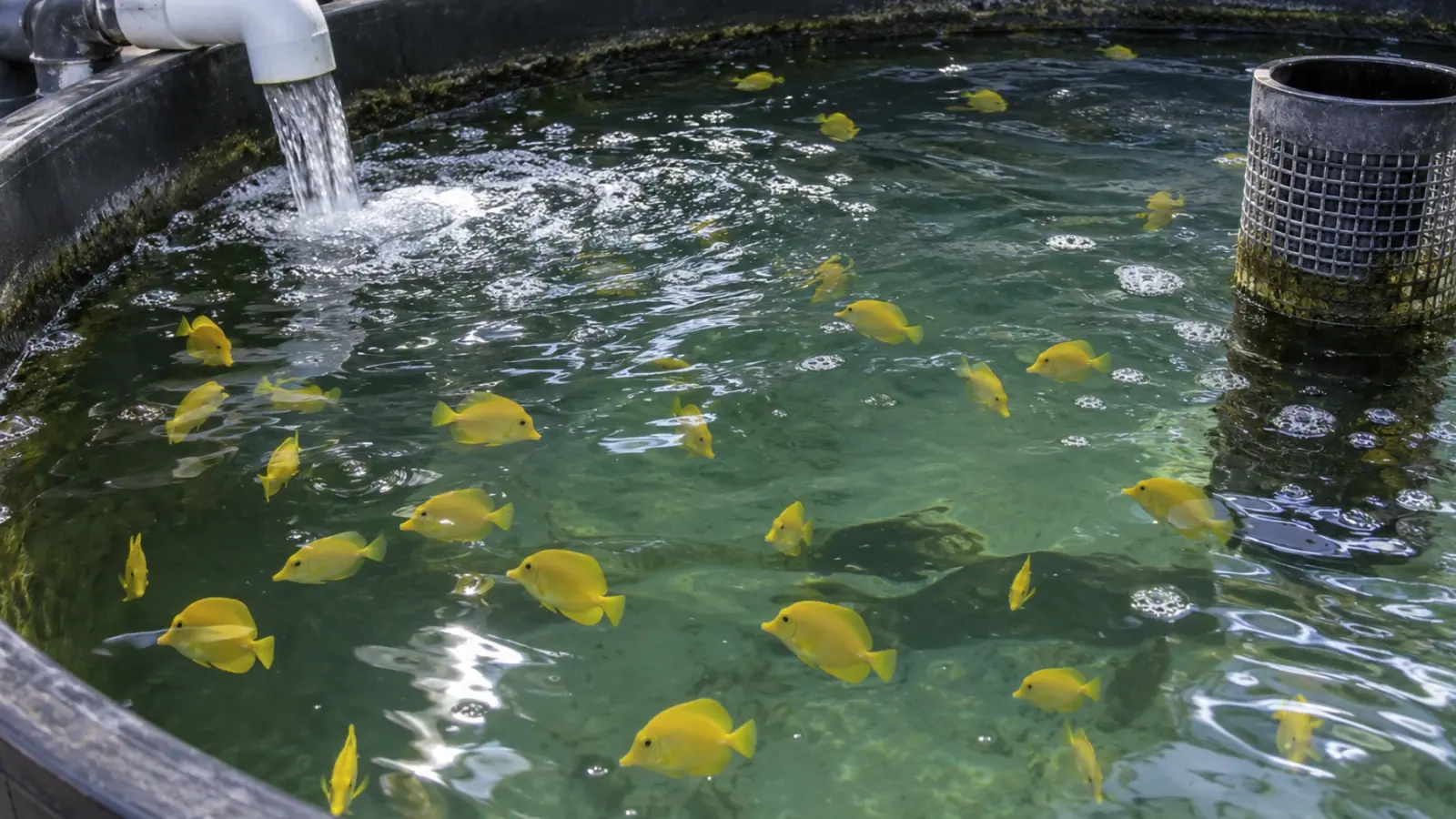
Yellow tang: finding Vibrio does not diagnose vibriosis
A September 2026 study follows the yellow tang microbiome from hatching to settlement. High relative abundances of Vibrio at some stages draw attention to live feeds, while leaving the cause of larval mortality unresolved.

- Content type
- Scientific news
- Sector
- Aquaculture
- Animal group
- Fish
- Theme
- DiagnosticsNutrition
- Keywords
- MicrobiomePCRBiosecurity
A production cohort, rather than a treatment trial
Yellow tang, Zebrasoma flavescens, are valuable marine ornamental fish, but their early development remains a difficult part of captive production. A study by Annie Deck and colleagues, published in PeerJ in September 2026, follows the bacterial communities associated with a cohort reared at the Oceanic Institute in Hawaii. The fish were produced in a recirculating aquaculture system.
The study tank held 1,000 litres and was stocked with approximately 40,000 fertilised eggs. Sampling covered eight ages between two and 76 days after hatching. Fish-associated communities were compared with bacteria detected in rearing water, tank particles and food. Sampling these compartments allows comparisons that incoming-water tests alone would miss.
This was one production cohort in one tank. Repeated samples and pooled larvae do not turn it into a comparison between independent hatcheries. The study describes microbial succession; it does not establish the effect of a feeding intervention or a disease treatment.
What a bacterial profile can tell a hatchery
The researchers analysed a region of the bacterial 16S ribosomal RNA gene using extracted DNA. Sequencing identifies bacterial groups and their relative representation in the sample. It does not directly count viable bacteria per millilitre of water or per fish intestine.
A larger share of sequence reads may reflect an increase in the group of interest, a decline in other groups, or both. It should not be reported as the percentage of fish that are infected. Nor is this community-profiling method equivalent to an individual diagnostic test for vibriosis.
There is another complication when comparing ages. Early samples consisted of pooled whole larvae, while later fish were large enough for intestinal dissection. The early signal can therefore include bacteria associated with surfaces and tissues outside the gut. The authors acknowledge this change in sampling material. Not every difference between early and late samples can be assigned exclusively to intestinal development.
High Vibrio proportions do not establish disease
The genus Vibrio was detected at every sampled age. It accounted for 97.2% of bacterial reads at 36 days after hatching and 94.2% at 55 days, before falling substantially at the final sampling point. These are relative sequence abundances, subject to the taxonomic resolution of the marker.
Several closely related species can share the same short sequence region. Detecting that sequence does not establish which virulence factors a strain carries. A genus that includes important pathogens can also contain bacteria whose detection does not demonstrate the cause of disease in the sampled fish.
Mortality was substantial in this cohort, but there was no infection challenge establishing its cause. Clinical observations, lesions, production records and appropriate microbiological investigations remain necessary when a hatchery suspects a disease episode. A high relative abundance can guide further investigation; it does not, on its own, justify a therapeutic decision.
Why the live-feed sequence deserves attention
The larvae received different live feeds as they developed. Artemia were introduced during the feeding sequence, with enriched Artemia supplied from around 30 days after hatching. The subsequent increase in the relative abundance of Vibrio led the researchers to consider live feed as a possible route of bacterial exposure.
Timing alone does not establish transmission that causes illness. Fish age, feed quantities, particulate material and microbial communities changed during the same period. Food samples were also composites rather than independent replicates for each source. This design cannot assign a quantified disease risk to a particular feed item.
Fish-associated communities also resembled those associated with tank particles. Such particles may include uneaten feed, microbial aggregates and material released by the fish. Exchange could operate in both directions: animals can acquire bacteria from particles and contribute bacteria to them. Similar profiles do not automatically identify the original source of an organism.
The probiotic finding needs a separate interpretation
An additive containing Pediococcus acidilactici was used during Artemia enrichment. The bacterium was not detected in the analysed samples. The authors discuss concentrations below the detection threshold or unsuccessful establishment as possible explanations.
The result does not measure a clinical benefit, because the study did not compare supplemented and unsupplemented production groups. Equally, it does not demonstrate that probiotics as a category are ineffective. Evaluating a specific product would require a design suited to that question, with documented exposure and health outcomes defined before the trial.
For hatchery staff, this distinction prevents two shortcuts: assuming that adding a product proves it has established, and assuming that a sequencing non-detection settles its effectiveness. Neither conclusion follows from the available observations.
Turn the findings into a clearer sampling question
The practical value of the work is in identifying what should be recorded and compared. Fish age, live-feed origin, enrichment procedures, food batches and mortality events provide context for laboratory findings. Water samples alone cannot substitute for examining affected animals and relevant feeding compartments.
Sample descriptions should specify whether the material is a whole larva, a pool of several fish or a dissected intestine. Without that information, comparisons can combine different biological compartments under the same label. Targeted pathogen testing and broader community profiling address different questions and should be selected accordingly.
Connect the molecular result with fish health
This study documents one yellow tang production cycle in detail. It raises testable hypotheses about feeds and tank particles, while providing no universal Vibrio threshold for intervention. Hatchery biosecurity decisions still require knowledge of production pathways and concordant health evidence.
Vetofish supports professional aquaculture operations with sampling design and interpretation of diagnostic investigations. The aim is to connect a laboratory result to a defined problem in the stock, so that management decisions follow the evidence available for that case.


