

Salmon transfer: salinity responses and microalgal limits
A 2024 Atlantic salmon trial found that plasma ion recovery and molecular responses followed different courses after brackish-to-seawater transfer. Microalgal diets provided limited mitigation under the conditions tested.


- Content type
- Scientific news
- Sector
- Aquaculture
- Animal group
- Salmonids
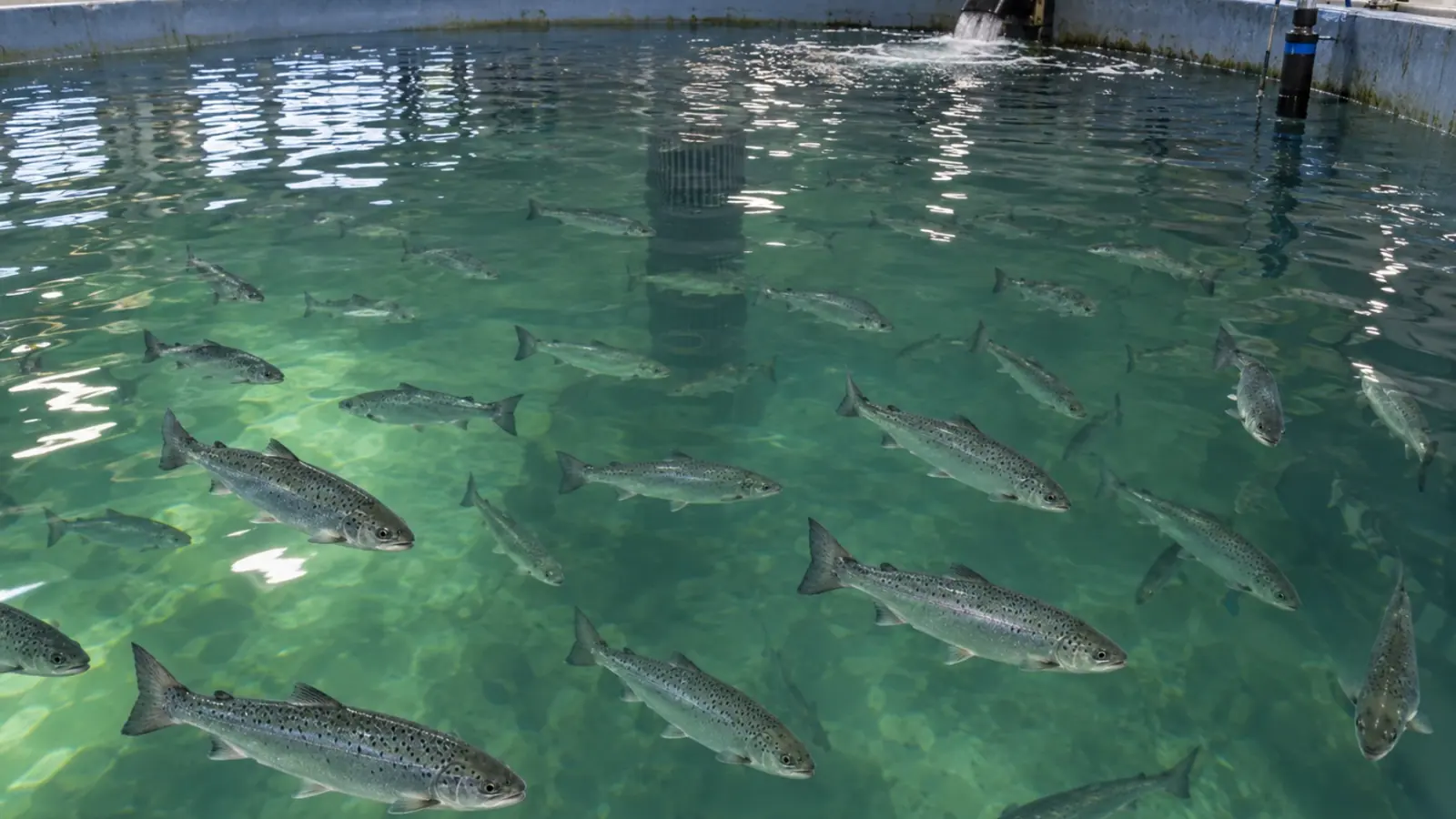
Seawater transfer can succeed in terms of ion balance while leaving other physiological responses detectable for longer. For Atlantic salmon farms, the salinity reached and the appearance of normal swimming cannot describe every part of adaptation. A 2024 study by van Muilekom and colleagues examined that distinction, alongside the limited effects of several microalgal dietary preparations.
The fish were already acclimated to brackish water before entering seawater. That history matters. This was not a direct recreation of every move from a freshwater hatchery to a marine cage, and the results should not be used as a universal transfer programme. They concern a defined transition, developmental stage and controlled rearing environment.
What the experiment actually compared
Salinity changes alter the gradients driving water and ion exchange between fish and their surroundings. Smoltification prepares young salmon for marine life, whereas acclimation continues after the environment changes. A silver appearance or a planned transfer date alone cannot establish that all relevant physiological functions are ready.
The experimental fish spent two months in brackish water before an eight-week feeding trial. They subsequently moved between recirculating systems with practical salinities of approximately 13 and 32. Those values describe the comparison. They do not establish a mandatory intermediate salinity or operating instructions for another farm. Water conditions and the fish’s previous history remain part of the evidence.
Six diets were tested: a control and five microalgal preparations included at 8%. Each diet had three tanks. At each sampling point, nine fish per diet were examined, distributed across those tanks. For dietary interpretation, tank replication is important; taking more measurements from individual fish does not create equivalent independent repetitions of the feeding conditions.
Ion balance and gene expression followed different courses
Sampling took place before transfer, twenty hours afterwards and two weeks afterwards. Osmoregulation maintains internal water and solute conditions within functional limits. Plasma sodium and chloride concentrations rose slightly at the early sampling point and returned towards their initial levels at the later one. This supports successful ionic compensation under the conditions tested.
Other measurements did not describe an identical recovery schedule. Gene-expression analyses in the gills and head kidney revealed changes that depended on both tissue and sampling time. Several measured gill genes were expressed at lower levels following transfer. In the head kidney, an early activation was followed by reduced expression affecting, among other targets, genes associated with antiviral responses.
Gene expression is a measurement of activity in selected molecular targets. It is not a direct measurement of resistance to infection. The experiment did not include an infectious challenge capable of demonstrating improved protection or increased clinical susceptibility. Describing the findings as proven disease vulnerability would therefore go beyond the evidence. Nor does a later molecular difference, by itself, establish poor welfare in every affected fish.
Dietary effects remained limited
The preparations involved Chlorella, Tetraselmis, Arthrospira and Schizochytrium. Dietary effects were limited relative to the changes associated with transfer. Some responses varied with diet and tissue, but they did not establish a general protective effect that would justify reducing attention to environmental or handling conditions.
The finding also has a boundary in the opposite direction. Limited mitigation in this experiment does not show that all microalgae lack nutritional value in aquaculture. The algal organism, preparation, inclusion level, overall formulation and salmon life stage define the comparison. “Microalgae” is not a single interchangeable feed ingredient with one predictable effect across products.
For a farm considering a functional diet, the useful question is which claimed outcome the supporting evidence actually measures. A change in a molecular marker is insufficient to demonstrate better survival, disease prevention or a consistent reduction in stress. Nutritional measures remain part of management rather than a substitute for physiological preparation, appropriate water conditions and careful handling.
Build follow-up around fish and their environment
A practical response is to combine animal observations with the record of environmental change. Feed intake, distribution within a tank, swimming, ventilation and losses can help identify an unusual course after transfer. No single observation proves that acclimation has finished. Conditions before and after movement, and other events occurring at the same time, should remain available for interpretation.
This professional monitoring proposal follows from the study’s limitations; the trial did not validate it as a follow-up protocol. Its three sampling points do not prescribe a veterinary examination timetable for every production site. They illustrate why timing changes the question being answered: an early assessment can reveal a response that differs from the pattern seen later.
Persistent feed refusal, unusual ventilation or rising losses warrant assessment of environmental, health and handling-related causes. Assuming that such signs are merely normal adjustment could delay investigation of another problem. Equally, a molecular result from this controlled trial cannot diagnose the cause of signs in a different production group.
Where these findings are useful
The experiment separates effective ionic compensation from a uniform return of every measured indicator to its starting state. Its value lies in that distinction and in setting limits on dietary claims. Different stocks, previous salinity exposure, temperatures and transfer arrangements may produce different responses. Evidence from brackish-to-seawater movement should retain that history whenever it informs a freshwater-to-seawater decision.
The findings support continued observation after transfer and careful appraisal of nutritional evidence. They provide neither a universal transfer recipe nor proof of protection against disease. More detailed monitoring should answer a defined operational question rather than add measurements without an interpretation plan.
Through our animal welfare support, Vetofish can help aquaculture teams select follow-up indicators, connect observations to the transfer sequence and assess the evidence behind functional feeds. The intended result is a site-specific decision record that retains the production group’s actual conditions and the uncertainties that remain.


