

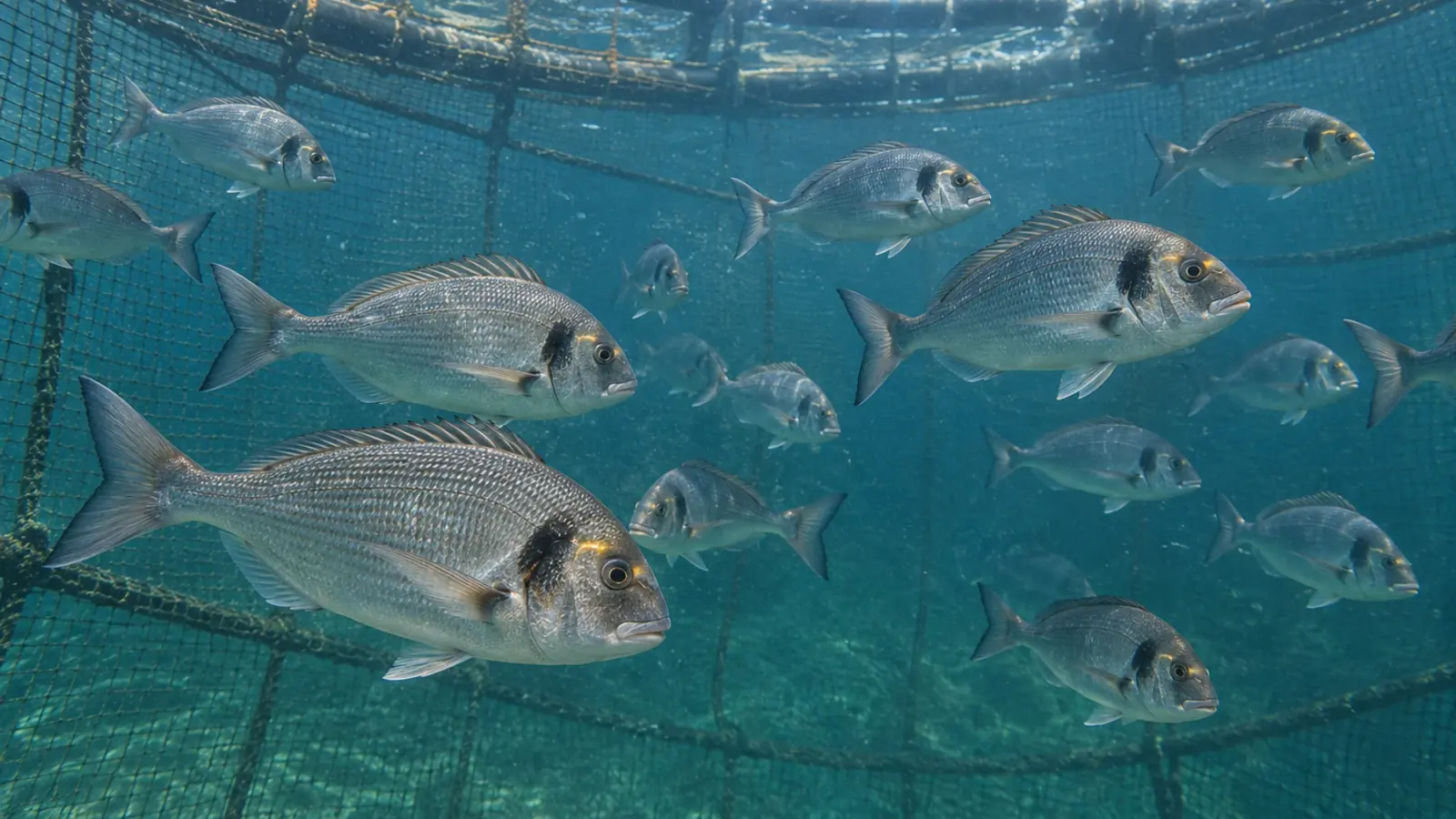
Farm resistomes: interpreting detected resistance genes
A Mediterranean study tracks resistance genes in gilthead sea bream and their farming environment. These findings can guide surveillance, but detecting a gene does not establish which bacterium carries it or whether a treatment will fail.


- Content type
- Scientific news
- Sector
- Aquaculture
- Animal group
- Fish
- Keywords
- BiosecurityPCRMicrobiome
A resistance-associated sequence in a sea bream, a water sample or a sediment sample provides different information from a bacterial isolate collected during a disease investigation. Sequencing describes genetic material in a sample. Susceptibility testing examines how a particular isolate responds under specified conditions. Moving directly from the first result to a treatment decision skips several necessary steps.
Two open studies help explain the distinction. Basili and colleagues investigated gilthead sea bream, Sparus aurata, across Mediterranean farming stages and environmental compartments. Ortiz-Severín and colleagues examined variants of the phenicol-resistance gene floR in bacterial communities associated with Chilean salmonid farms. The findings are complementary, provided each remains tied to its own population and methods.
What a resistome survey measures
A resistome is the collection of genetic resistance determinants considered within an environment or microbial community. Shotgun metagenomics examines DNA extracted from a sample without first growing each microorganism separately. This makes it possible to investigate complex communities, including bacteria that are difficult to recover through routine culture.
The resulting inventory depends on DNA quantity, sequencing depth, sequence-matching criteria and reference databases. It is not automatically a complete catalogue of every determinant present. Failure to recover a sequence can reflect sampling or analytical limitations rather than biological absence.
An antimicrobial susceptibility test answers a different question about a cultured isolate. A detected gene’s integrity, expression and bacterial host can affect its consequences. Finding a resistance determinant in farm water therefore does not establish which medicine would be appropriate for a diseased fish. Molecular surveillance and clinical investigation need to be connected through a specific question.
Following sea bream through production
The study by Basili and colleagues appears in the 2026 volume of Aquaculture. It includes farming sites in Italy, Greece and Spain, different production stages and environmental matrices. Wild sea bream from Italy and Greece provide comparisons. The work includes no French site and should not be treated as a random survey of the whole Mediterranean industry.
Of 440 samples collected, 200 contained enough DNA for sequencing. These were not 200 independent fish: the material included tissues, early developmental stages and environmental samples. Both the selection for sequencing and the mixture of sample types matter when comparing results.
Resistance-gene profiles differed between fish and their surroundings, with further shifts between land-based and marine farming phases. Beta-lactam-associated determinants were prominent in farmed adults. These findings describe the distribution of sequences. They do not demonstrate treatment failure in every fish carrying such material, nor do they establish transmission to people eating farmed fish.
The Mediterranean setting makes the work relevant to regional surveillance, while its limits remain local and methodological. Similarities between production systems can justify asking the same question elsewhere; they cannot establish that another farm has the same gene profile.
A gene name does not establish its function
The Chilean study adds an experimental check. The researchers collected surface seawater bacterial communities from two salmonid farming sites, investigated floR sequence variation and expressed selected sequences in an experimental bacterial host. This allowed them to examine phenicol resistance rather than stopping at sequence identification.
The recovered variants did not produce identical resistance phenotypes in that system. Sequence changes could increase or decrease the measured response. This is a practical illustration of why assigning a familiar gene name to a sequence does not replace functional assessment.
The experiment does not provide a treatment ranking for all bacteria at salmon farms. Two sites, their particular histories and expression in an experimental host cannot reproduce every combination of bacterial background, gene regulation, fish and medicine. Its value is a mechanistic demonstration within the tested conditions.
Keep the sampling and analysis comparable
Before comparing reports, identify the compartment: water, biofilm, sediment, feed or fish tissue. These matrices contain different communities. An increase in sediment-associated sequences is not equivalent to an increase in fish, even when samples come from the same facility.
Normalisation also changes what a number means. Relative abundance describes a gene’s representation within a set of sequences. It does not directly give the number of resistant bacteria per litre. A database update or a change in identification thresholds may alter an inventory without any corresponding change at the farm.
A useful time series retains location, date, developmental stage, health events and interventions. Water temperature and movement can help describe sampling conditions. Their association with a difference does not, by itself, establish what caused the genetic pattern.
Decide what the result will be used for
A targeted PCR assay can complement metagenomic work when a defined determinant needs investigation. It remains a target-detection method. A positive result does not automatically establish bacterial viability, gene expression or the identity of the host organism. The intended decision should be written down before requesting the assay.
During a clinical episode, observations, lesions and appropriately selected samples remain essential. Culture and susceptibility work on relevant isolates can address questions that a community DNA survey cannot answer alone. At site level, resistome surveillance may help select compartments for further investigation or assess whether an apparent trend is reproducible.
These uses do not justify preventive treatment of the environment simply because a gene was detected. The investigation needs to distinguish a molecular observation, a demonstrated biological function and evidence relevant to the affected animals.
Conclusion and Vetofish support
Resistome analysis expands surveillance beyond the isolates recovered in culture. Its interpretation should keep three questions explicit: which sequence was found, in which compartment, and what function has actually been demonstrated?
Vetofish’s aquatic health expertise can help define sampling questions and interpret results with aquaculture teams. The aim is to connect molecular information with a proportionate health decision while retaining the distinction between environmental surveillance and treatment evidence.


