

Shellfish mortality: separating reports from surveillance
Two diagnostic investigations do not mean that an entire industry experienced only two mortality events. Scotland’s 2025 shellfish survey brings together production returns, risk-based inspections and health investigations. Understanding what each system records is essential before drawing conclusions about farm losses.
- Content type
- Practical guide
- Sector
- Aquaculture
- Animal group
- Corals and invertebrates
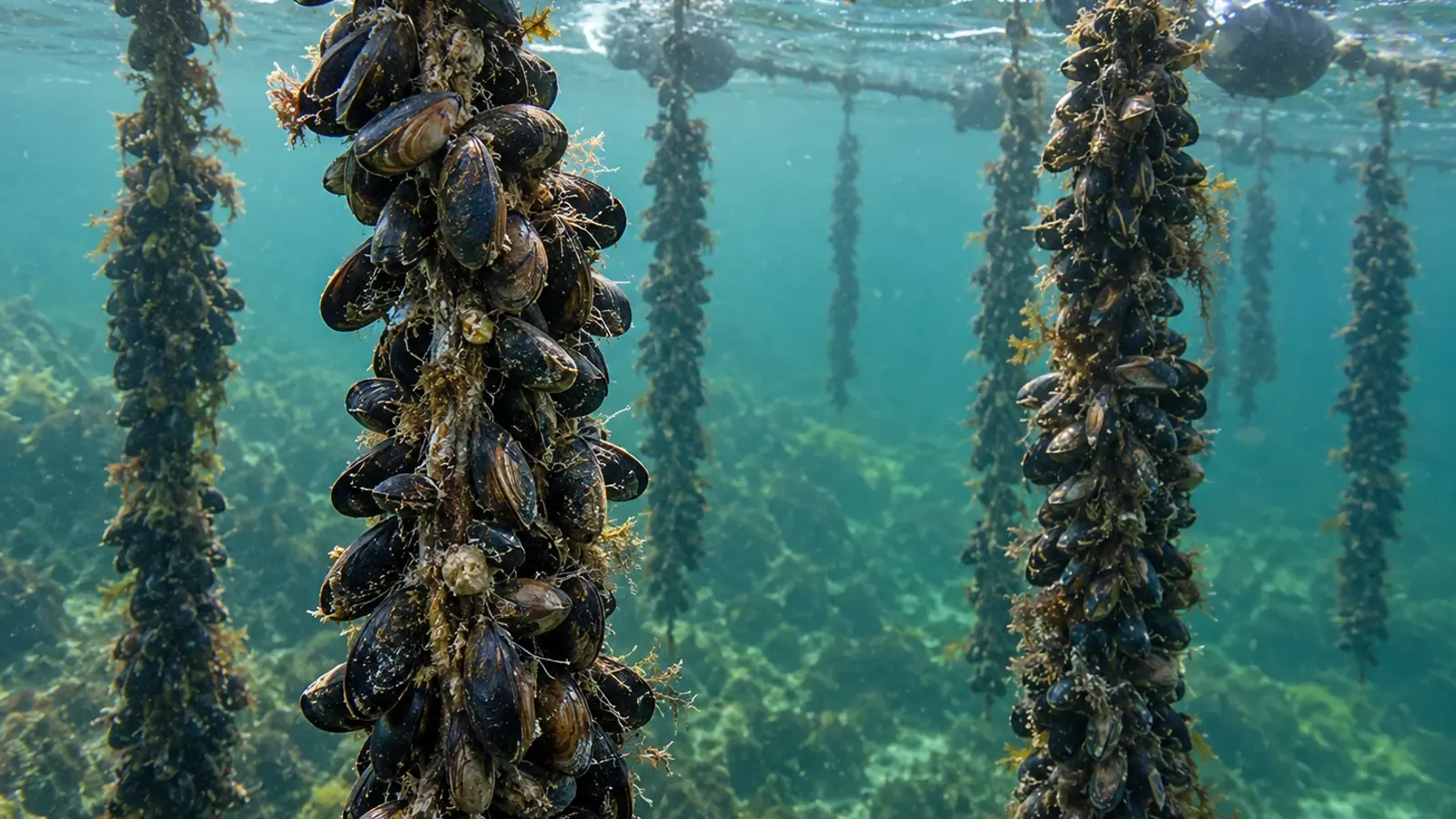
A farm may first notice losses as empty shells, a thinning section of cultivation rope or a change in the condition of stock. Those observations need a defined scale. A problem on one rope, basket or growing area does not yet describe the whole site. The same caution applies to industry statistics: the number of diagnostic files opened by an inspectorate cannot stand for every animal lost during the year.
The health chapter of Scotland’s shellfish production report, published in May 2026, brings together monitoring activities that answer different questions and require different denominators.
Keep production returns, inspections and investigations separate
The Scottish Shellfish Farm Production Survey 2025 starts with a questionnaire sent to active, authorised shellfish businesses. The reported response rate was 100%. That figure describes participation in the production survey. It does not establish that every shellfish death was counted, examined or investigated diagnostically.
A separate health programme used risk-based surveillance. The report records inspections at 110 of 272 active sites, with records checked remotely at another 37 sites. Visits considered facilities, stock health, biosecurity measures and movements, among other matters. The programme is not described as a random sample designed to estimate disease prevalence throughout the industry.
High, unexplained mortality reports can also lead to diagnostic investigation. These cases form a third stream of information, with their own triggers. Questionnaires, site visits and diagnostic cases should therefore remain separate in a dashboard or report. They may concern the same farm, and adding them together would mix different activities rather than describe a single surveillance total.
Whenever a figure is quoted, the accompanying question should be clear: how many respondents, how many sites visited or how many cases investigated? Without that distinction, apparently straightforward comparisons become difficult to interpret.
What the two diagnostic cases establish
The health chapter reports two shellfish diagnostic cases arising from notifications of high, unexplained mortalities in 2025. It states that the investigations found no association with listed, notifiable diseases. That conclusion applies to the investigations conducted and the diseases considered within them.
The report also lists causes to which reported mortalities were attributed, including predation, fouling organisms, adverse weather and damage during grading or handling. It does not provide a national percentage of losses caused by each factor. These are reported attributions across different circumstances, potentially supported by different levels of evidence.
Farm records benefit from an equally careful distinction between observations. Empty shells on the seabed, detached animals and dead stock still held on a cultivation support are not identical findings. Recording them separately preserves the question of whether the observed loss involved death, displacement or disappearance whose mechanism remains uncertain. An early label should not remove that uncertainty from the record.
Bound a negative result to the question examined
A diagnostic result needs the investigation question, the animals examined and the sampling date. Finding no association with particular diseases does not, by itself, identify what caused the losses. Nor does it establish the health status of animals that were never examined.
Histopathology can describe tissue lesions, for example, while a targeted agent test addresses a different question. The appropriate combination of examinations depends on the case and should be agreed with the veterinarian and receiving laboratory. The Scottish report does not prescribe a universal testing panel for every shellfish mortality event.
Place and time also limit the interpretation. The report concerns Scotland and the 2025 reporting year. Its health and administrative information does not establish the current status of another territory. Decisions about stock movements require the official conditions relevant to the location, species and date, checked with the competent authority.
These limits make the result more useful. They show which questions have been addressed and which remain open, instead of allowing a short negative conclusion to carry more weight than the investigation supports.
Build a usable account of losses at the farm
A practical case record begins with an identified stock batch and cultivation unit, the first observation date and the distribution of losses. It should say what was counted and what was inferred from a sample or a visual check. A whole-farm percentage can be misleading when only an accessible section of the installation has been examined.
Consistent units help reveal change over time. Repeated observations of the same batch, length of rope or sampling method are easier to compare than records whose scope changes from visit to visit. An incidence estimate requires an exposed population and a defined period. If the initial number of animals is uncertain, that uncertainty belongs alongside the estimate rather than disappearing behind a precise percentage.
Recent movements, grading operations, transport, weather events and temperature records can then be placed on the same timeline. A close temporal association identifies something to investigate; it does not demonstrate a cause. Neighbouring batches may provide useful context, provided differences in origin, age and management are retained.
Such preparation supports communication with animal-health professionals. It should not delay notification of abnormal or unexplained mortality under local requirements while staff try to complete a perfect dossier. Sampling and shipping arrangements should be agreed with the receiving professionals so that the specimens and field observations address the same question.
Use the figures to improve the next decision
The Scottish example distinguishes survey participation, inspection coverage and diagnostic conclusions. None summarises the health of every farm by itself. Reporting totals also depend on what staff can observe, recognise and communicate, so changes in those totals may require a look at the reporting system as well as conditions in the stock.
At farm level, useful comparisons start by making the underlying record interpretable: which population, over what period, experiencing what event and observed by which method? Those details give a trend its meaning and help define the next investigation.
Vetofish supports aquaculture professionals with health expertise and surveillance planning. The work connects farm observations, batch traceability and diagnostic questions through responsibilities and reporting routes suited to the operation.


