

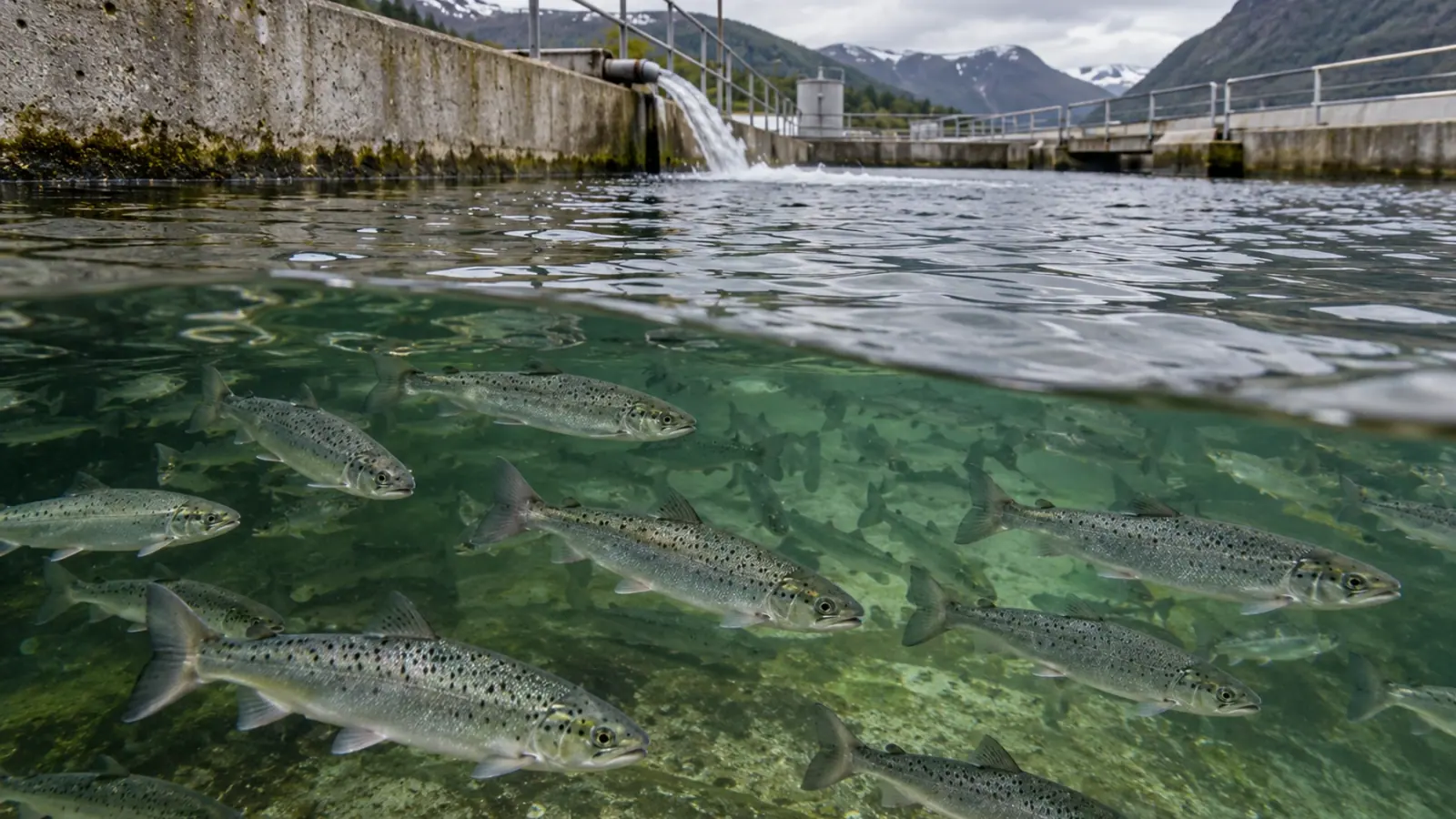
Smolts: combine indicators before seawater transfer
A heavy, silver salmon is not necessarily ready for seawater. A photoperiod study supports assessing rearing history, physiological indicators and health together before approving transfer.


- Content type
- Scientific news
- Sector
- Aquaculture
- Animal group
- Salmonids
Weight and silvering answer only part of the question
Before moving Atlantic salmon (Salmo salar) to sea, a hatchery may have an average weight, photographs and a production schedule. These describe the group and its appearance. They do not directly measure its ability to maintain internal water and ion balance in a much saltier environment. Smoltification involves physiological, morphological and behavioural changes that need not progress at exactly the same pace.
A silver fish can therefore leave an important part of its readiness unresolved. Equally, a size difference between groups does not establish a corresponding difference in physiological preparation. The operational question is specific: what evidence supports transferring this group to this receiving site under the proposed conditions? The decision record therefore needs compatible observations alongside photographs and weight measurements.
A light-regime comparison with important limitations
Gjerde and colleagues compared three light regimes in 3,000 presmolts from 100 families, using two tanks per regime before transfer to a shared sea cage. Their 2025 paper reports a freshwater weight advantage under continuous light that did not translate into significant weight differences at either sea sampling. More early deaths were also observed in that group.
This is not a universal lighting prescription. Few replicate tanks limited statistical power, and incomplete recovery of dead fish complicated survival estimates. Ulcers and later losses led to early termination of follow-up. The findings support treating freshwater growth, preparation for environmental change and subsequent health events as separate questions. They do not establish that every loss at sea was caused by the earlier photoperiod or justify a guaranteed outcome from a particular lighting programme.
Know which physiological measurement was performed
Osmoregulation maintains water and ion exchanges within the animal’s functional limits. Gills contribute alongside the intestine and kidneys. Na+/K+-ATPase, usually shortened to NKA, is an enzyme involved in ion transport. Measuring its activity is different from measuring expression of genes for its subunits. A gene-expression result cannot simply be read as an enzyme-activity result.
The methodological review by Takvam and colleagues explains why tissue, sampling and analytical method matter. It supports looking beyond a single gill marker. This does not mean ordering every available investigation before every transfer. An analysis needs a defined purpose and a laboratory able to explain what the result can establish, including its relevance to the rearing conditions in question.
Assemble the group record before confirming departure
A useful decision record can bring together origin, developmental stage, size variation, light and temperature history, interventions and recent health observations. Dates matter. A temperature reading on loading day cannot reconstruct previous weeks or explain changes in husbandry. Interrupted water supply, reduced feeding and unusual losses should remain visible alongside favourable production figures, rather than being held in a separate incident log that the transfer team never sees.
For laboratory work, record when fish were sampled, how they were selected and how material was handled and transported. Selecting only the largest individuals may give a misleading view of the group that will actually be moved. The record should distinguish an available measurement from an interpretable one and from an unresolved conclusion. Missing information is not evidence of readiness, even when the departure slot has already been booked.
Match the assessment to the receiving conditions
Receiving-water salinity, transport arrangements, handling and staff availability affect the transfer decision. A satisfactory physiological result does not replace a clinical assessment or a workable movement plan. The purpose is to prevent one reassuring indicator from overriding a known problem elsewhere: developing lesions, unstable water conditions, unavailable equipment or an arrival period with inadequate observation.
The transfer lead and veterinarian can agree beforehand which information is required, which uncertainties can be accepted and what would justify postponement. If an additional biopsy or tolerance assessment is proposed, its likely contribution and its cost to the fish need consideration within an appropriate protocol. Neither cited publication supplies an NKA threshold valid for every site or a departure timetable that can be copied across production systems.
Use post-transfer observations to evaluate the decision
Monitoring should continue beyond unloading. Feed intake, swimming, distribution within the cage, lesions and mortality need to remain attributable to the transferred group. Denominators require care: fish loaded, received, removed and recovered dead are different counts. Survival inferred from incomplete recovery can give an overly favourable impression. A clear accounting of missing animals is part of interpreting the outcome, rather than an administrative detail to resolve later.
Learning across successive transfers also requires consistent indicator definitions and a record of changes in site or management. A problem after arrival calls for investigation. It does not retrospectively prove that a particular marker failed or that lighting alone was responsible. Comparisons become informative when hatchery observations and marine-site records can be connected without losing the conditions under which each was collected.
Make the reasoning available to the people doing the transfer
Seawater readiness is best treated as a supported decision with explicit limits. Weight, appearance and physiological tests each contribute information. Their practical value depends on the quality of the group record and on being able to examine the consequences afterwards. A checklist is useful only when its entries are understood and unresolved issues can change the decision.
Vetofish can help define useful observations, postponement criteria and post-transfer monitoring through its advisory and support service for aquaculture teams. The work can connect the risks of the group and receiving site with a procedure that the people authorising, carrying out and monitoring the transfer can use together.


