

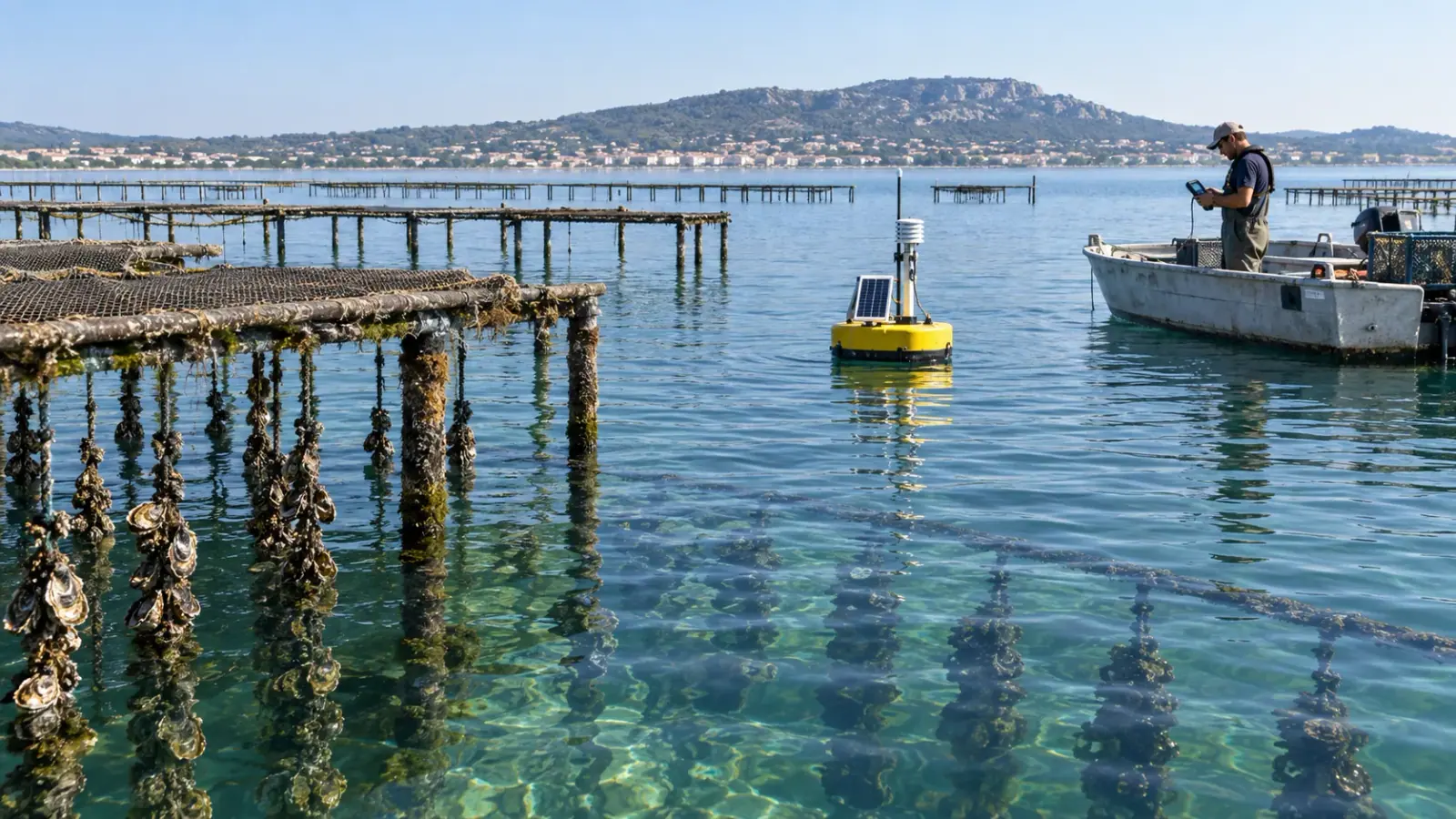
Thau Lagoon: monitoring oxygen before a crisis
Summer oxygen monitoring in Thau Lagoon helps shellfish farmers identify deterioration, but a spot reading cannot guarantee protection from anoxia.
- Content type
- Scientific news
- Sector
- Aquaculture
- Animal group
- Corals and invertebrates
- Keywords
- OxygenTemperatureSalinityStress
In Thau Lagoon, a summer fall in dissolved oxygen can quickly threaten oysters and mussels when heat, weak mixing and biological demand combine. The Syndicat mixte du bassin de Thau is again publishing measurements in 2026 for shellfish farmers and other lagoon users. This surveillance offers a useful warning and a shared picture of conditions. It does not predict the exact timing or severity of every event, and it cannot replace observations around individual farms, depths and batches.
What the 2026 campaign actually measures
The SMBT programme tracks oxygen, temperature and salinity during the sensitive season. The organisation reports that regular monitoring has been conducted since 2007 to anticipate local summer anoxia events known as “malaïgues”. Critical results are relayed to professionals, while bulletins document conditions through early September.
The value lies in the time series rather than in one number. A concentration measured at one place and time describes the water around that sensor at that moment. It may differ between the surface and the bottom, between shellfish tables and open water, and between night and afternoon. A downward trend across several stations is therefore more informative than a single value detached from its sampling context.
Temperature and salinity help interpret the oxygen record. Warm water physically holds less oxygen at saturation and accelerates many metabolic processes. Density differences driven by temperature or salinity can sometimes restrict renewal of deeper water. None of these variables explains an event alone: wind, circulation, biomass, organic matter and sediment activity also contribute.
Why a productive lagoon can run short of oxygen
Oxygen enters the water through air–water exchange and photosynthesis. It is consumed by animals, plants and microorganisms and by the decomposition of organic material. Photosynthesis stops at night while respiration continues, so the daily minimum often occurs near dawn. Monitoring only in bright daylight can therefore provide false reassurance.
Research conducted in Thau also shows why the bottom matters. During an event documented in 1994, Souchu and colleagues followed the water column and sediments through ten days of bottom anoxia. That historical study does not describe conditions in 2026, but it demonstrates why a crisis cannot be reduced to “too many shellfish” or “not enough wind”. Oxygen demand, mineralisation and exchanges between sediment and water are coupled processes.
At a longer timescale, Derolez and colleagues analysed five decades of lagoon data. Better wastewater treatment reduced nutrient inputs and was associated with oligotrophication and ecological regime shifts. That positive trajectory has not eliminated extreme events. Instead, it means that current risk must be interpreted in a transformed ecosystem still exposed to heat and variable weather.
Do not turn a bulletin into a universal threshold
Tolerance of hypoxia varies with species, temperature, duration of exposure, size and physiological condition. The same oxygen concentration may be tolerated briefly but become damaging when prolonged. Valve activity, filtration, gill condition and previous exposure also shape the response. A general value from the literature should not become an automatic mortality threshold for every oyster or mussel batch in Thau.
A bulletin is better used to trigger graded vigilance. An unusual decline can prompt more frequent checks, comparisons among depths and attention to the least-flushed areas. If the trend persists, farmers can reconsider planned handling, avoid adding stress and prepare batch records. Decisions about stock or farm structures still need to be site-specific and coordinated with lagoon managers.
Building useful monitoring at farm level
A local sensor is only as reliable as its maintenance and interpretation. The membrane or optical surface, biofouling, calibration, depth, time and local flow should all be documented. An implausible reading deserves confirmation before it drives an expensive decision. Conversely, a stable graph should never overrule visible mortality or abnormal animal behaviour.
An internal plan can name who reviews bulletins, who confirms an alert and which events are logged: mortality, weather, temperature, salinity, work on structures, grading and batch movements. This timeline helps separate correlation from cause and improves discussions with veterinarians, laboratories and monitoring organisations.
After mortality, sampling should preserve a differential diagnosis. Hypoxia may be a strong explanation without being the only one. Infectious agents, harmful algal toxins, thermal stress or several simultaneous pressures may cause or worsen losses. Representative moribund animals, water history and the spatial distribution of affected stocks are more informative than deteriorated specimens collected late.
An early-warning tool, not a prevention guarantee
The SMBT programme provides a shared resource: repeated, comparable measurements that can be circulated quickly. For shellfish farmers, its best use is to combine regional information with farm observations and pre-agreed decisions that reduce additional stress during a vulnerable period. It cannot guarantee that a malaïgue will be avoided or resolve the lagoon’s hydrodynamic and sediment processes on its own.
Vetofish can help shellfish operations structure water-monitoring plans, qualify alerts, organise sampling during mortality events and interpret environmental data alongside lesions and laboratory results. The objective is to turn an oxygen curve into a traceable decision without claiming that the curve says more than it does.
To move from evidence to action, explore our health expertise and biosecurity service and our expertise in aquaculture.


