

Water-borne cortisol: what does the fish sample represent?
Water-borne cortisol can support repeated measurements under controlled conditions. Environmental use requires validation of collection, signal attribution and analysis; non-invasive sampling does not always mean capture-free sampling.


- Content type
- Practical guide
- Sector
- Environment
- Animal group
- Fish
- Keywords
- StressEcotoxicologyTemperature
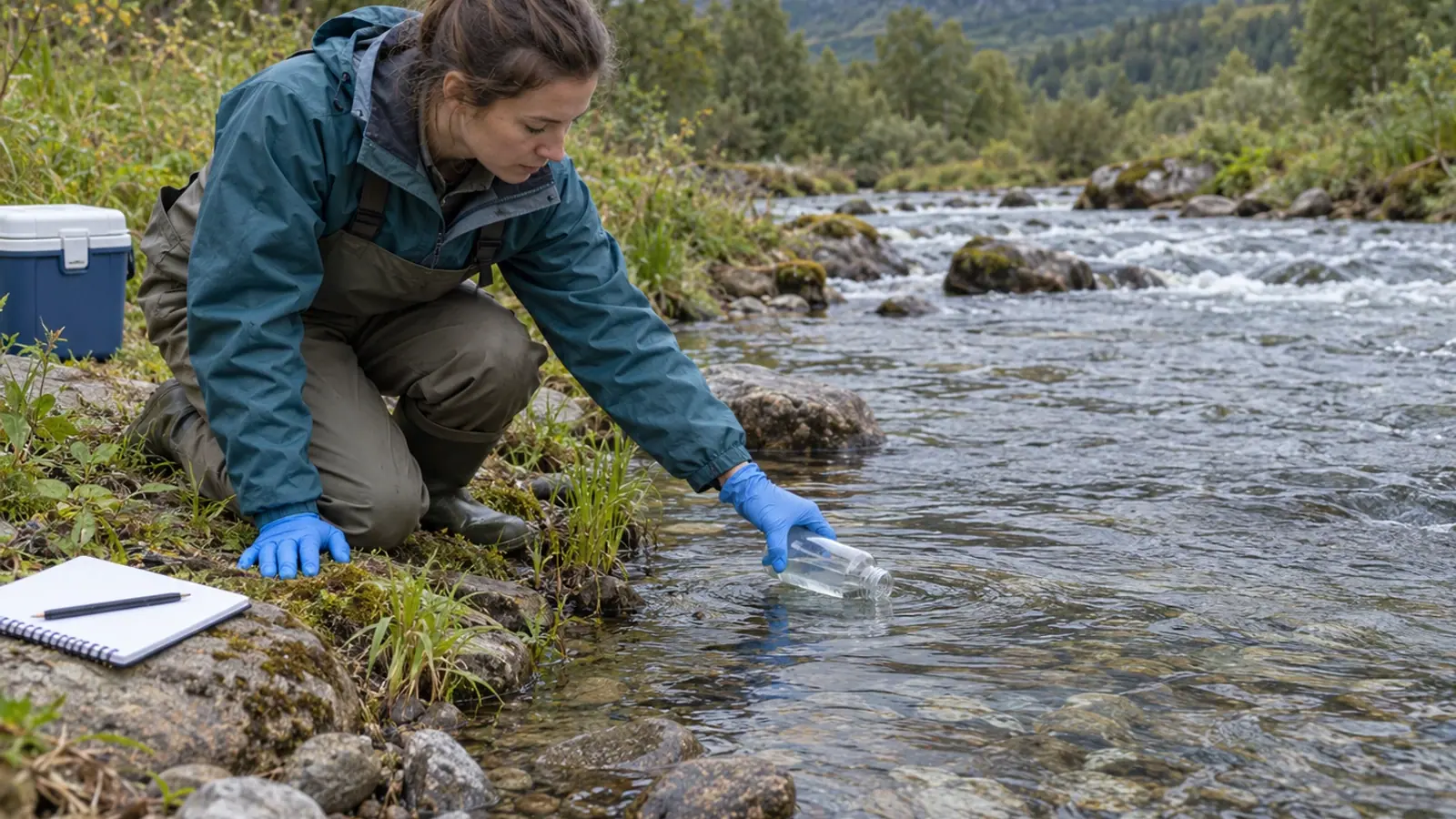
Collecting water can be less invasive than collecting blood. That advantage matters when measuring cortisol in fish, but it does not remove every difficulty. The sample must contain a signal attributable to the animals, collected over a known period and analysed with an appropriate method. Filling a bottle beside a river therefore does not automatically measure the stress experienced by the fish living there.
Understand what the water sample represents
Cortisol is a biomarker of the physiological stress response in teleost fish. Its concentration needs biological context and a defined sampling time. It is not a universal suffering score and cannot, on its own, identify a pollutant or handling event as the cause of an observed condition. The question should be framed before a numerical result is requested.
The methodological review by Lemos and colleagues, published in 2023, discusses blood, tissues, mucus, scales, faeces and surrounding water as possible matrices. Free cortisol can be released across the gills, while metabolism and excretion also affect the fate of steroid hormones. Different matrices need not represent the same period or biological process, even when they are used to investigate related questions.
Water offers the possibility of repeated measurements without collecting tissue each time. However, “non-invasive” describes collection of the signal rather than every part of the procedure. If a fish must first be caught, isolated or moved into a separate volume, those steps may contribute to the response subsequently measured. A report should state the actual procedure rather than implying that no disturbance occurred.
Laboratory validation has a defined scope
Midttun and colleagues studied adult zebrafish, Danio rerio, in work published in 2022. The initial group comprised 25 females and 24 males from the AB strain. They collected water after repeated stress tests using an individual sampling arrangement and controlled timing, then extracted and assayed cortisol. This retained the connection between an individual fish and its sample.
Responses showed consistency across tests within individuals. The final association between water-borne and whole-body cortisol was stronger in males. In females, it did not reach statistical significance, with eight animals in that comparison and a p value of 0.09. This finding establishes neither absence of an association in females nor equal validity across sexes. The sample size and sex difference remain part of the interpretation.
The study supports use of the matrix within a controlled design for a specific question. It does not establish a threshold for wild fish of every species. Housing conditions, life stage, sex and collection procedure constrain the result’s reach. Keeping those conditions visible avoids turning a research method into a universally validated field test.
Concentration depends on how water is collected
A sampling plan needs the water volume, collection interval, animals contributing to the sample and exchange with surrounding water. A concentration accumulated in a closed volume and a signal carried through continuously renewed water have different meanings. Flow affects dilution and transport. Comparing locations without recording it can hide the contrast of interest or introduce another one.
Record temperature, time of day, fish biomass and events preceding collection. A comparison that simultaneously changes the apparatus, duration and physical conditions cannot straightforwardly attribute a difference to the environment. Units and any normalisation should be agreed with the laboratory beforehand. They should not be improvised after seeing the results or used to make unlike procedures appear comparable.
Water blanks and analytical controls help examine background signal and measurement quality. The zebrafish study used blank water samples and corrected for residual cortisol in the system water. That principle alone does not validate every river-water matrix. The laboratory still needs to establish whether the assay performs appropriately in the actual water being collected, including sample preparation and recovery.
Design a pilot before environmental monitoring
For an initial pilot, an environmental manager can define a feasible comparison involving the same species, comparable life stages, documented collection conditions and a clearly defined intervention. The first aim is to establish whether an interpretable signal can be obtained in that context. It is premature to produce a map labelled “fish stress” from isolated concentrations without demonstrating what those concentrations represent.
If capture or confinement is required, its timing and conditions should be consistent between groups and included in the welfare protocol. Explain whether the intended outcome concerns the preceding state, the response to handling or recovery afterwards. Without that distinction, a technically valid assay may answer a different question from the one the monitoring programme was meant to address.
The pilot should combine hormone measurements with independent observations: fish condition, behaviour where observable, physical environmental measurements and the history of field operations. These can reveal agreement without requiring every indicator to move in parallel. Discordant results deserve examination rather than removal of whichever observation is least convenient. The records should support that examination after the sampling team has left the site.
Analytical precision does not settle biological attribution
The 2023 review distinguishes immunoassays from chromatography coupled to mass spectrometry. These approaches have different specificity, preparation requirements and controls. A sensitive analytical method does not by itself resolve uncertainty about the signal’s source. Chemical validation and biological validation address complementary parts of the problem and both are needed for a meaningful monitoring design.
A cortisol change may accompany several processes. It does not prove exposure to a named toxicant, clinical disease or poor habitat quality as a whole. A low value likewise cannot establish that fish are free of adverse constraints. Reporting should identify the conclusions supported by the procedure and those it cannot support, including any uncertainty introduced by collection conditions or group-level attribution.
Conclusion and Vetofish support
Water-borne cortisol can be useful when collection, animal context and analysis form a coherent design. Its environmental value needs a suitable pilot, without equating absence of blood sampling with absence of capture. Our consulting and support service can help aquatic environmental teams formulate the comparison, plan controls and interpret measurements alongside the other field observations.


