

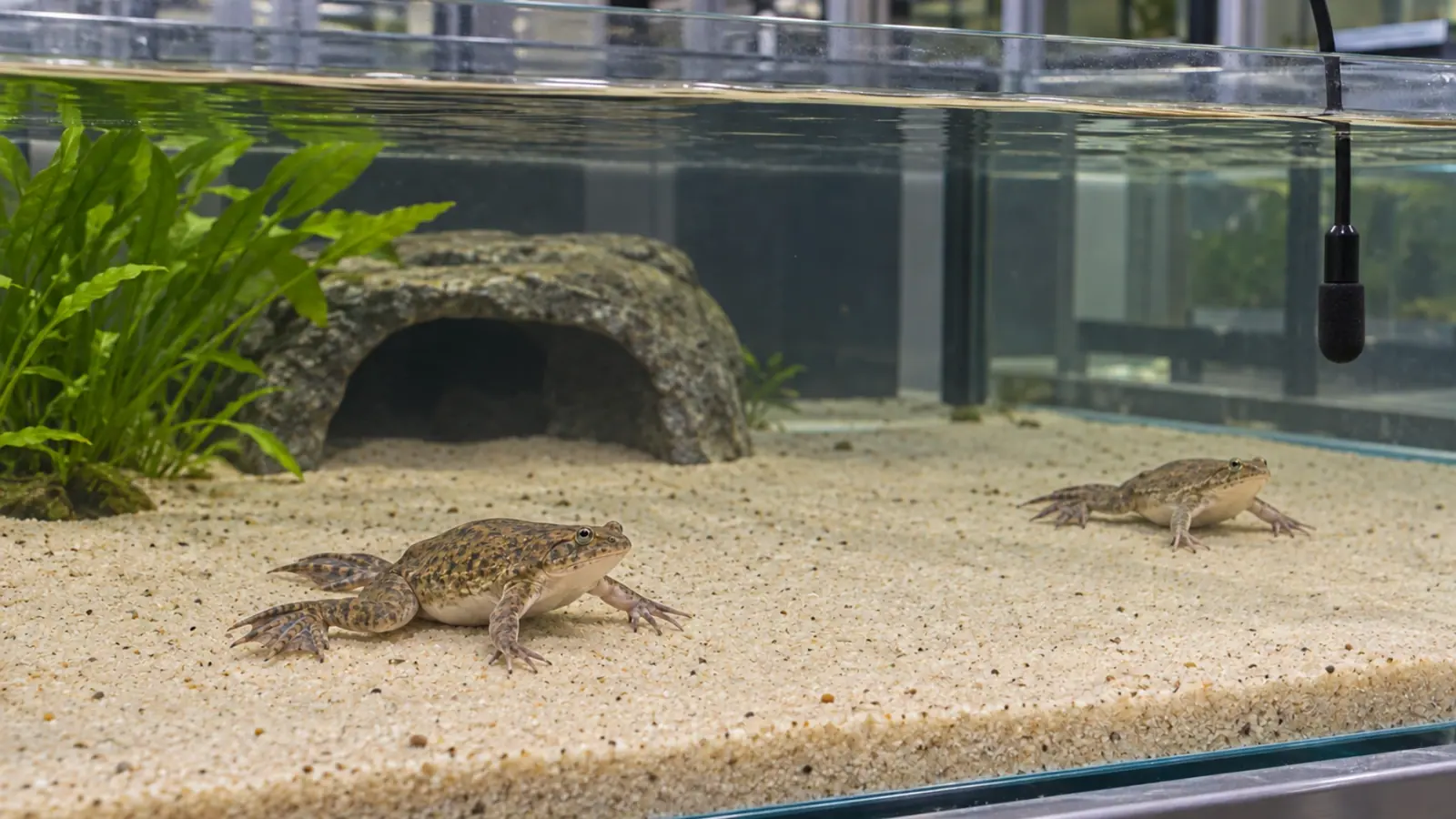
Xenopus: observing amplexus and vocal exchanges
In Xenopus laevis, clasping alone establishes neither a partner’s sex nor breeding success. Recording contact and vocal exchanges helps describe behaviour without treating every interaction as a measure of fertility.


- Content type
- Practical guide
- Sector
- Research facilities
- Animal group
- Xenopus
- Keywords
- ReproductionEthogramTemperature
Two African clawed frogs can clasp one another without forming a breeding pair. Male–male contact is part of the behaviour described in Xenopus laevis. Recording every embrace as successful reproductive activity can therefore distort both colony records and experimental conclusions.
Studies published by Tobias and colleagues in 1998 and 2004 combined observation with underwater sound recording to examine these interactions. These established behavioural studies provide a framework for interpretation. They do not validate a hormone administration protocol or a stand-alone assessment of welfare in a research colony.
Describe contact before assigning its meaning
Amplexus is the reproductive embrace of amphibians. In Xenopus it is typically inguinal, with the male holding the partner in front of the hindlimbs. Position describes an action; it does not independently establish the partner’s sex, receptivity or fertilisation of eggs.
The 2004 paper describes contact between males, usually directed towards the inguinal region but also towards a leg, side or head. Records should therefore specify position, duration and both individuals’ identities. “Attempted clasp” may be a more accurate event category than immediately entering a successful breeding interaction.
Sexually dimorphic features can assist identification, but an uncertain sex assignment should not become certain because one frog clasps another. Identity and presumed sex are separate observations from behaviour. Keeping those fields separate helps prevent a circular interpretation of subsequent reproductive records.
Listen for the kind of exchange
The 1998 study describes a rapid receptive female call, termed rapping, that elicits a distinctive male answer call. Playback experiments reproduced part of that response. Unreceptive females produce another, slower call, ticking, associated with reduced male vocal activity.
The type of signal and its context are therefore more informative than total sound production alone. The results do not establish that a silent individual is infertile, unwell or unable to breed. Reproductive state, the partner and recording conditions influence what can be observed.
The researchers used field observations and experimental settings, including hormonal stimulation in several comparisons. Sample sizes were small and varied between tests. Numerous calls from one frog do not amount to numerous independent animals. A colony monitoring scheme should retain the individual as well as the event being counted.
Male partners also change the response
In 2004, the team described several male call types and showed that one partner could strongly suppress another’s calling. A comparison involving thirteen pairs of stimulated males found large differences in calling duration between partners after pairing. Barrier experiments indicated that physical contact was not required for vocal suppression.
Calling totals would consequently be a poor basis for assigning an intrinsic reproductive performance score. Changing a partner or social arrangement can alter what is recorded. The paper also distinguishes the frog doing the clasping from the frog being clasped; their behaviour and signals cannot be treated as interchangeable.
Facility teams can use these distinctions in an observation sheet that records events and circumstances. It does not support sorting animals into productive and unproductive categories from a single recording or short encounter.
Build a record that colleagues can interpret
A practical record includes animal identifiers, time, group composition, observation start and finish, contacts and recognisable vocalisations. Handling and project interventions are logged separately. Time-stamped video or acoustic excerpts can help two observers compare event coding without adding unnecessary animal handling.
Temperature, photoperiod and recent environmental changes belong alongside the behavioural observations. Reproductive monitoring also extends beyond contact: egg presence, spawning time and developmental criteria are recorded where relevant to the project. Observed eggs, fertilised eggs and followed development remain different outcomes.
An underwater hydrophone records a signal affected by its position and background noise. Failure to identify a call may therefore be a recording limitation. In a group, attribution to a particular frog requires a suitable method; loudness alone does not identify the caller.
Consistency is particularly useful when staff change between shifts. Definitions and examples of recorded events make disagreements visible, rather than allowing different interpretations to accumulate under the same category.
Behavioural description is not a welfare threshold
These studies clarify communication in X. laevis. They do not establish a universal maximum contact duration or an acoustic threshold for suffering. Social events need to be assessed alongside body condition, possible lesions, access to the surface, feeding and change over time.
Repeated clasping accompanied by difficulty reaching the surface or new lesions calls for assessment under facility procedures. Staff should not wait to confirm a reproductive interpretation before reporting an animal concern. Intervention criteria belong with the people responsible for veterinary oversight and the project.
A reported effect of hormones in a research paper is not an instruction to administer them. The justification and details of reproductive induction belong to the authorised protocol and its monitoring arrangements. They cannot be inferred from a single unsuccessful observation period.
The observations also concern a particular species. They should not be transferred automatically to another Xenopus species or to a different amphibian breeding system simply because an embrace looks similar.
Separate contact, communication and breeding outcome
The practical conclusion is to keep clasping, vocal exchanges, spawning and reproductive success distinct. Each answers a different question and needs an explicit observational unit. A precise record can reveal a meaningful change without reducing an animal’s condition to one signal.
For research facilities, our training programmes can help teams establish shared behavioural descriptions, compare observations and connect records with ongoing animal monitoring.


