

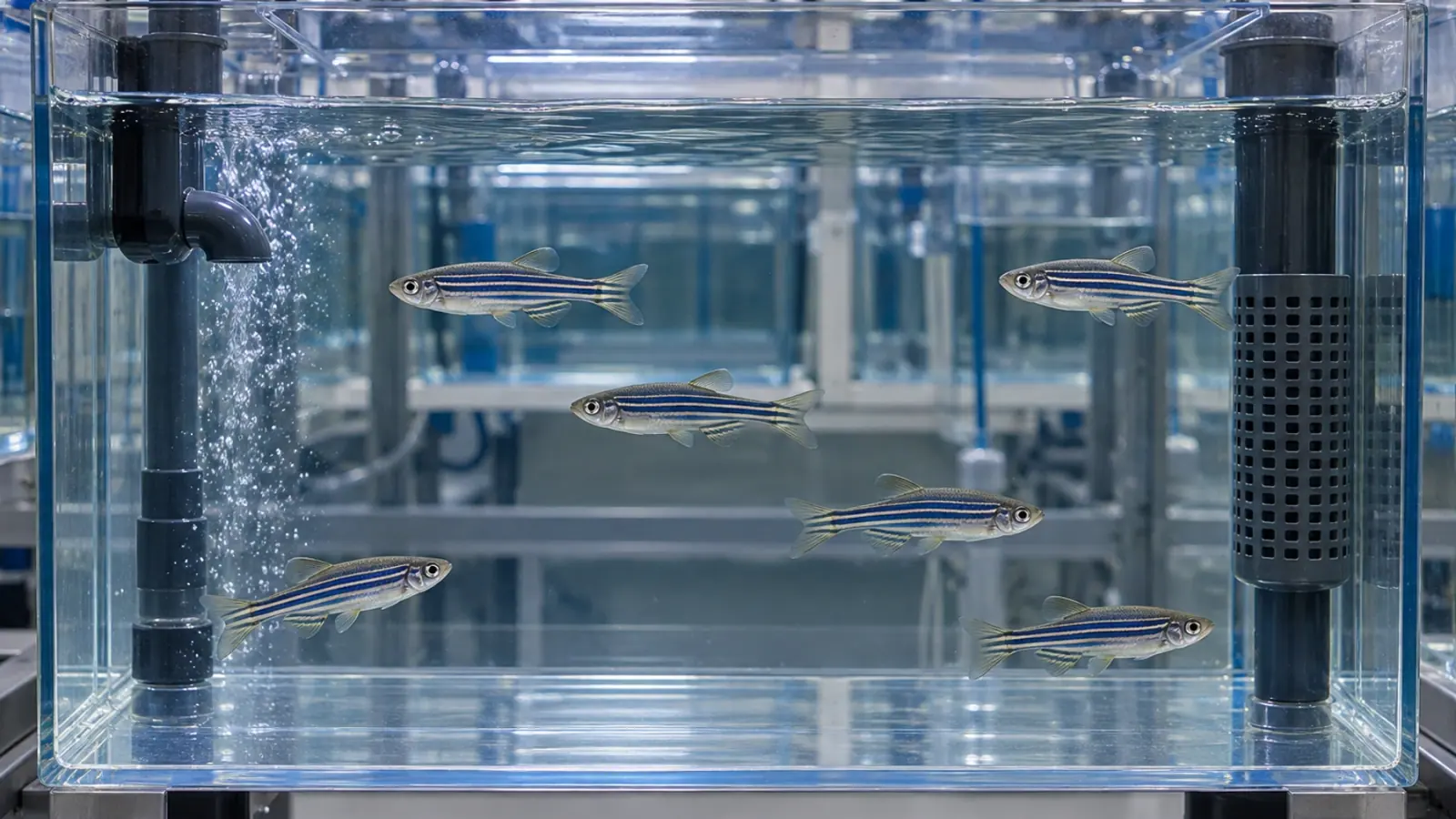
Zebrafish breeding: plan cohorts to reduce surplus fish
Reducing surplus zebrafish starts before a breeding cross is set up. Experimental demand, required genotypes, replacement breeders and rearing capacity need to be considered together. Reduction under the 3Rs cannot be achieved by accepting poorer survival or care.


- Content type
- Practical guide
- Sector
- Research facilities
- Keywords
- ReproductionBiosecurityStress
A successful spawning can fill nursery space even when a project will use only a small proportion of the offspring. Surplus often originates before the eggs are produced: demand is unclear, crosses are repeated routinely, the required genotype is poorly anticipated or an experimental timetable changes after breeding has started. Research demand needs to inform the next breeding decision before another cross is set up.
This guide concerns zebrafish, Danio rerio, in research facilities. It draws on the meeting report published by Osborne and colleagues in 2016 and Norecopa’s PREPARE principle on avoiding surplus animals, updated in February 2026. It does not report a new trial establishing a universal percentage reduction in animal use.
Specify the animals the study actually requires
Experimental demand includes a defined line, genotype, developmental stage, age window and, where relevant, sex. A request for a total number of fish without these characteristics leaves considerable room for mismatch. Animals may be available yet unsuitable for the planned experiment, while still requiring care and space.
The required number should follow a justified experimental design. Reduction does not mean cutting numbers arbitrarily until the study can no longer answer its question. It means avoiding production without an identified experimental or breeding purpose while preserving the scientific value of the work.
For each request, record a responsible person, an intended use date and the circumstances likely to change demand. Staff availability, equipment and experimental space need to fit the animal timetable. Uncertain technical capacity is a reason to review the schedule before spawning, rather than automatically setting up several precautionary crosses.
Connect the cross with the required genotypes
Parental genotypes and the crossing scheme determine the possible offspring categories. The expected genetic proportions help planning but do not guarantee the exact composition of a small clutch. Fertility, viability and line-specific characteristics also need to be considered using the facility’s own records.
Phenotype and genotype should remain distinct. A normal appearance does not always identify the animals the study needs. When genotyping is required, its turnaround time and the burden of a suitable sampling method should be included in the plan for the relevant life stage.
Osborne and colleagues describe the Zebrafish Mutation Project as presented at a 2014 meeting, including selection of relevant offspring before rearing them to adulthood. This is experience from the organisation of a large colony. It does not establish one selection procedure for every line or authorise transferring an intervention without local evaluation.
Give every cohort an intended destination
A cohort record should connect the project, fertilisation date and expected offspring categories. Animals intended for experiments, replacement breeders and animals with uncertain allocation should remain identifiable. Uncertain allocation needs review rather than becoming a permanent, unexamined holding category.
Replacement breeding requires its own timetable. Without forward planning, teams may respond to ageing or poorly breeding stock by repeatedly increasing crosses. Keeping excessive replacements for every possibility can produce the opposite problem: a persistent surplus that never appears in the original experimental request.
Sharing and archiving can be considered according to the line’s value and expected use. A validated sperm bank may support this organisation, but ending a live colony requires demonstrated recovery and an acceptable lead time for future projects. The technical procedures for cryopreservation are outside the scope of this guide.
Reduce production without lowering care standards
Fish already present still require appropriate care. Restricting food, increasing crowding or accepting higher losses is not implementation of Reduction. Better survival may allow fewer offspring to be started for the same justified demand, provided the husbandry remains appropriate for the animals.
The 2016 report highlights nursery conditions and good records as tools for managing numbers and identifying line-specific welfare difficulties. Its local rearing results are not universal survival coefficients. Forecasts should use documented performance for the relevant facility, line and stage, rather than assuming that another centre’s outcomes will transfer unchanged.
A health problem or a decline following a feeding change needs investigation. Producing more fish to compensate may conceal the cause and prolong welfare problems. Sharing arrangements also require attention to health status and biosecurity, so a reduction strategy does not create a new route for infection.
Revise demand before the next spawning
A brief planning discussion between researchers, husbandry staff and the veterinarian can review confirmed demand, cohorts already underway and likely delays. Its frequency should match the facility’s work. The essential point is to change the next breeding decision while there is still time, rather than waiting until all nursery tanks are occupied.
The review should distinguish planned production, fish reared, animals used and other destinations. Reasons for deviations matter: an unexpected genotype distribution, project cancellation, fertility difficulty and disease-related losses require different responses. A single surplus percentage without these categories can lead to an inappropriate correction.
The PREPARE recommendation is a planning principle, not a formula prescribing breeder numbers or an archiving interval. Its application needs to protect scientific quality, line continuity and animal welfare within the facility’s approved procedures and relevant authorisations. No foreign legal requirement is being presented here as a rule for every reader.
Conclusion and Vetofish support
A controlled breeding programme begins with a defined request and a timetable that can be revised. Following genotypes, cohorts and destinations helps locate the source of surplus before another batch is started.
Through its advice and support service, Vetofish can help research facilities connect husbandry practice with project requirements. The work centres on documented breeding decisions and their consequences, while maintaining care standards and avoiding unsupported promises of a numerical saving.


