

Sexing zebrafish: record uncertainty too
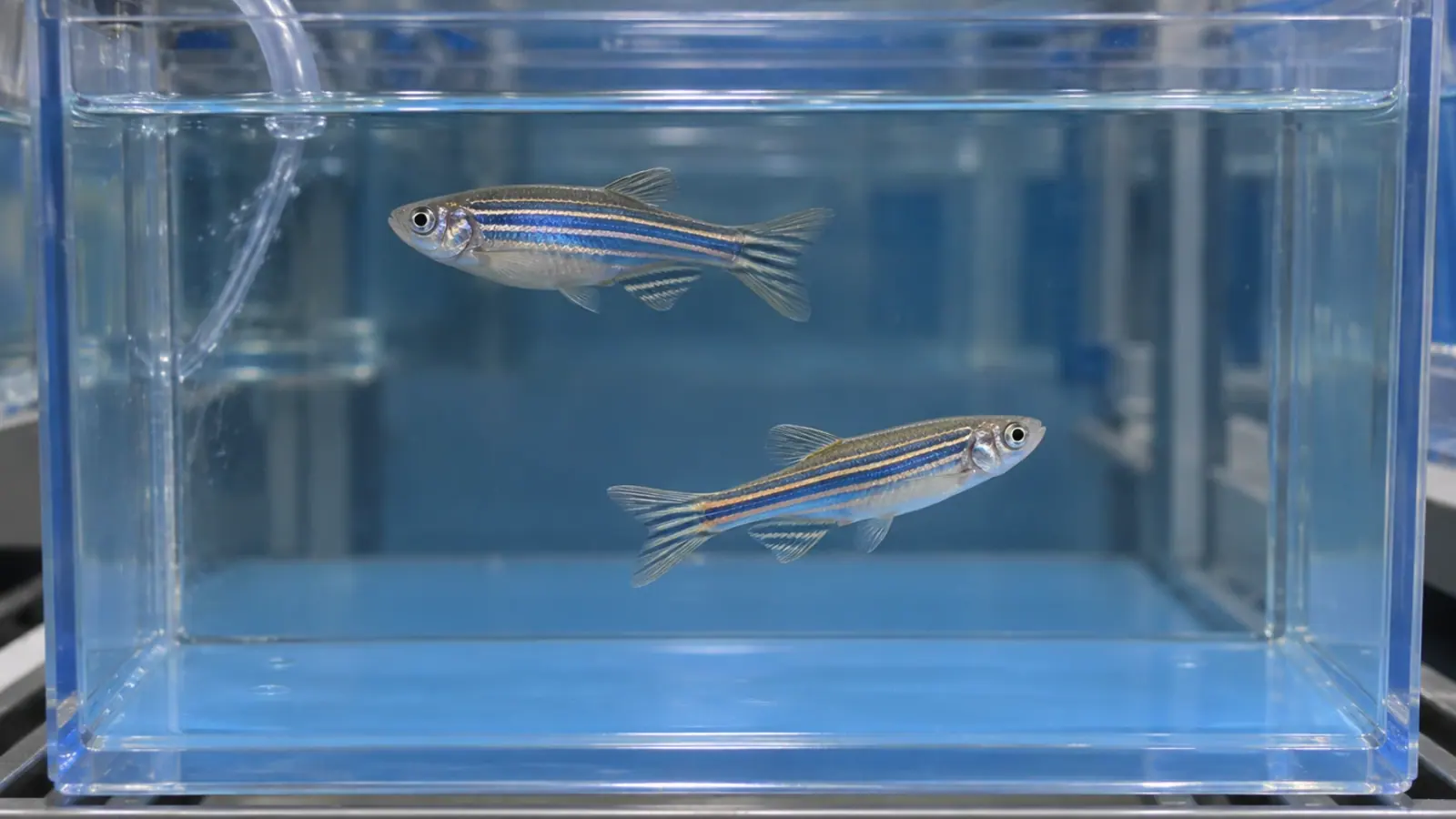
A rounded abdomen or stronger colour can help identify adult zebrafish sex, but neither works reliably in every group. Combining observations and retaining an undetermined category can improve sorting records while avoiding repeated handling.


- Content type
- Practical guide
- Sector
- Research facilities
- Animal group
- Zebrafish
- Keywords
- ReproductionStressAnaesthesia
Selecting breeders begins with knowing which fish were classified as male, female or undetermined. Adult zebrafish show sexual dimorphism, but interpreting it takes experience. An uncertain classification can quickly become a supposedly definite fact as it moves between tank labels, breeding records and experimental datasets. Recording the observation behind the decision makes that uncertainty easier to manage.
Combine body profile with colour
The Zebrafish Husbandry Association describes two common difficulties: females carrying few eggs may have an inconspicuous abdomen, while well-fed males can look rounded. Body and fin colour provide further clues, but vary with age, diet and strain. A rule based on one feature may therefore work in one tank and fail in another.
McGill’s training handout recommends comparing animals of similar ages and using an opposite-sex comparison. This helps an operator learn from a coherent group rather than interpreting an isolated silhouette under changing lighting. It does not provide a universal accuracy rate or a key that can be applied to every genetically modified fish.
For routine sorting, stable viewing conditions and a useful view of body shape and fins can reduce the need for repeated capture. Observation should remain brief enough to protect welfare. A fish that is hard to classify should not undergo successive handling episodes simply until somebody feels confident enough to choose a category.
Record the feature separately from the conclusion
A facility record can include both the classification and its basis: body profile, colour, comparison with known animals, date and operator. An undetermined category describes an observational limit. It does not diagnose abnormal sexual development, infertility or disease. Keeping that distinction explicit prevents an uncertain visual assessment from becoming a clinical claim.
The distinction matters when several teams use the same stock. A breeding manager may be able to keep a group under observation, whereas an experiment requiring a defined sex allocation may need an appropriate confirmation step. The same uncertainty can therefore have different consequences for different projects. Decisions depend on the scientific objective and the available means of verification.
External sex classification, genotype and reproductive function should also remain separate fields. A genotyping assay for a mutation of interest does not automatically identify sex. Failure to spawn does not, on its own, justify reclassifying an animal either, because spawning success depends on more than the sex assigned to each fish.
Review the group’s history before moving fish
Before sorting, check strain, age, maturity and the reason for the task. Aleström and colleagues’ husbandry recommendations explain that development and maturation depend on rearing conditions. Equal chronological age therefore does not guarantee equal reproductive appearance across facilities.
Recent feeding changes, treatment or a clinical observation may also justify postponing a visual conclusion. An unusually distended abdomen deserves a health assessment; automatically recording it as a female characteristic could conceal a problem. Conversely, a slim body does not prove that an individual is male or healthy.
Observation equipment, destination tanks and labels should be ready before capture begins. Preparation reduces waiting and repeated handling. It also prevents a simple but consequential error: placing the correctly classified fish into a tank whose identifier no longer matches the electronic record.
A local procedure can specify where uncertain fish will remain and how their status is communicated. The aim is to keep an unresolved classification visible when animals change rooms, are selected for breeding or enter an experimental allocation.
Teach operators to discuss difficult cases
The ZHA recommends learning with an experienced zebrafish user and then practising. Training can begin with adults showing clear features before progressing to less obvious examples. Asking trainees to explain what they observed is more informative than collecting only male or female answers.
Two operators can compare classifications using images or observations that require no additional capture, then discuss disagreements. This is a proposed team-training approach, not a sexing assay whose diagnostic sensitivity has been validated by those guides. If a facility measures disagreement rates, it needs to state the conditions and the reference against which classifications were assessed.
The procedure can also define when to seek a second opinion and how to amend a classification. Retaining the original observation alongside a dated correction avoids silently rewriting the history. For a study, records should indicate whether verification occurred before group allocation or after experimental measurements were collected.
Confirm only what the decision requires
A more detailed examination needs justification based on the project, strain and animal risk. McGill’s handout emphasises limiting handling and using appropriate procedures. Anaesthesia is not a trivial step to repeat simply to resolve an administrative uncertainty; any indication and method should follow the facility’s approved arrangements.
These practical sources do not establish that a colour, photograph or morphometric equation correctly identifies every individual. Nor do they validate a universal early-sexing method. External criteria need reassessment in immature animals, unusual pigmentation backgrounds or models affecting gonadal development.
Capture stress must be weighed against the value of the additional information. If uncertainty does not affect the immediate decision, leaving the fish in a correctly identified group may be preferable to another intervention. That choice still needs to fit the protocol and the facility’s monitoring requirements.
Make the classification usable by the next person
A useful sexing record links the observation, its context and an explicit level of confidence. An undetermined category protects data quality when external features do not support a conclusion. It allows the team to decide what needs checking, when and by which method, without treating appearance as proof of reproductive function.
Vetofish can help facilities align sorting criteria, records and second-opinion rules through its training programmes, designed for teams working in research facilities.


