

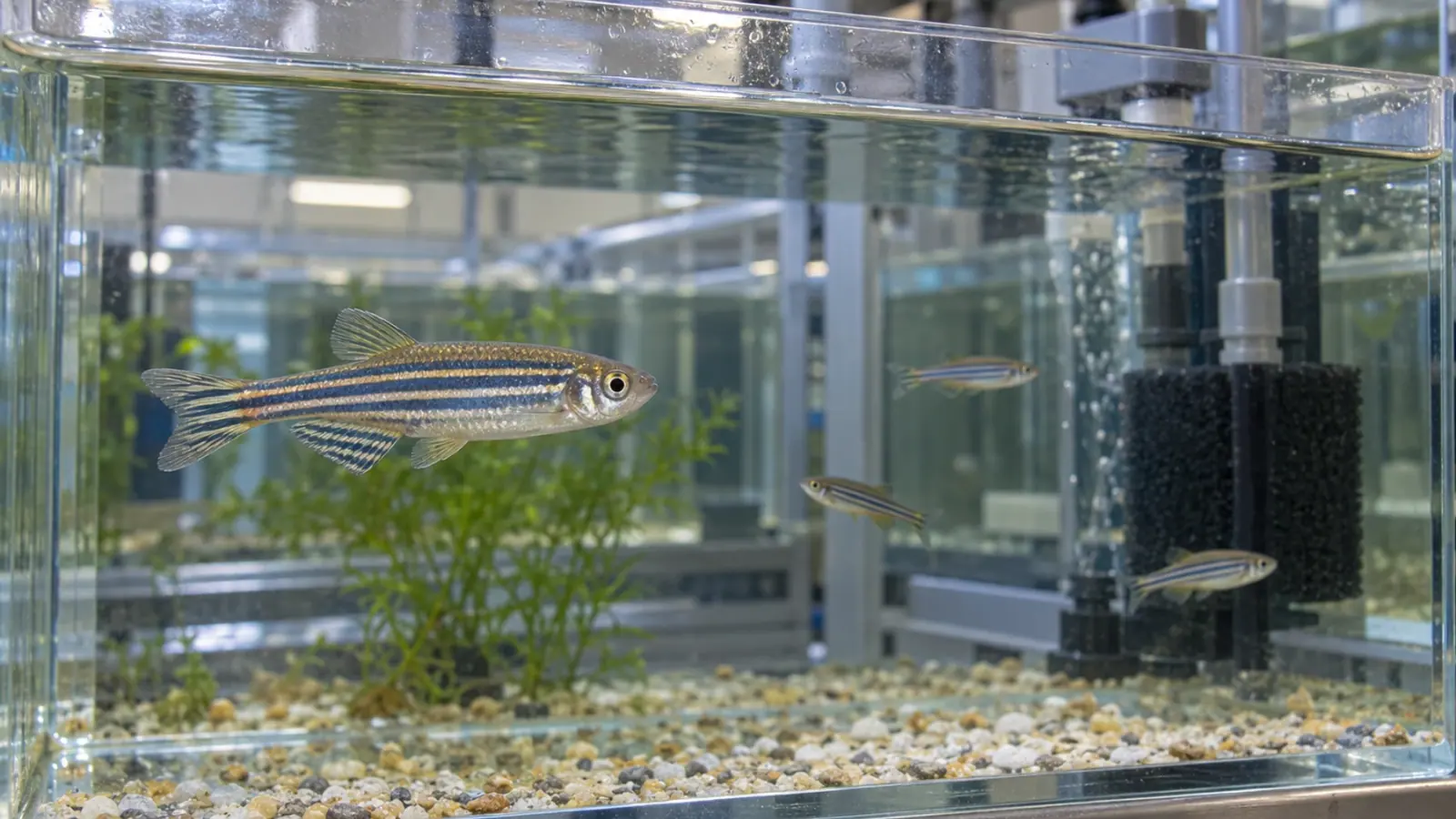
Zebrafish: track age without dismissing signs of decline
Age can affect zebrafish activity and exploration differently across sexes and strains. Changes in swimming or feeding still need assessment; recording an older age does not establish that a decline is normal or harmless.


- Content type
- Practical guide
- Sector
- Research facilities
- Animal group
- Zebrafish
- Keywords
- EthogramStressTemperature
Age belongs in the observation record
Zebrafish activity can vary with age, sex, strain, environment and health. A research facility keeping adults for extended periods needs to retain this context instead of comparing every fish with a single picture of normal adult behaviour. A change may be meaningful even when the animals remain within a broad adult age category.
Chronological age is not a diagnosis. Reduced feeding, altered swimming or isolation still requires assessment in an older group. Calling such changes normal ageing can delay recognition of a potentially reversible problem or a decline in welfare. The observation should remain visible even when staff have a plausible explanation for it.
Here, functional decline describes a concern requiring attention, rather than a validated frailty score. The study discussed below did not establish a clinical scoring system for older zebrafish. Keeping everyday surveillance language separate from experimental measurements prevents a practical observation from acquiring a precision that the evidence does not support.
A comparison of adults at six and twelve months
Hudock and Kenney studied male and female zebrafish from the TL and TU strains in 2024. They compared groups aged six and twelve months using a novel tank test. Each fish was observed for six minutes and tested again twenty-four hours later. These were repeated observations of the same individuals, rather than two independent samples of fish.
The test measures behaviour in a new environment. It does not directly establish the animals’ usual activity in their home tank. The comparison also concerns different age groups, rather than following every individual across its lifespan. Both features limit transfer to routine facility monitoring.
Twelve months represents a middle-aged group in this work, not a universal geriatric boundary. The experiment supplies no retirement age, care schedule or clinical end-of-life criterion. Its contribution is to demonstrate that age can affect the interpretation of commonly used behavioural measurements, and that this effect needs context.
Strain and outcome change the interpretation
The authors found reduced locomotor activity with age in TU fish. The evidence was less conclusive in TL fish. Differences were not uniform across sexes and test sessions, so the findings should not become a statement that all older zebrafish swim less. The strength and scope of each comparison need to remain attached to the result.
Exploration measures added further variation. Bottom dwelling and proximity to tank walls did not change in the same way across strains and sexes. These measures are often used to investigate anxiety-like responses, but they do not provide an individual clinical diagnosis of stress or pain. A fish spending more time in one part of a tank needs a wider assessment.
The study also did not find a consistent age effect across the habituation measures. Reduced locomotion should therefore not be rewritten as a general loss of memory. The measured behaviour, testing conditions and limits of the comparison are essential parts of the scientific conclusion, not qualifications that can be removed for a simpler message.
Describe the behaviour before explaining it
An ethogram gives observable behaviours shared definitions. In a facility log, descriptions such as reduced swimming, difficulty maintaining position or failure to approach food can be more useful than calling an animal old. Clear descriptions also help different staff members recognise whether they are recording the same sign.
Link the observation to known age, identified sex, strain and recent changes. Water temperature, maintenance work, animal movements and altered routines can provide context. Their presence does not establish causation. A good record supports investigation without deciding the explanation before the relevant checks have been made.
Home-tank observation has its own value. Repeating a novelty test simply to check whether an animal is declining would add a procedure without turning that test into a validated clinical tool. The published experiment informs interpretation; it does not prescribe a novel tank test as a daily surveillance procedure for older fish.
Do not dismiss a loss of function
Canadian Council on Animal Care guidelines address welfare and health monitoring in zebrafish and other small laboratory fish. They describe signs requiring attention, including changes in feeding, activity and buoyancy. The guidance is a Canadian technical framework, and this article does not present it as French legislation or assume that it replaces local project requirements.
An individual sign remains non-specific. Altered posture or a curved body cannot establish ageing as the cause. Strain background, environmental conditions and health assessment remain relevant. Observations should reach the responsible team with their timeline rather than being replaced in the record by an unverified explanation.
Humane endpoints identify in advance circumstances requiring action to protect an animal within the relevant project and care framework. They need to be consistent with monitoring arrangements and veterinary advice. Age does not replace these decisions. Neither the experiment nor this article provides a universal behavioural threshold or a treatment protocol for older zebrafish.
Improve the record without inventing a care standard
For fish maintained over time, the practical aim is an interpretable history: what changed, when it changed, which animals were affected and what else was happening. A difference between age groups deserves assessment without being assumed pathological. Equally, a persistent decline does not become acceptable simply because the affected fish are older.
Age, sex and strain can help explain observations while leaving the need for individual assessment intact. This approach improves the quality of surveillance without converting a behavioural experiment into a clinical care standard. It also gives keepers and veterinarians a clearer basis for discussing uncertainty and deciding what to examine next.
Vetofish can support your facility in defining behavioural descriptions, reviewing observation histories and connecting them with veterinary decisions. The aim is monitoring that fits the fish and projects involved, with clear responsibilities and alert criteria rather than an unsupported rule based on age alone.
To move from evidence to action, explore our animal welfare service and our expertise for research facilities.


