

Zebrafish colour preference needs a measured baseline
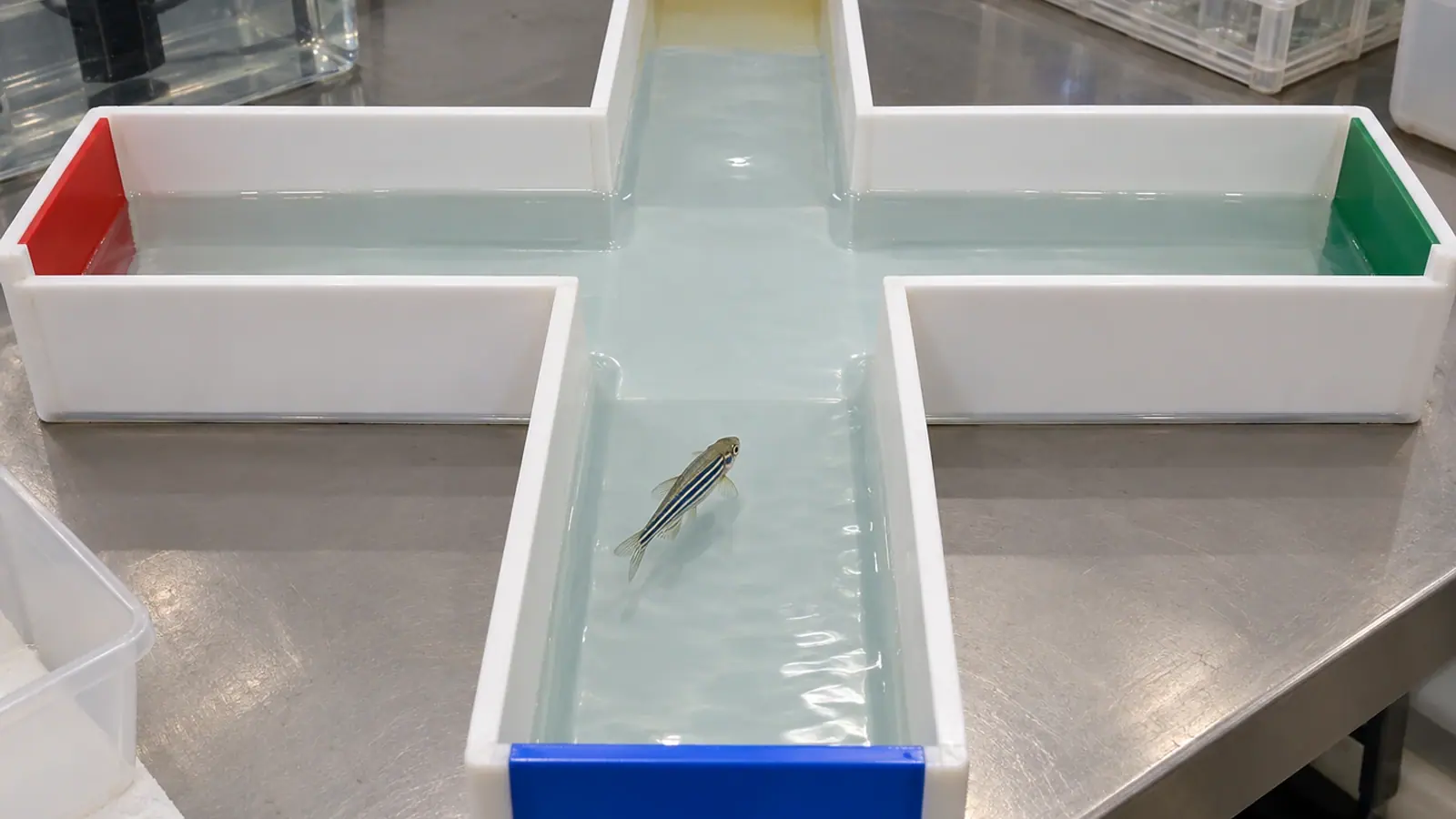
A zebrafish may favour a coloured area before any learning has taken place. A method published in 2023 documented baseline colour choice in adults using a four-arm maze. Research teams need that baseline to separate the properties of the arena from the effect being tested.


- Content type
- Scientific news
- Sector
- Research facilities
- Animal group
- Fish
- Keywords
- EthogramLightingTemperature
Spending more time in a coloured area does not, by itself, show that a fish has learned to associate that area with a reward. It may already favour the colour, location or local lighting. That starting preference belongs to the interaction between the animal and the apparatus and needs to be understood before a later change is interpreted.
Ethan V. Hagen, Yanbo Zhang and Trevor J. Hamilton published a method for documenting colour choice in adult zebrafish, Danio rerio, in 2023. Its value lies in distinguishing baseline behaviour from a response attributed to learning or another intervention. The study validates a particular behavioural method, rather than a universal ranking of attractive colours.
A plus maze measures time in defined zones
The arena has four arms and a neutral central area. Red, green, yellow and blue panels mark the arm ends. An overhead camera records movement, and video tracking quantifies time within each zone. The authors changed colour positions between batches of trials to reduce the possibility that a directional preference would be mistaken for a colour preference.
Vision is involved in the task, but zone occupancy does not describe the entire sensory process. A location can be attractive, differ in contrast or interact with a movement pattern. The optical properties of the setup therefore belong in the experimental record, together with panel position and lighting conditions. A colour name alone is an incomplete description of what the fish encounters.
What the validation in 55 adults found
The validation involved 55 adults: 35 males and 20 females. After twenty minutes of acclimation to the testing room, fish were observed individually for ten minutes. They spent significantly more time in the blue zone than in the red and yellow zones. This supports a baseline preference in that experiment; it does not establish a complete, universal ranking of all four colours.
The same blue preference was reported within both sexes, and no sex difference in preference was detected. A non-significant comparison does not prove equivalence between all male and female fish. The finding retains its sample, source population and method. It cannot automatically be transferred to larvae, another genetic background or a different arena.
More video frames also do not mean more experimental animals. Repeated observations within a fish are related measurements. The number of animals and the number of exported tracking points need to remain distinct in the analysis and report. This distinction matters even when the software delivers a large, complete-looking data file.
Establish the starting response before assigning meaning
In a learning experiment, pairing a reward with an already preferred colour can complicate the interpretation of subsequent occupancy. The result combines an initial tendency with the response to the protocol. Hagen and colleagues’ method illustrates why a baseline, appropriate controls and a comparison plan should be defined before the main interpretation is made.
A behavioural phenotype describes what the animal expresses under specified conditions. It is not simply a general property such as good memory or low anxiety. Specify the endpoint: time in a zone, entries into an arm, distance travelled or another measure. Several endpoints can be derived from one recording while answering different questions. Their availability does not make them interchangeable evidence for the same claim.
Record the conditions needed for comparisons between sessions
Water temperature, testing time, the housing photoperiod and feeding history contribute to the context. Recording them helps identify differences between sessions. The published procedure fed fish after testing; this experimental arrangement does not define a fasting period suitable for every research facility. Husbandry decisions need their own justification and animal monitoring.
Video tracking requires attention to zone boundaries, reflections, visual obstructions and missed detections. A complete export can still misclassify some transitions. Checking selected recording excerpts, including difficult trajectories, helps describe those errors. This is a proposed data-quality application of the method, rather than an additional experimental result measured in the paper.
Moving the panels reduces a directional confound but does not replace documentation of the full design. Allocation and analysis need to match the scientific question. A baseline preference should not be dealt with afterwards by retaining only fish whose behaviour suits the expected outcome. Decisions about inclusion and data handling need to remain visible and scientifically justified.
A method does not establish a housing or clinical standard
The study does not demonstrate that blue housing improves overall welfare, that choosing blue is a clinical test or that a treatment changes memory. Its result is a preference measured with a particular apparatus in adults. Different results from other settings are a reason to check the baseline, rather than to assume one colour is neutral everywhere.
The useful decision is to define the control before interpreting the change. Between groups or laboratories, share the arena layout, measurement conditions, analysis rules and limitations. Zone occupancy can then be reported as a situated behavioural result whose scope can be assessed. That is a stronger basis for comparison than treating a preferred zone as a direct readout of an unmeasured mental state.
Training teams to interpret behavioural measurements
Vetofish offers training for aquatic research teams on the distinctions between observation, measured endpoints and interpretation in research facilities. Work can focus on session records, traceable conditions and criteria for monitoring animals. The aim is a more precise reading of the evidence, without promising that one apparatus will remove all biological or technical variability.


